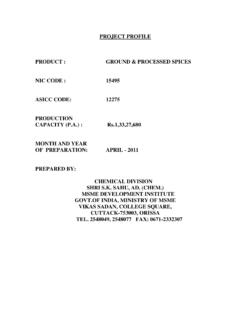
Transcription of “BREAKING NEW GROUND” A COMPREHENSIVE …
1 breaking NEW ground . A COMPREHENSIVE PLAN FOR THE DEVELOPMENT OF. SUSTAINABLE HUMAN SETTLEMENTS. AUGUST 2004. TOP SECRET Date: 05/08/04. OVERVIEW. The purpose of this document is to outline a plan for the development of sustainable human settlements over the next five years, embracing the People's Contract as the basis for delivery. The document has been prepared in three parts: PART A: BACKGROUND - Provides an outline of the challenges in the sector, informed by the outcome of an extensive stakeholder consultation process and review of local trends.
2 PART B: COMPREHENSIVE PLAN - Highlights shifts in the way that sustainable human settlements will be addressed over the next 5 years and provides a summary of key programmes, highlighting enhancements necessary for successful implementation. PART C: BUSINESS PLANS - Provides detailed information on the programmes, with clear indicators of deliverables, time frames and estimated resource requirements. The following Business Plans are included: o Business Plan 1: Stimulating the Residential Property Market o Business Plan 2: Spatial Restructuring and Sustainable Human Settlements o Business Plan 3: Social (Medium-Density) Housing Programme o Business Plan 4: Informal Settlement Upgrading Programme o Business Plan 5: Institutional Reform and Capacity Building o Business Plan 6: Housing Subsidy Funding System Reforms o Business Plan 7.
3 Housing and Job Creation The document is based upon a detailed assessment and understanding of the local context, a review of the current performance of the Department and is the outcome of extensive and ongoing consultations with public and private sector stakeholders. 2. TOP SECRET Date: 05/08/04. breaking NEW ground . PART A - BACKGROUND. 1. INTRODUCTION. This section provides an outline of the challenges in the housing sector, informed by the outcome of an extensive stakeholder consultation process the review of local trends and taking advantage of international best practice 2.
4 HOUSING DEMAND. The nature of demand for government-assisted housing in South Africa has changed significantly over the last five years: An average population growth of per annum has resulted in the population increasing by or over million people between 1996 and 2001. If this growth has been sustained since 2001, the extrapolated population for 2004 is million people In addition, the country has experienced a 30% increase in the absolute number of households, where only a 10% increase was expected. This has been caused by the drop in average household size from people per household in 1996 to in 2001.
5 Urban populations have increased as a result of both urbanisation and natural population growth. One fifth of urban residents are relative newcomers to urban areas ( first generation residents) and urban areas are expected to continue to grow at a rate of per annum. Population growth trends however reveal significant regional differences and increasing spatial concentration. Thus, Gauteng has a significantly higher population growth rate, growing at twice the national average. The Western Cape, KwaZulu Natal and Mpumalanga also have population growth rates above the national average.
6 Over a quarter of the households in the country's nine largest cities (around million in total). continued to live in informal dwellings in 2001. This is equivalent to over one-third of all informal dwellings nationally. The greatest growth is however occurring in South Africa's secondary cities. Unemployment, on the official definition, leapt from 16% in 1995 to 30% in 2002, placing pressure on household incomes. Growing unemployment is a feature of the increased size of the labour pool, and slow job creation. Whilst the economy has created 12% more jobs over the last five years, the number of potentially economically active individuals has increased threefold.
7 Thus the Towards a 10 Year Review notes a dramatic increase of 4% in the economically active population in the country. As a result of high rates of unemployment, housing and service provision has not kept pace with household formation, and a range of other factors have had negative impact on social coherence and crime, particularly contact crimes (comprising 40% of all crimes). This has a human settlement dimension in that many of these crimes typically take place in private, domestic spaces where public policing has limited impact.
8 Moreover informal settlements have been associated with high levels of crime. Despite scale delivery, the changing nature of demand and the pace of urbanisation has meant that the size of the backlog has increased. Current figures indicate that there are over million dwellings which can be classified as inadequate housing. The 3. TOP SECRET Date: 05/08/04. number of households living in shacks in informal settlements and backyards increased from million in 1996 to million in 2001, an increase of 26%, which is far greater than the 11% increase in population over the same period2.
9 Delivery at scale, in both high, medium and low cost housing, has also not created a functionally balanced residential property market. The repeal of the Group Areas Act created an increased demand in historically well serviced and located neighbourhoods fuelling demand and increasing prices and sale and property investment. By contrast, investment in large parts of the middle to lower end of the property market historically working class neighbourhoods, has declined. The consequent uneven investment in housing has skewed the growth of the residential property market.
10 Bringing windfalls to approximately 30% of the market, whilst continued stagnation thwarted property value appreciation in marginalized areas. This has been exacerbated by the practice of red lining by financial institutions barring housing investment and sales in inner city areas and traditional black townships. 3. HOUSING SUPPLY. Over the last 10 years, state-assisted housing investment of some R29,5 Bn has provided million housing opportunities and has allowed 500,000 families the opportunity to secure titles of old public housing stock.