Transcription of Building(a(DNAModel(
1 Science Enhanced Scope and Sequence Life Science building a DNA Model Strand Life Systems Topic Investigating the structure and role of DNA Primary SOL The student will investigate and understand that organisms reproduce and transmit genetic information to new generations. Key concepts include a) the structure and role of DNA; b) the function of genes and chromosomes; c) genotypes and phenotypes; d) characteristics that can and cannot be inherited; e) genetic engineering and its applications; and f) historical contributions and significance of discoveries related to genetics. The student will demonstrate an understanding of scientific reasoning, logic, and the nature of science by planning and conducting investigations in which d) models and simulations are constructed and used to illustrate and explain phenomena.
2 Related SOL The student will investigate and understand that all living things are composed of cells. Key concepts include a) cell structure and organelles. Background Information Chromosomes contain deoxyribosenucleic acid (DNA). Each chromosome contains one strand of DNA. DNA contains all of the information necessary to create an organism and is found in the nucleus of the cell. DNA is made up of a long chain of molecules resembling a twisted ladder. This is referred to as a double helix shape. The rungs of the ladder are made up of four bases: adenine, guanine, cytosine, and thymine. These are often referred to as the nitrogen or nitrogenous bases in DNA. Each base is attached to a sugar molecule on each side, and the sugar is attached to a phosphate group. This sugar and phosphate make up the sides of the ladder.
3 The nitrogen bases pair up only in certain ways: adenine will combine only with thymine, and guanine will combine only with cytosine. Make students aware of the historical contributions made by Gregor Mendel, Rosalind Franklin, and James Watson and Francis Crick. Gregor Mendel, an Austrian monk, was the first to describe the idea of genes and how they are related to inherited traits. Rosalind Franklin discovered the double- helix shape of DNA. She used x- ray techniques to show that the spiral was actually two spirals connected by rungs like a ladder. Watson and Crick made a model of DNA showing the twisted strands of sugar, phosphates, and nitrogen bases. Materials 24- inch pieces of clear fishing line Virginia Department of Education 2012 1 Science Enhanced Scope and Sequence Life Science 2- inch pieces of blue pipe cleaners, green pipe cleaners, purple pipe cleaners, and orange pipe cleaners Dry, uncooked pinwheel pasta Dry, uncooked ziti cut pasta Vocabulary chemical code, chromosome, deoxyribonucleic acid (DNA), double helix, genes, genetics, nitrogen bases, nucleus, phosphates, replication, sugars Student/Teacher Actions (what students and teachers should be doing to facilitate learning).
4 1. Ask students to identify traits they possess in common with their parents, such as eye color, hair texture, and facial characteristics. Then ask them how these traits are passed on from one generation to the next. The answer is DNA, or deoxyribonucleic acid. Explain that all organisms carry a sort of blueprint containing the information necessary to develop and maintain life. This manual of instructions is located in a chemical molecule called DNA. DNA is found within a person's genes. Genes are small structures found in chromosomes, structures within the nucleus of cells. 2. Explain to students that DNA works something like the alphabet. While the alphabet has 26 letters, DNA's alphabet has only four letters: guanine (G), adenine (A), cytosine (C), and thymine (T). Just as the 26 letters of the alphabet can be used to form millions of words for communication, DNA's alphabet can be combined to form codes with more than five billion combinations of Gs, As, Ts, and Cs.
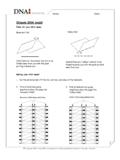
5 The differences in these combinations result in differences among human beings. The DNA molecule consists of two strands that form a double helix, a spiraling shape much like a twisted ladder. The DNA molecule has a sugar component, a phosphate component, and four different bases adenine, thymine, cytosine, and guanine. To help students understand how these components fit together to form DNA, have each student make a model of DNA with fishing line, dried pasta, and different- colored pipe cleaners. 3. First, give each student two pieces of line, 18 pieces of pinwheel pasta, 16 pieces of ziti pasta, and different- colored chenille stems (pipe cleaners). Explain that the pinwheel pasta represents the sugar component; the ziti pasta, the phosphate; and the chenille stems, each of the bases. 4.
6 Tell students to start with the pinwheel pasta and alternate with the ziti pasta as they thread the pasta on the line. On each line, they should string nine pieces of pinwheel pasta alternating with eight pieces of ziti. Wrap the line around the final piece of pasta at the end of each line so that the pasta does not fall off. After pasta has been strung on both lines, each line should have a total of 17 alternating pieces of pasta. Have students lay the two lines side by side. 5. Then, give students the code for the chenille stems: blue represents adenine; green, thymine; purple, cytosine; and orange, guanine. 6. Explain that the bases in DNA are found in pairs and that adenine always pairs with thymine and cytosine always pairs with guanine. Virginia Department of Education 2012 2 Science Enhanced Scope and Sequence Life Science 7.
7 Have students represent these base pairs with twisted chenille stems. First, have them twist the eight blue stems and eight green stems together, making a total of eight blue- . green stems, about two inches long. Likewise, have them twist the eight purple and eight orange stems together, making a total of eight purple- orange stems, about two inches long. 8. Now, have students create a ladder using the pasta lines as the sides and the twisted chenille stems as steps. Direct students to begin at the top and connect the two ends of twisted chenille stems to the top pasta pieces on the two lines. Then use a second chenille stem to connect the next two pasta pieces directly across from each other. They should continue building their ladder, one step at a time, until they have connected the bottom two pieces of pasta.
8 Remind them that they can place the twisted chenille stems in any order. (The blue- green stems do not have to alternate with the orange- purple stems.) After all the stems have been woven, the DNA model is complete. 9. Explain that the model they have built is much like the arrangement of the DNA molecule that is needed to pass genetic information from one generation to the next. Explain the process of DNA replication and how it is necessary for the continuity of life. Assessment Questions o How would you describe the shape and arrangement of the DNA molecule? o Why is DNA necessary to life? o How are chromosomes and genes related? How are genes and DNA related? Journal/Writing Prompts o Now that we know more about DNA and the genetic code, describe how this can be an important part of curing genetic diseases, such as cystic fibrosis or muscular dystrophy.
9 O Explain how is your DNA model is similar and different to actual DNA found in living organisms. Extensions and Connections (for all students). Have students construct a timeline of the historical contributions made in the study of DNA. Have students think of other ways to construct models of DNA using other materials. Strategies for Differentiation Have students color a diagram of the double helix, DNA. Provide a key for coloring different components. Have students complete an online simulation of constructing DNA models. In 1997, scientists were able to clone a sheep. Discuss cloning with students, speculate about its future, and identify concerns related to its practice. Have students address ethical issues related to cloning in a poster, journal entry, electronic slideshow, or other presentation.
10 Virginia Department of Education 2012 3