Transcription of Building Code Title 27 Subchapter 3 - New York City
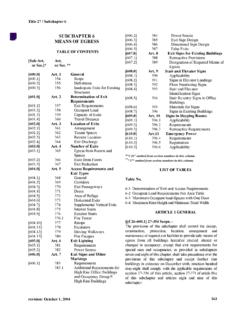
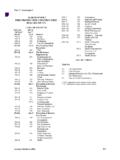
1 Title 27 / Subchapter 3113 Subchapter 3 OCCUPANCY AND CONSTRUCTIONCLASSIFICATIONTABLE OF CONTENTS[Sub-Art. Art. or Sec.]* or Sec.**[ ] Art. 1 General[ ] 234 Scope[ ] 235 Reference Standards[ ] 236 Definitions[ ] Art. 2 Occupancy Classifications[ ]237 Occupancy Groups[ ] 238 Classification of Spaces[ ] 239 Classification of Buildings[ ] 240 Separation of Occupancies[ ]241 Classification Tables[ ] 242 Multiple Occupancy or Use[ ] Art. 3 Occupancy Group A-HighHazard[ ] 243 Classification[ ] 244 Location Restrictions[ ] Art. 4 Occupancy Group B-Storage[ ] 245 Classification[ ] 246 Occupancy Group B-1[ ] 247 Occupancy Group B-2[ ] Art.
2 5 Occupancy Group C-Mercantile[ ] 248 Classification[ ] Art. 6 Occupancy Group D-Industrial[ ] 249 Classification[ ] 250 Occupancy Group D-1[ ] 251 Occupancy Group D-2[ ] 252 Location Restrictions[ ] Art. 7 Occupancy Group E-Business[ ] 253 Classification[ ] Art. 8 Occupancy Group F-Assembly[ ] 254 Classification[ ] 255 Occupancy Group F-1[ ] 256 Occupancy Group F-2[ ] 257 Occupancy Group F-3[ ] 258 Occupancy Group F-4[ ] Art. 9 Occupancy Group G-Educational[ ] 259 Classification[ ] Art. 10 Occupancy Group H-Institutional[ ] 260 Classification[ ] 261 Occupancy Group H-1[ ] 262 Occupancy Group H-2[ ] Art.
3 11 Occupancy Group J-Residential[ ] 263 Classification[ ] 264 Occupancy Group J-1[ ] 265 Occupancy Group J-2[ ] 266 Occupancy Group J-3[ ] Art. 12 Occupancy Group K-Miscellaneous[ ] 267 Classification[ ] Art. 13 Doubtful Occupancies[ ] 268 Classification[ ] Art. 14 ConstructionClassifications[ ]269 Construction Classes[ ] 270 Classification ofBuildings and Spaces[ ]271 Classification Table[ ]272 False Designation[ ] 273 Minimum Requirements[ ] Art. 15 Construction Group I-Noncombustible[ ] 274 Classification[ ] 275 Construction Class I-A[ ] 276 Construction Class I-B[ ] 277 Construction Class I-C[ ] 278 Construction Class I-D[ ] 279 Construction Class I-E[ ] Art.
4 16 Construction Group II-Combustible[ ] 280 Classification[ ] 281 Construction Class II-A[ ] 282 Construction Class II-B[ ] 283 Construction Class II-C[ ] 284 Construction Class II-D[ ] 285 Construction Class II-E[ ] Art. 17 Mixed Construction[ ] 286 Classification[ ] 287 Restrictions*"C26" omitted from section numbers in this column.**"27" omitted from section numbers in this OF TABLEST able Classifications3-2 Typical Occupancies for OccupancyClassification3-3 Construction Classes3-4 Construction Classifications Notes to 1 GENERAL [ ] 27-234 provisions of thissubchapter shall establish and control the classificationof all buildings, and spaces therein, with respect tooccupancy group and class of construction.
5 [ ] 27-235 Reference 27 / Subchapter 3114 Occupancy and construction classifications which appearin the several reference standards of this code shall applyto the provisions of the reference standard only unlessotherwise indicated. [ ] 27-236 definitions to beused in the interpretation of this Subchapter , seesubchapter two of this 2 OCCUPANCY CLASSIFICATIONS [ ] 27-237 Occupancy 3-1 lists occupancy groups and sub groups that shall beestablished for classifying buildings and spaces inaccordance with the provisions of articles threethrough twelve of this 3-1 OCCUPANCY CLASSIFICATIONSO ccupancyGroupClassificationFireIndexAHig h hazard4B-1 Storage (moderate hazard)3B-2 Storage (low hazard)2 CMercantile2D-1 Industrial (moderate hazard)3D-2 Industrial (low hazard)2 EBusiness2F-1aAssembly (theaters, etc.)
6 1F-1bAssembly (churches, concert halls,etc.)1F-2 Assembly (outdoors)1F-3 Assembly (museums, etc.)1F-4 Assembly (restaurants, etc.)1 GEducation1H-1 Institutional (restrained)1H-2 Institutional (incapacitated)1J-1 Residential (hotels, etc.)1J-2 Residential (apartment houses, etc.)1J-3 Residential (one-and-two-familydwellings)1 KMiscellaneous1 [ ] 27-238 Classification of or room hereafter altered or erected shall, for thepurposes of this code , be classified in one of theoccupancy groups listed in Table 3-1 according to theoccupancy or use of the space or room. [ ] 27-239 Classification of hereafter erected or altered under the provisionsof section 27-115 of article four of Subchapter one of thischapter shall, for the purposes of this code , be classifiedin one of the occupancy groups listed in table 3-1according to the main use or dominant occupancy of thebuilding.
7 However, at the option of the applicant, subjectto the approval of the commissioner, buildings may beclassified in any other occupancy group, provided suchoccupancy group has a higher fire index, as listed in table3-1, than the fire index of the occupancy groupclassification of the main use or dominant occupant. [ ] 27-240 Separation of within buildings shall be separated fromone another as follows:a. Spaces classified in occupancy groups having ahigher fire index, as listed in table 3-1, than the fireindex of the occupancy group classification of thebuilding, shall be separated from adjoining spaces byconstruction meeting the fire-resistance ratingrequirements for fire divisions under the provisions ofsubdivision (a) of section 27-339 of article five ofsubchapter five of this chapter.
8 Such occupanciesshall, for the purposes of this code , be classified andtreated as separate buildings (hereinafter referred to as Building section ).b. Spaces classified in occupancy groups having thesame or lower fire index, as listed in table 3-1, than thefire index of the occupancy group classification of thebuilding, shall be separated from adjoining spaces byconstruction meeting the fire-resistance ratingrequirements for fire separations under the provisionsof subdivision (b) of section 27-339 of article five ofsubchapter five of this chapter. [ ] 27-241 Classification and reference standard RS 3-3 list representativeTitle 27 / Subchapter 3115occupancies that shall be used as a basis for classifyingbuildings and spaces by occupancy. [ ] 27-242 Multiple occupancy or a Building or space is used for multiple purposes,involving different activities at different times, the Building orspace shall be given a separate occupancy group classificationfor each of the activities involved.
9 The design and constructionof the Building or space shall be in accordance with the mostrestrictive provisions of this code that apply to any of theoccupancy group classifications utilized. However, a minorvariation of any occupancy or use of a space from technicalcompliance with a particular space occupancy classificationshall not be prohibited if such variation is normally associatedwith the occupancy classification and no specific danger orhazard is 3 OCCUPANCY GROUP A-HIGHHAZARD [ ] 27-243 and spacesshall be classified in the high hazard occupancy group whenthey are used for storing, manufacturing, or processingpotentially-explosive products or materials, or highly-combustible or highly-flammable products or materials thatare likely to burn with extreme rapidity.
10 The high hazardgroup shall also include: uses that involve storing, processing,or handling any materials that produce explosive dust, or thatresult in the division of matter into fine particles subject tospontaneous ignition; uses that employ solids or substancesthat ignite or produce flammable gases on contact with water;and any other uses that constitute a high fire hazard becauseof the form, character, or volume of the materials involved.(a) Typical material gas and gasesunder pressure of fifteen psig or more and in quantitiesgreater than twenty-five hundred cubic feet, includinghydrogen, illuminating gas, natural gas, and all othergases subject to explosion; gas piping at pressure levelsabove fifteen psig regardless of the quantities of gas;celluloid and celluloid products; cotton batting; kerosene;fuel or other oils having a flash point under 200*F (tagclosed cup), except five hundred fifty gallons or less inone- and two-family dwellings.