Transcription of Burnout and Compassion Fatigue
1 HEALTH PROGRESS JULY - AUGUST 2011 47BY DENNIS PORTNOY, Catholic health care leaders, balancing mission with regulatory and fiscal realities means facing up to a future that demands delivering higher quality health care to more people at lower cost. In the struggle to provide quality, compassionate care in a climate that offers fewer resources and, at the same time, adapt to new business models, leaders can underestimate the strain on their front-line caregivers. But losing sight of Burnout and Compassion Fatigue which is a type of Burnout puts both the health care workers and their patients at risk.
2 FIt takes a multi-pronged approach to minimize the negative impact. The organization and its policies play a key role by creating conditions that not only reduce the risk of Burnout and Compassion Fatigue , but also promote healthy, more effective involved in direct patient care are exposed to suffering and negativity on a daily basis. They face increasing demands in the workplace, while at home they juggle family life, personal interests and often care for their own children and their aging par-ents as well. Psychologists Ayala Pines, , and Elliot Aronson, , describe Burnout as a state of physical, emo-tional and mental exhaustion caused by long-term involvement in emotion-ally demanding situations.
3 It is accom-panied by disillusionment and nega-tive Psychologist and author Judith Herman writes that repeated exposure to people s suffering can diminish the helper s trust in humanity and often leads to a heightened sense of have described how Burnout among nurses affects the quality of treatment for patients, low-ers morale and increases absenteeism, with an accompanying financial impact on the hospital. Nurse turnover due to stress takes a financial toll, as , 4 Hospital leaders need to understand how downsizing, re-engineering and staff turnover causes Burnout in health care managers, as Anne M.
4 Nordhaus-Bike has In terms of dollars and cents, researchers Deborah Jones, Takeshi Tanigawa and Stephen Weiss place associated costs at $300 bil-lion annually. This figure includes estimates of the dollar effects of reductions in operat-ing effectiveness, medical expenses and attrition resulting from caregivers and their employers also need to learn to recog-nize signs of Burnout and Compassion Fatigue , because people in helping roles are at great risk. In the early stages, Burnout symp-toms include frequent colds, reduced sense of accomplishment, headaches, Fatigue , lowered resiliency and moodi-ness and increased interpersonal con-flicts.
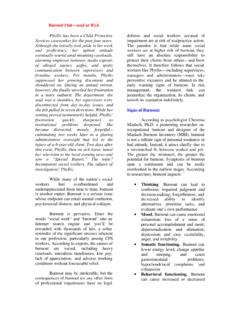
5 If not treated, Burnout gradually moves into an advanced stage display-ing symptoms of somatic complaints, social withdrawal, depersonalization, cynicism, exhaustion, irritability, low energy, feeling underappreciated and overworked. In time, a helper becomes numb, disillusioned, hardened and overwhelmed. Often, caregivers don t realize the negative effects until they experience a health crisis or other sig-nificant Fatigue is a type of Burnout and Compassion Fatigue Watch for the SignsThe organization and its policies play a key role by creating conditions that not only reduce the risk of Burnout and Compassion Fatigue , but also promote healthy, more effective IT WORK AT WORKJULY - AUGUST 2011 HEALTH PROGRESS 46 JULY - AUGUST 2011 HEALTH PROGRESS 48burnout.
6 It emerges suddenly and with little warn-ing, and it is usually more pervasive than burn -out. In addition to regular Burnout symptoms, a person experiencing Compassion Fatigue can feel a loss of meaning and hope and can have reac-tions associated with Post Traumatic Stress Dis-order (PTSD) such as strong feelings of anxiety, difficulty concentrating, being jumpy or easily startled, irritability, difficulty sleeping, excessive emotional numbing, intrusive images of another s traumatic material. Past traumas can also be acti-vated. Long-term effects include reduced empa-thy, diminished sense of personal safety, reduced sense of control, hopelessness, increased involve-ment in escape activities and chronic overeating, drug or alcohol of the research on com-passion Fatigue has focused on counselors and first respond-ers who work with trauma vic-tims.
7 Laurie Anne Pearlman and Lisa McCann, who have done research on the long-term effects of compas-sion Fatigue , report helpers develop a diminished sense of personal safety and disrupted schemas around trust, vulnerability, meaning and control. 7 There is overlap between Burnout and com-passion Fatigue , and an individual can suffer from both. They share some symptoms, and both take a toll on health and on relationships. Both affect the workplace in low morale, absenteeism, decreased motivation and apathy, though people suffering from Compassion Fatigue often love their jobs.
8 Compassion Fatigue is caused by empathy. It is the natural consequence of stress resulting from caring for and helping traumatized or suffering people. It involves a preoccupation with an indi-vidual or his or her trauma, and it doesn t require being present at the stressful event. Simply being exposed to another person s painful narrative can be enough. Author and researcher Beth Hudnall Stamm defines Compassion Fatigue as the con-vergence of primary stress, secondary traumatic stress and cumulative stress in the lives of helping professionals and other care those in the helping professions, early rec-ognition and improved self-care both in and out of the workplace are key to creating wellness.
9 Many caregivers focus on others at the expense of their own well-being. It is crucial for them to replenish themselves and commit to having a life outside of work that includes daily nurturing activities. People often understand this concept intellectu-ally, but the knowledge doesn t necessarily lead to taking better care of themselves. It is important for individuals and their employers to recognize and challenge the psycho-logical obstacles that get in the way of self-care, such as the belief that focusing on personal needs is selfish or indulgent.
10 Enlightened self-interest is quite different from narcissistic preoccupation. Self-care actually increases a caregiver s capac-ity to care for others. Self-care, however, is not just about making healthy lifestyle choices it is about being present with one s feelings, sen-sations and intuitive guidance in order to detect what is best in any given moment. A 2010 study done on nurses and Compassion Fatigue revealed that Compassion Fatigue was sig- Compassion Fatigue Burnout SYMPTOMSC ognitiveLowered concentration, apathy, rigidity, disorientation, minimization, preoccupation with traumaEmotionalPowerlessness, anxiety, guilt, anger, numbness, fear, helplessness, sadness, depression, depleted, shock, blunted or enhanced troubling dreams similar to a patient s dream.