Transcription of BUSINESS REPORTS - Library
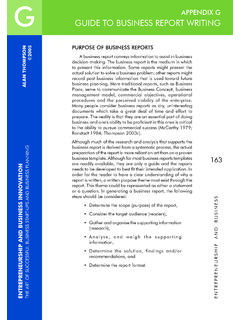
1 T. Helpsheet Giblin Eunson Library BUSINESS REPORTS . Use this sheet to help you: Produce clear and correctly structured BUSINESS REPORTS . 5 minute self test Before you read the Helpsheet, spend five minutes considering the following questions: Thinking about BUSINESS REPORTS , do you know . Yes I do I'm not sure No idea! Why you might need to write a BUSINESS report ? Who you might write it for? What details you might need to include? How you might structure it? Author: Eggins, M. Editing: Calma, A. Design and layout: Shaw, J. BUSINESS REPORTS T. 1. What is a BUSINESS report ? Organisations need accurate, timely, objective and concise information to make effective decisions.
2 One way they can obtain such information is from a BUSINESS report . This document can be defined as an organised presentation of information to a specific audience for the purpose of helping an organisation achieve an objective . (Bowman & Branchaw, 1988, p. 12). While BUSINESS REPORTS share similar characteristics, they also need to be customised for their particular purpose. An informal report may be a brief summary while longer REPORTS follow a more complex and formal structure. Informal REPORTS may feature: letter or memo format minimal use of headings and visual aids personal pronouns and contractions a length from a few paragraphs up to five pages content primarily for internal audiences More formal REPORTS however tend to have: a more standard format organised into separate sections front and back matter (sections) along with the body of the report a greater number of headings (including subheadings) and visual aids third person pronouns and no contractions or slang a length from five pages to several hundred content designed for internal and/or external audiences 2.
3 Why do I need to write a BUSINESS report ? Formal BUSINESS REPORTS often feature in university assessment tasks in disciplines such as accounting, management and marketing as writing such REPORTS is an essential skill in BUSINESS . These tasks may require giving information only ( financial statements), information and interpretation ( product surveys) or offering information, analysis and recommendations. A report that details the last type could highlight a problem and suggest a solution which might involve analysing a BUSINESS 's history, operations, problems, competition and goals, followed by a number of possible solutions (including their advantages and disadvantages).
4 Following this investigation, a specific solution might be recommended to aid future growth. Please note that BUSINESS REPORTS have some of the same features as research REPORTS . For more information on the latter please see the Study and Research Helpsheets - Research REPORTS and report Checklist. Page 1. BUSINESS REPORTS T. 3. How do BUSINESS REPORTS differ from essays? An accessible reader-centred style which includes standard formal English is a hallmark of academic writing including in essays or REPORTS . However, there are some key differences between the two genres: Essays BUSINESS REPORTS Articulate a point of view in rela- Often recommend action to solve Purpose tion to a particular proposition a specific problem Have introduction, body and con- Always have sections clearly clusion sections that normally do divided by numbered headings Format & Struc- not use headings (and often sub-headings).
5 Ture Use shorter, more concise para- Use cohesive paragraphs to link graphs and dot-points where ideas rather than list dot-points applicable Always have an abstract (or Typically don't normally need an executive summary) as readers are Abstract abstract as readers read the text typically time poor' and skim and carefully from start to finish scan through the text quickly Feature graphics (such as tables Rarely use graphics as written Graphics and graphs) for supporting main evidence points Are generally the result of indi- Writer Are often the result of group work vidual work Are addressed to a specific Are written for the lecturer/tutor Reader audience ( client or manager).
6 Or other academic audiences established by the topic Page 2. BUSINESS REPORTS T. 4. How do I write a BUSINESS report ? There are several major steps typically involved in writing a BUSINESS report . These include: 1) planning (including determining the scope and target audience). 2) researching, organising, evaluating and analysing your information sources 3) drafting the body section 4) devising conclusions and recommendations based on the findings 5) further drafting and editing/proofreading You need first to consider exactly what you have been asked to do - that is - the overall purpose of your report . Carefully considering the assessment task and related criteria should help you clarify: your objective and readership what information you need the format and level of detail required From this, prepare an outline (including a working title and the overall structure of the report , including the major and supporting ideas).
7 Start on your draft early so you can develop your ideas (editing can come later). Who is your audience? Your readers are your priority. Note that while BUSINESS REPORTS are typically written by specialists' for generalists' (most commonly the decision-makers in organisations), there can be a number of audiences for any one report . Therefore carefully consider your readers' likely: prior knowledge and experience with the background information, technical language, concepts and contexts covered in the report interest in and possible opinions regarding the report 's topic Ask yourself the following questions: What do my readers know and think about the topic?
8 What background, definitions and other information do they need? What questions or objections might they raise about the issue/s? Is my audience internal', external' or both? - Is it for readers up, across or down the hierarchy of the organisation and/or people from outside? Page 3. BUSINESS REPORTS T. If you can identify and assess your audience well, then you can match your content, visuals and structure to their level of expertise. Keep in mind for example that the higher up the chain of command a report it goes, the more condensed and formal it should be. A more general audience, in contrast, needs less technical vocabulary and more explanation.
9 In addition, if writing the report as a group, ensure consistency by agreeing about content, structure and presentation (including fonts and headings, line spacing and indenting) before drafting and also allocate each group member a specific role (including what area they need to research). How should I begin gathering information? Along with your key audience, you will also need to establish the key concepts and issues you are dealing with to generate keywords for your research. Consider whether or not your report needs either primary and/or secondary data. The former depends on first-hand sources from your own research ( interviews, surveys and observations) while secondary research involves using existing information based on other people's investigations.
10 Allow time to read widely to locate the best resources remembering that your report should be supported by documented sources which are authoritative, current, reliable and relevant. In particular, to ensure objectivity, if you are doing a report on a particular organisation, don't solely rely on information from them. If you quote, paraphrase, or summarise someone else's ideas, acknowledge them appropriately. This will usually include indicating 1) the family name of the author, 2). date of publication, and 3) the page number when used in the text. Record these details on a separate page too at the end of the report in your reference list where you need to include other information such as the title, publisher and city of publication.