Transcription of Buying a Used Car - Consumer Information
1 Federal Trade Commission | a used CarContentsBefore You Buy a used Car ..1 Pay in Full or Finance ..2 Dealer Sales and the Buyers Guide ..3 Warranties ..5As Is - No Dealer Warranty ..5 Implied Warranties ..6 Implied Warranty of Merchantability ..6 Implied Warranty of Fitness for a Particular Purpose ..7 Full and Limited Warranties ..7 Warranty Documents ..8 Unexpired Manufacturer s Warranties ..8 Service Contracts ..8An Independent Inspection Before You Buy ..10 Private Sales ..11If You Have Problems ..12 Sample Buyers Guide ..141 Before you start shopping for a used car, do some homework. It may save you serious money. Consider your driving habits, what the car will be used for, and your budget. Research models, options, costs, repair records, safety tests, and mileage online and through libraries and bookstores.
2 Before You Buy a used CarWhether you buy a used car from a dealer or an individual: Test drive the car under varied road conditions on hills, highways, and in stop-and-go traffic. Ask for the car s maintenance record from the owner, dealer, or repair shop. Determine the value of the vehicle before you negotiate the purchase. Check the National Automobile Dealers Association s (NADA) Guides ( ), Edmunds ( ), Kelley Blue Book ( ), and Consumer Reports ( ). Some of these organizations charge for this Information . Research the upkeep costs for models you re interested in, including the frequency of repairs and maintenance costs. Examine the car using an inspection checklist. You can find checklists in magazines, books, and on websites that deal with used cars.
3 Check whether there are any unrepaired recalls on a vehicle. Start by asking the dealer if the vehicle you re considering has a recall. You also can check yourself by entering the VIN at , or by calling the National Highway Traffic Safety Administration s (NHTSA) Vehicle Safety Hotline at 1-888-327-4236. If there is a recall, ask the dealer to fix it, or to give you Information showing it was fixed. Keep in mind that federal law doesn t require dealers to fix recalls on used cars, so you might need to get the repair done yourself. But don t wait according to NHTSA, all safety recalls pose safety risks and, left unrepaired, might lead to Get an independent review of a vehicle s history. Check a trusted database service that gathers Information from state and local authorities, salvage yards, and insurance companies.
4 For example, the Department of Justice s National Motor Vehicle Title Information System (NMVTIS) ( ) offers Information about a vehicle s title, odometer data, and certain damage history. Expect to pay a small fee for each report. The National Insurance Crime Bureau (NICB) ( ) maintains a free database that includes flood damage and other Information . You can investigate a car s history by its Vehicle Identification Number (VIN). You also can search online for companies that sell vehicle history reports. If the report isn t recent or you suspect that it has missing or fabricated Information , verify it with the reporting company. The Information in the reports may not be complete, so you may want to get a second report from a different reporting company.
5 Some dealer websites have links to free reports. Consider hiring a mechanic to inspect the in Full or FinanceYou have two choices: pay in full or finance over time. Financing increases the total cost of the car because you re also paying for the cost of credit, including interest and other costs. Consider how much you can put down, the monthly payment, the financing term (such as 48 months), and the annual percentage rate (APR). Rates usually are higher and financing periods shorter on used cars than on new and other finance sources (like finance companies, credit unions, and banks) offer a variety of financing terms. Shop around, compare offers, and negotiate the best deal you can. If you re a first-time buyer or if your credit isn t great be cautious about special financing offers.
6 They can require a big down payment and You can investigate a car s history by its Vehicle Identification Number (VIN).3a high APR. If you agree to financing that carries a high APR, you may be taking a big risk. If you decide to sell the car before the end of the financing period, the amount you get from the sale may be less than the amount you need to pay off the financing agreement. If the car is repossessed or declared a total loss because of an accident, you may have to pay a considerable amount to repay the loan even after the proceeds from the sale of the car or the insurance payment have been deducted. If money is tight, you might consider paying cash for a less expensive you decide to finance, make sure you understand the financing agreement before you sign any documents.
7 What is the exact price you re paying for the vehicle? How much are you financing? What is the finance charge (the dollar amount the credit will cost you)? What is the APR (a measure of the cost of credit, expressed as a yearly rate)? How many payments will you make and how much is each one? What is the total sales price the sum of the monthly payments plus the down payment?Dealer Sales and the Buyers GuideUsed cars are sold through a variety of outlets: franchised and independent dealers, rental car companies, leasing companies, used car superstores, and online. Ask friends, relatives, and co-workers for recommendations. Contact your local Consumer protection agency ( ) and state Attorney General ( ) to find out if any unresolved complaints are on file about a particular dealer.
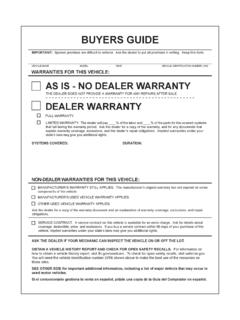
8 You also can search online for reviews or complaints. Enter the name of the seller and the word review or complaint into a search dealers attract customers with no-haggle prices, factory certified used cars, and better warranties. Consider the dealer s reputation when you evaluate its are not required by federal law to give used car buyers a three-day right to cancel. In some states, dealers are required to give a right to cancel. In other states, the right to return the car in a few days for a refund exists only if the dealer chooses to offer this privilege. Dealers may describe the right to cancel as a cooling-off period, a money-back guarantee, or a no questions asked return policy. Before you buy from a dealer, ask about the dealer s return policy, get it in writing, and read it Federal Trade Commission s (FTC) used Car Rule requires dealers to display a Buyers Guide in every used car they offer for sale, and to give it to buyers after the sale.
9 This includes light-duty vans, light-duty trucks, demonstrators, and program cars. Demonstrators are new cars that haven t been owned, leased, or used as rentals, but have been driven by dealer staff. Program cars are low-mileage, current-model-year vehicles returned from short-term leases or rentals. Buyers Guides do not have to be posted on motorcycles and most recreational vehicles. Anyone who sells, or offers for sale, fewer than six cars in a year doesn t have to post a Buyers Buyers Guide tells you: the major mechanical and electrical systems on the car, including some of the major problems you should look out for; whether the vehicle is being sold as is or with a warranty; what percentage of the repair costs a dealer will pay under the warranty; to get all promises in writing; to ask to have the car inspected by an independent mechanic before you buy; The FTC s used Car Rule requires dealers to post a Buyers Guide in every used car they offer for sale.
10 5 to get a vehicle history report and to visit for Information on how to get a vehicle history report, how to check for safety recalls, and other topics; to ask for a Spanish Buyers Guide if the sale is conducted in Spanish; the dealer s contact Information , including the contact for complaints; and to remember: spoken promises are difficult to the Buyers Guide for reference after the and Wisconsin are exempt from the FTC s used Car Rule. Those states require dealers to display a different version of the Buyers you buy a used car from a dealer, the Guide must reflect any negotiated changes in warranty coverage. It becomes part of your sales contract and overrides any contrary provisions. For example, if the Buyers Guide says the car comes with a warranty and the contract says the car is sold as is, the dealer must give you the warranty described in the Is - No Dealer WarrantyWhen the dealer offers a vehicle as is, the box next to the As Is - No Dealer Warranty disclosure on the Buyers Guide must be checked.