Transcription of C2 The Cambridge English Scale explained …
1 CEFR 230. 220. C2. 210. The Cambridge English Scale explained 200. C1. 190. 180. B2. 170. 160. B1. 150. 140. A2. 130. 120. A1. 110. 100. Below A1. 90. 80. Aligning Cambridge English exams What are the benefits of using to international standards the Cambridge English Scale ? Cambridge English exams are aligned to the Common The Cambridge English Scale provides clearer and more European Framework of Reference for Languages detailed information than was previously available, (Council of Europe 2001)* the international standard showing where the candidate's performance falls within in measuring language ability. each CEFR level and grade. This gives candidates and their teachers better information about their performance Our exams are known around the world for giving and helps them to identify areas for improvement. objective and reliable evidence of English language ability. Extensive research and validation ensures that The same Scale is used across our exams, so it is also each exam and each grade represent the same level of easier to understand the relationship between them.
2 English , no matter where or when the exams are taken. For the many candidates who take two or more of our exams in succession this will be particularly useful, as they will clearly be able to understand how their level What is the Cambridge English of English is improving from one exam to the next. Scale ? The Cambridge English Scale gives more detailed information for organisations that use our exams, such The Cambridge English Scale is a range of scores used as universities, employers, professional bodies and to report results for Cambridge English exams. It was immigration authorities. This will help them to make introduced in January 2015. decisions about individual candidates, particularly in cases where the organisation wants to focus on specific It is a refinement of our existing approach to score language skills. reporting and provides a clearer and more consistent way of describing candidate performance in Cambridge Because the scores are reported on the same reference English exams.
3 Scale , it is possible for organisations to state a requirement for a particular overall score, plus minimum The Cambridge English Scale covers a wide range of scores for Reading, Writing, Listening, Speaking and Use language proficiency and is aligned to the Common of English . European Framework of Reference (CEFR). In all exams, other than Cambridge English : Key and Key for Schools candidates receive a Cambridge English Scale Which exams use the Cambridge score for each skill Reading, Writing, Listening and English Scale ? Speaking. Where tested, they also get a separate score for Use of English . Cambridge English : Key and Key for Results for Cambridge English : First, First for Schools, Schools candidates receive a score for each paper. Advanced and Proficiency have been reported on the Scale since January 2015. The overall score is calculated by averaging the individual scores a candidate receives. In Cambridge English : Key Results for Cambridge English : Key, Key for Schools, and Key for Schools, the score for the Reading and Writing Preliminary, Preliminary for Schools and Business paper is doubled to account for the double weighting of Certificates will be reported on the Scale from this paper.
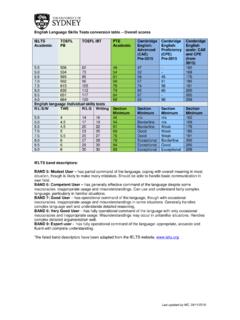
4 February 2016. Cambridge English Scale scores replace the standardised IELTS** is mapped to the Cambridge English Scale , but score and candidate profile used for exams taken before will continue to use the existing nine-band Scale for 2015. reporting results. The candidate's Statement of Results shows: an overall Cambridge English Scale score Cambridge English Scale scores for each skill (Reading, Writing, Listening and Speaking). and Use of English where tested *. Further information about the Common European Framework of Reference for Languages (CEFR) can be found on our website at: a grade **. IELTS is jointly owned by British Council, IDP: IELTS Australia and Cambridge English a CEFR level. Language Assessment. 2 The Cambridge English Scale explained The diagram below shows how Cambridge English : Key, Preliminary, First, Advanced, Proficiency and Business Certificates are mapped to the Cambridge English Scale . Common European Cambridge Cambridge Cambridge Cambridge Cambridge Cambridge Cambridge Cambridge Cambridge Framework of English English : English : English : English : English : English : English : English : Reference (CEFR) Scale Key Preliminary First Advanced Proficiency Business Business Business Preliminary Vantage Higher 230.
5 Grade A. 220. Grade B. C2 210. Proficient user Grade C. Grade A Grade A. 200. Grade B Grade B. C1 190. Grade C. Level C1. Grade C. Grade A Grade A. 180. Grade B Grade B. B2. Independent user 170 Level B2 Level B2. Grade C Grade C. Distinction Distinction 160. Merit Merit B1 150. Pass Level B1. Pass Level B1. Distinction 140. Merit A2 130. Pass Level A2 Level A2. Basic user 120. A1 110 Level A1. 100. Below A1 90. 80. IELTS is mapped to, but will not be reported on the Cambridge English Scale *. How do the scores work? The Cambridge English Scale is aligned to the CEFR, and each of our exams covers a particular section of the Scale . This means that a particular score on the Cambridge English Scale represents the same level of language proficiency, no matter which exam is taken. For example, scores between 180 and 199 cover CEFR Level C1. Candidates at the lowest end of C1 would receive a score of 180. They would achieve this score whether they took Cambridge English : First, Advanced or Proficiency.
6 This is illustrated in the diagram on the following page. 3. Where is the score used? The overall score and the individual Common European Cambridge Cambridge Cambridge Cambridge Cam scores are shown on the candidate's Framework of English English : English : English : En Reference (CEFR) Scale First Advanced Proficiency IELTS S. Statement of Results and on their certificate. 230. Grade A. These scores also appear on the online 220. Grade B. Results Verification Service. C2 210. Proficient user Grade C Grade A. You can see an example of the new 200. Statement of Results for Cambridge Grade B English : Advanced on page 7 of this C1 190 Level C1. document. Grade A. Grade C. 180 Grade B. B2. Independent user 170 Level B2. Grade C 160. B1 150 Level B1 140. A2 130. Basic user 120. How was the Cambridge English Scale produced? A1 110. There is a well-established link between Cambridge English exams and the CEFR, and the current score-reporting system reflects this. Results on the Cambridge English Scale are 100.
7 Reached by applying the same underlying methodology, but the link between our exams andBelow the CEFR is refined. This brings a greater clarity and transparency A1between different to score meanings and facilitates easy comparisons 90. exams. 80. The Scale was developed according to the well-documented and researched links between performance on different tests (using data from millions of candidates) and the processes by which we define and maintain standards. These processes vary slightly for the different components and are described below. First Advanced Example assessment criteria Writing and Speaking components Uses the conventions of the communicative Writing and Speaking components task with sufficient flexibility to communicate are marked by trained, standardised C2 complex ideas in an effective way, holding the target reader's attention with ease, fulfilling examiners according to a set of all communicative purposes analytic scales, covering a range Uses the conventions of the communicative of assessment criteria.
8 C1 task effectively to hold the target reader's attention and communicate straightforward and complex ideas as appropriate The assessment criteria are linked to the CEFR and form an Uses the conventions of the overlapping ladder'. communicative task to hold the target B2 reader's attention and communicate straightforward ideas The criteria for each level are the same across all our exams. For example, the criteria required to meet CEFR Level B2 Uses the conventions of the communicative are identical for both Cambridge English : B1 task in generally appropriate ways to communicate straightforward ideas First and Cambridge English : Advanced. 4 The Cambridge English Scale explained Marks are awarded according to the assessment criteria, However, test alignment is not a one-off project validation and are combined to provide the total mark for the is an ongoing process which requires regular re-evaluation component. Because both the assessment criteria and and confirmation that existing alignments continue to hold.
9 The Cambridge English Scale are linked to the CEFR, the To this end, and with the introduction of the Cambridge Cambridge English Scale score for the component can be English Scale in mind, a series of alignment studies are determined from this total mark. in process to evaluate and validate the links between adjacent exams (for example between Cambridge English : This process ensures that candidates who demonstrate First and Advanced) involving candidates taking both the same level of ability (no matter which exam is taken) exams. This will ensure the integrity of the Scale across are awarded the same Cambridge English Scale score. the suite of exams, and mean that we can be sure that a score of 175 on Cambridge English : First corresponds to the For example: same level of performance as a score of 175 on Cambridge English : Advanced. Two candidates at low CEFR Level B2 sit our exams . one sits Cambridge English : First, the other Cambridge The alignment of IELTS to the CEFR and to the Cambridge English : Advanced.
10 They both just meet the criteria for English Scale has been similarly established by means Level B2 in the Writing paper and are awarded marks of empirical investigation. In 2009, we undertook a for the component accordingly. Although the raw marks comparison study to benchmark C1 level as represented across the two tests are different, the candidates are both by Cambridge English : Advanced against IELTS scores. awarded a Scale score of 160 for the Writing component, For this exercise an empirical validation study was as they have demonstrated the same level of ability. undertaken where registered IELTS candidates were invited to also take Cambridge English : Advanced, and Reading, Listening and Use of English components registered Cambridge English : Advanced candidates were invited to take IELTS. This counterbalanced design Reading, Listening and Use of English components accounted for preparation or motivation-related effects contain a series of items which are marked as either on one test or the other.