Transcription of Calculating starch adhesive solids - HarperLove
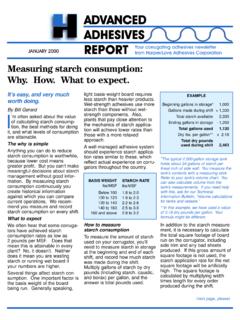
1 AUGUST 2010. Calculating starch adhesive solids However you do it, understand what is in calculation is approximately 1 percent. In all cases the units your calculation and be consistent of measure need to be in pounds not gallons. (To convert gallons to pounds multiply by ). By John Kohl Drying methods T he percent solids of starch corrugating adhesive is the ratio of the weight of the TYPICAL 320-GALLON BATCH IN AN AUTOMATIC MIXER There are three accepted methods used dry ingredients to the weight Primary water 834 lbs (100 gal) to dry down an adhesive of the entire batch. This is Primary starch 95 lbs 95 sample to check the solids Caustic (dry wt) 16 lbs 16 content. an important metric used to determine if the starch content Borax (5 mol) 10 lbs 10 1. One is to use a of the finished adhesive is Secondary water 1230 lbs (148 gal) laboratory oven, set at adequate for the box plant's Secondary starch 620 lbs 620 105oC.
2 A liquid sample of production mix and corrugator Total 2805 lbs 741 approximately 5 grams is weighed and placed in the equipment and not too high Percent solids = 741 2805 = .2641 x 100 = oven for 3 hours and then to cause excessive consumption reweighed. The dry weight and cost. If calculated with starch only: is divided by the original Knowing the solids content Percent solids = 715 2805 = .2549 x 100 = wet weight of the sample of an adhesive is an excellent Oven dried calculation subtracting 10% water from starch : and multiplied by 100 to tool for quality control. A box give the percent solids . plant can periodically check Percent solids = 667 2805 = .2378 x 100 = Remember to subtract the solids content of a sample the weight of the weigh of adhesive by drying it in a lab dish before and after the oven, moisture meter, or a simple microwave oven to verify sample is dried.
3 That all the ingredients are being added to the formula or to 2. An infrared (IR) moisture meter, common in box plants to check for the presence of excess water. check paper and combined board moisture, can also be Some of the newer automatic starch mixers calculate the used. Just set a weigh dish in the meter and zero the scale, percent solids and display it with the formula information. add 3 to 5 grams of adhesive , close the lid and run the test. They also include the condensate (water from the steam) This type of meter takes only 8 to 12 minutes to run. so the additional water weight is accounted for. If adhesive 3. Microwave ovens are also used to dry down an adhesive solids will be checked by drying in an oven, it is important to sample. This is the same sample weigh method as with the understand how the mixer software is doing the calculation.
4 Lab oven but the weigh dish must be plastic and the sample Older two-tank and semiautomatic systems do not account size need be only 2 or 3 grams. The microwave must be for steam condensate that will lower final batch solids . With set to a low power, about 50 percent depending upon the some systems, and in colder climates, condensate can add wattage. The more powerful the microwave the lower the as much as 30 gallons of water to a 700-gallon batch of power setting needs to be, otherwise the sample will boil adhesive . and spray some of the starch out of the pan and give an inaccurate result. The oven needs to dry the sample for All the dry ingredients, or starch only? only 2 or 3 minutes to completely remove all the moisture. There are two ways to calculate the solids content.
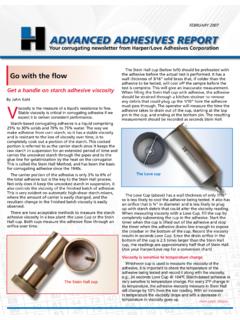
5 One is Oven-dried solids results will always be lower than the to include all of the dry ingredients in the numerator of the percent solids calculated manually or by the mixer software, equation and divide by the total batch weight. The other if the condensate was accounted for. This is because all is to include only the starch portion of the adhesive (both cornstarch arrives from the supplier containing some carrier and secondary starch ) and divide by the total batch residual moisture. The average is about 10 percent. This weight. The difference between using all the dry ingredients ( starch , caustic, and borax) and just the starch in the Next page, please An infrared (IR) moisture meter, common in box plants to check paper and combined board moisture, can also be used.
6 Just set a weigh dish in the meter and zero the scale, add 3 to 5 grams of adhesive , close the lid and run the test. This type of meter takes only 8 to 12 minutes to run. will make the oven-dried solids test result lower by 2 or 3 Whatever method you use to calculate percent solids , and percent, depending on the total pounds of starch used. Test whatever drying method you prefer for verification, it is results can easily be verified by subtracting 10 percent of important to be consistent and keep good records to get full the starch weight in the numerator of the equation before value from this valuable quality control tool. dividing it by the total batch weight. Switch to starch adhesive for running dual arch board It's cheaper, more convenient, and runs faster imagine the forces at work and why a thicker medium has than PVA higher stress.
7 Two thinner mediums, of the same combined caliper as one thicker one, will form better because they can By Rex Woodville-Price move relative to each other and thus have less chance of fracturing the flutes or tearing the fibers. The paper fiber What is dual arch board? in the two thinner mediums would be aligned in a more Dual arch is the name given to single-wall board made orderly pattern and would lie more parallel to the surface using two mediums. One medium has adhesive applied to it of the sheet in the machine direction. They would thus be just before it enters the single facer. The two mediums are better able to withstand these tensile forces since most bonded together as they are formed into flutes. would act along their length, where they are strongest.
8 Why dual arch? Advantages of dual arch Dual arch board uses only two liners compared to three Dual arch has some characteristics that can be exploited for double-wall board. This reduces cost. Although it cannot for special cases. actually replace double wall, dual arch can be a suitable substitute for certain applications. Being a single-wall board, it takes up less space than double wall, so more of the space allotted for transportation Since a significant proportion of the ECT strength of can be filled with product and less with packaging. corrugated board is provided by the medium, it can be Dual arch also has superior flat crush value. In any board, advantageous to add fiber to the medium. Why not just use flat crush strength comes from the fluted medium.
9 It is thicker medium? Well, there are some practical limitations well known that double wall has very low resistance to flat to that. First of all, paper machines can make medium only crush since the flutes that make it up (typically B & C) do up to a certain thickness or caliper. So if you need thickness not line up and will actually deflect each other. Dual arch beyond that limit, you must resort to dual arch. construction doesn't have this problem. There are other considerations: when the medium is Dual arch allows plants with only one single facer to supply formed in the corrugating labyrinth, the medium paper heavier duty boxes without the investment required for fibers are put under significant stress. If we consider that producing double-wall board.
10 Considering that dual arch the medium is being forced to bend almost 180 degrees in production is not widespread, it could allow some plants a very small distance as it forms the flute profile, we can the ability to supply a market niche that differentiates them from their competition. Limitations of dual arch Faster run speeds. When using the proper additive Dual arch generally runs slower than single wall, but since combination, it is possible to run faster with starch than with PVA. it can replace double wall, its production speed is offset by this since it can run at speeds comparable to double wall. Simpler adhesive inventory. Since dual arch tends to be Running three papers continuously on one single facer will a niche market, it is often difficult to predict production require three splicers.