Transcription of Calculus Cheat Sheet Derivatives - Lamar University
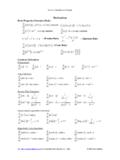
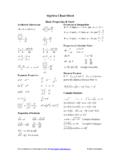
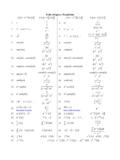
1 Calculus Cheat Sheet Calculus Cheat Sheet Derivatives Chain Rule Variants Definition and Notation The chain rule applied to some specific functions. f x h f x d n n 1 d If y f x then the derivative is defined to be f x lim . 1. f x n f x f x 5. cos f x f x sin f x h 0 h dx dx d f x f x d 2. e f x e 6. tan f x f x sec 2 f x If y f x then all of the following are If y f x all of the following are equivalent dx dx d f x d equivalent notations for the derivative. notations for derivative evaluated at x a . 3. ln f x 7. sec f ( x ) f ( x ) sec f ( x ) tan f ( x ).
2 Df dy d df dy dx f x dx f x y f x Df x f a y x a Df a d f x dx dx dx dx x a dx x a d 8. tan 1. f x 4. sin f x f x cos f x dx 2. dx 1 f x Interpretation of the Derivative If y f x then, 2. f a is the instantaneous rate of Higher Order Derivatives The Second Derivative is denoted as The nth Derivative is denoted as 1. m f a is the slope of the tangent change of f x at x a. 2. 2 d f n dn f line to y f x at x a and the 3. If f x is the position of an object at f x f x 2. and is defined as f x and is defined as dx dx n equation of the tangent line at x a is time x then f a is the velocity of f x f x , the derivative of the f n x f n 1.
3 X , the derivative of given by y f a f a x a . the object at x a. first derivative, f x . the (n-1)st derivative, f n 1. x . Basic Properties and Formulas If f x and g x are differentiable functions (the derivative exists), c and n are any real numbers, Implicit Differentiation d Find y if e 2 x 9y x3 y 2 sin y 11 x . Remember y y x here, so products/quotients of x and y 1. cf cf x 5. c 0. dx will use the product/quotient rule and Derivatives of y will use the chain rule. The trick is to 2. f g f x g x d n differentiate as normal and every time you differentiate a y you tack on a y (from the chain rule).
4 6. x n x n 1 Power Rule After differentiating solve for y . dx 3. f g f g f g Product Rule d 7. f g x f g x g x e2 x 9y 2 9y 3x2 y2 2 x3 y y cos y y 11. f f g f g dx 4. Quotient Rule This is the Chain Rule 2x 9 y 2x 9 y 2 2 3 11 2e 2 x 9 y 3 x 2 y 2. g g2 2e 9y e 3x y 2x y y cos y y 11 y 2 x 3 y 9e 2 x 9 y cos y 2 x 3 y 9e 2 x 9y cos y y 11 2e 2 x 9y 3x2 y 2. Common Derivatives d d d x 1 csc x csc x cot x ax a x ln a Increasing/Decreasing Concave Up/Concave Down dx dx dx Critical Points d d d x c is a critical point of f x provided either Concave Up/Concave Down sin x cos x cot x csc 2 x ex ex dx dx dx 1.
5 If f x 0 for all x in an interval I then 1. f c 0 or 2. f c doesn't exist. d d 1 d 1. cos x sin x sin 1 x ln x , x 0 f x is concave up on the interval I. dx dx 1 x2 dx x d d 1 Increasing/Decreasing 2. If f x 0 for all x in an interval I then tan x sec2 x d 1 ln x , x 0. cos 1 x 1. If f x 0 for all x in an interval I then dx dx 1 x2 dx x f x is concave down on the interval I. d d 1 f x is increasing on the interval I. sec x sec x tan x d 1 log a x , x 0. dx tan 1 x dx x ln a 2. If f x 0 for all x in an interval I then Inflection Points dx 1 x2.
6 X c is a inflection point of f x if the f x is decreasing on the interval I. concavity changes at x c. 3. If f x 0 for all x in an interval I then f x is constant on the interval I. Visit for a complete set of Calculus notes. 2005 Paul Dawkins Visit for a complete set of Calculus notes. 2005 Paul Dawkins Calculus Cheat Sheet Calculus Cheat Sheet Extrema Related Rates Absolute Extrema Relative (local) Extrema Sketch picture and identify known/unknown quantities. Write down equation relating quantities 1. x c is an absolute maximum of f x 1. x c is a relative (or local) maximum of and differentiate with respect to t using implicit differentiation ( add on a derivative every time f x if f c f x for all x near c.)
7 You differentiate a function of t). Plug in known quantities and solve for the unknown quantity. if f c f x for all x in the domain. 2. x c is a relative (or local) minimum of Ex. A 15 foot ladder is resting against a wall. Ex. Two people are 50 ft apart when one 2. x c is an absolute minimum of f x The bottom is initially 10 ft away and is being starts walking north. The angle changes at f x if f c f x for all x near c. if f c f x for all x in the domain. pushed towards the wall at 14 ft/sec. How fast rad/min. At what rate is the distance is the top moving after 12 sec?
8 Between them changing when rad? 1st Derivative Test Fermat's Theorem If x c is a critical point of f x then x c is If f x has a relative (or local) extrema at 1. a rel. max. of f x if f x 0 to the left x c , then x c is a critical point of f x . of x c and f x 0 to the right of x c. We have rad/min. and want to find Extreme Value Theorem 2. a rel. min. of f x if f x 0 to the left x is negative because x is decreasing. Using x . We can use various trig fcns but easiest is, If f x is continuous on the closed interval Pythagorean Theorem and differentiating, of x c and f x 0 to the right of x c.
9 X x x 2 y 2 15 2 2x x 2 y y 0 sec sec tan a, b then there exist numbers c and d so that, 3. not a relative extrema of f x if f x is 50 50. After 12 sec we have x 10 12 1. 4. 7 and We know so plug in and solve. 1. a c, d b , 2. f c is the abs. max. in the same sign on both sides of x c. so y 15 2. 7 2. 176 . Plug in and solve x sec tan a, b , 3. f d is the abs. min. in a, b . 50. 2nd Derivative Test for y . If x c is a critical point of f x such that 7 x ft/sec Finding Absolute Extrema 7 1. 4. 176 y 0 y ft/sec Remember to have calculator in radians!
10 To find the absolute extrema of the continuous f c 0 then x c 4 176. function f x on the interval a , b use the 1. is a relative maximum of f x if f c 0. Optimization following process. 2. is a relative minimum of f x if f c 0. Sketch picture if needed, write down equation to be optimized and constraint. Solve constraint for 1. Find all critical points of f x in a, b . 3. may be a relative maximum, relative one of the two variables and plug into first equation. Find critical points of equation in range of 2. Evaluate f x at all points found in Step 1.