Transcription of California Courts Self-Help Center
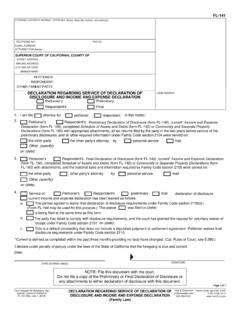
1 California Courts Self-Help Center Instructions for property declaration (Family Law), Form FL-160 You can file form FL-160: With your petition After you file your petition With Your Petition You only need to use this form if you run out of room on the petition to list property and debts. Use one form for your community property and debts and a different one for your separate property and debts. You do not need to write the value of your property or debts at this time. If you need more room use a Continuation of property declaration , form FL-161. After You File Your Petition If you already filled out a form FL-160 but do not have a written agreement with your spouse about how to divide your property , file form FL-160 again.
2 This time you must provide enough information to finish your case. Use one form for your community property and debts and another form for separate property and debts. Fill in all of the columns to show how much your assets are worth and how you think they should be divided. The court may ask you to explain your opinion. California law says that in most cases your community property will be divided equally. So, make sure that the total community property value minus the community debts is about equal for each spouse. Otherwise, the judge may not approve your proposed division. ALERT! If you have a question about whether some asset is community property , separate property , or mixed, please consult a lawyer for advice.
3 The same is true if you are unsure about how a debt should be paid. To make it equal, you may need to include an "equalizing payment." This is when one spouse pays the other some amount of cash so the division of community property will be equal in value. To calculate an equalizing payment: Look at your initial proposal for dividing the property . Subtract the smaller dollar amount from the higher dollar amount. Divide that amount by 2. Instructions for Form FL-160 Page 1 of 2 Instructions for Form FL-160 Page 2 of 2 ADD the result to the side that has the lower value. And SUBTRACT that same amount from the other side. Now, you should have an equal property distribution. Example: Initial Proposed property Distributions: Wife Husband Car $10,000 $4,000 Household Furniture + 5,000 +1,000 Total $15,000 $5,000 Calculate the Equalizing Payment: $15,000 - 5,000 = $10,000 Equalizing Payment = $10,000/2 = $5,000 Calculate an Equal property Distribution: Wife Husband Initial Distribution $15,000 $5,000 Equalizing Payment -$5,000 +$5,000 Equal property Distribution $10,000 $10,000