Transcription of California Milk Pricing Formulas
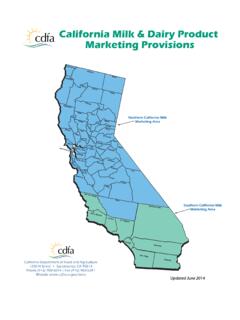
1 California milk Pricing Formulas California s milk marketing program establishes minimum prices that processors must pay for Grade A milk received from dairy farmers. For the purposes of setting prices, there are five classes of milk that are established depending on the type of dairy product. The most significant factors in determining the minimum price that processors must pay for milk are the wholesale commercial market prices for four dairy product commodities: 1. The simple average spot price for Grade AA butter at the Chicago Mercantile Exchange (CME), 2. The California weighted average price (CWAP) for nonfat dry milk (NFDM) as reported by the California Department of Food and Agriculture (Department), 3. The simple average spot price for block Cheddar cheese at the Chicago Mercantile Exchange (CME), and 4. The simple average of the mostly price for Western dry whey (WDW) as reported by Dairy Market News (DMN). milk consists of three basic components: butterfat (fat), solids-not-fat (SNF), and fluid carrier (water).
2 Prices are assigned to all three components in the determination of the Class 1 milk price. Only the fat and SNF components are used to set the Class 2, 3, 4a, and 4b milk prices. Because prices are determined for individual milk components, a simple calculation must be performed to obtain the implied hundredweight price for representative milk testing fat and SNF. Class 1, 4a, and 4b prices are adjusted monthly, and Class 2 and 3 prices are adjusted bi-monthly. The Five Classes of milk Class 1: milk used in fluid products, including whole, reduced fat, lowfat, and nonfat milks. Class 2: milk used in heavy cream, cottage cheese, yogurt, and condensed products. Class 3: milk used in ice cream and other frozen products. Class 4a: milk used in butter and dry milk products, such as nonfat dry milk . Class 4b: milk used in cheese, other than cottage cheese, and whey products. Class 4a Price formula (butter and dry milk products) Prices for butter and nonfat powder in the Class 4a formula are calculated using the period of the 26th of the prior month to the 25th of the current month.
3 (1) Price of Class 4a fat = (Butter price $ $ ) x (2) Price for Class 4a SNF = (Nonfat powder - $ ) x (3) Class 4a price per 100 pounds of standardized milk fat and SNF) = ( x price of Class 4a fat) + ( x price of Class 4a SNF) For any month in which the Secretary implements the collection of charges for the milk Producers Security Trust Fund, the minimum Class 4a price shall be increased by: $ per pound of fat, and $ per pound of SNF Manufacturing cost allowance; the amount deducted from the product price to compensate for the processor s costs. The average market price per pound of Grade AA butter at the Chicago Mercantile Exchange. The difference between the Chicago Mercantile Exchange butter price and the price received by California butter processors. Butter yield; can produce lbs. of butter from one pound of fat. Manufacturing cost allowance; the amount deducted from the product price to compensate for the processor s costs.
4 NFDM yield; can produce lbs. of nonfat powder from one pound of SNF. SNF = solids-not-fat The weighted average price received by California processors for Grade A and Extra Grade nonfat powder. Class 4b Price formula (cheese) The Class 4b price calculation consists of four steps. The first step sets the fat component price in 4b milk to that of 4a milk . The second step determines the product value of cheese, Grade B butter, and dry skim whey per hundred pounds of milk . The third step identifies the 4b SNF price. The fourth step converts the component prices to a standardized milk price. Prices for butter, cheese, and dry whey in the Class 4b formula are calculated using the prices announced during the period of the 26th of the prior month to the 25th of the current month. Step 1: Price of Class 4a fat = Price of Class 4b fat Step 2: Product value = (Cheddar price $ $ ) x + (CME AA butter $ $ ) x + whey factor Step 3: Price of Class 4b SNF = Product value ( x Price of Class 4b fat) 8.
5 80 Cheese yield; can produce lbs. of cheese from 100 pounds of milk . The difference between the CME block Cheddar cheese price and the price that California processors receive. Manufacturing cost allowances; the amounts deducted from the product price to compensate for the processor s costs. Adjustment to reflect the value of whey butter relative to CME Grade AA butter price. Average percent of solids not fat in milk used in Cheddar cheese plants. Average percent of fat in milk used in Cheddar cheese plants. Market price per pound of Grade AA butter at the Chicago Mercantile Exchange. Whey butter yield; can produce lbs of whey butter from 100 pounds of milk . The average market price per pound of Cheddar cheese at Chicago Mercantile Exchange. Whey Value per cwt. based on the following scale, using the DMN dry whey commodity series: DMN Monthly Average Dry Whey Price ($/lb) Whey Factor in 4b formula ($/cwt.) < and < and < and < and < and < and < and < Step 4: Class 4b price per 100 pounds of standardized milk fat and SNF) = ( x price of Class 4b fat) + ( x price of Class 4b SNF) For any month in which the Secretary implements the collection of charges for the milk Producers Security Trust Fund, the minimum Class 4b price shall be increased by: $ per pound of fat, and $ per pound of SNF Class 3 Price formula (frozen dairy products) Class 3 prices are established on a bi-monthly basis prior to the beginning of each even month.
6 For example, the February March Pricing period for Class 3 milk uses the average Class 4a component prices for December and January. (1) Class 3 fat price = average Class 4a fat price (throughout California ) (2) Class 3 SNF price = average Class 4a SNF price + ($ throughout California ) (3) Class 3 price per 100 pounds of standardized milk (@ fat and SNF) = ( x price of Class 3 fat) + ( x price of Class 3 SNF) For any month in which the Secretary implements the collection of charges for the milk Producers Security Trust Fund, the minimum Class 3 price shall be increased by: $ per pound of fat, and $ per pound of SNF Class 2 Price formula (sour cream, heavy cream, cottage cheese, and yogurt) Like the Class 3 prices, Class 2 prices are established on a bi-monthly basis prior to the beginning of each even month. For example, the February March Pricing period for Class 2 milk uses the average Class 4a component prices for December and January. (1) Class 2 fat price = average Class 4a fat price (throughout California ) ($ in Northern California ) (2) Class 2 SNF price = average Class 4a SNF price + ($ in Southern California ) (3) Class 2 price per 100 pounds of standardized milk fat and SNF) = ( x price of Class 2 fat) + ( x price of Class 2 SNF) For any month in which the Secretary implements the collection of charges for the milk Producers Security Trust Fund, the minimum Class 2 price shall be increased by: $ per pound of fat, and $ per pound of SNF The average Class 4a price for two consecutive months Differentials depend on milk component and processor location Class 1 Price formula for Fluid milk Products Determining the price for fluid milk products involves several steps.
7 The Class 1 fat price in the fluid milk Pricing formula is set directly and uses the Chicago Mercantile Exchange (CME) butter price with an adjuster. The SNF and carrier prices are calculated as residuals. They rely on a basic price mover called the commodity reference price (CRP) which is based off the higher of the price for CME Cheddar cheese and Mostly Western Dry Whey or the CME Grade AA butter and California weighted average price for nonfat dry milk . The value of the Class 1 fat price is subtracted from the CRP and the remaining residual value is allocated to SNF and carrier. Once the component prices have been assigned to fat, SNF, and fluid carrier portions of milk , these component prices are converted to a standardized hundredweight milk price. Commodity prices for butter, cheese, dry whey, and nonfat dry milk in the Class 1 formula are calculated using the prices announced during the period of the 26th of the second prior month to the 10th of the prior month. Step 1: Price of Class 1 fat = (CME butter $ ) x Step 2: Commodity Reference Price = the higher of two price calculations: (CME Cheddar ) x + (CME AA butter $ ) x + (Dry Whey Price x ) - $ Market price per pound of Grade AA butter at the Chicago Mercantile Exchange Butter adjuster Butter yield; can produce lbs of butter from one pound of fat Market price per pound of Cheddar cheese at the Chicago Mercantile Exchange Cheese yield; can produce lbs of cheese from 100 pounds of milk Whey butter yield; can produce lbs of whey butter from 100 pounds of milk Adjustment to reflect the value of whey butter relative to CME Grade AA butter price Market price per pound of Grade AA butter at the Chicago Mercantile Exchange Market price per pound of Dry Whey using the Western Dry Whey (mostly) prices Western Dry Whey yield; can produce lbs.
8 Of Dry Whey from 100 pounds of milk . Dry Whey Adjuster OR (CME butter x ) x + (CA NFDM x ) x Step 3: Price of Class 1 SNF = [{(CRP - $ ) (Class 1 fat price x )} x ] Step 4: Price of Class 1 fluid = [{(CRP - $ ) (Class 1 fat price x )} x ] Step 5: Class 1 price per 100 pounds of milk fat and SNF) = ( x Class 1 fat) + ( x Class 1 SNF) + ( x Class 1 carrier) For any month in which the Secretary implements the collection of charges for the milk Producers Security Trust Fund, the minimum Class 1 price shall be increased by: $ per pound of fat, $ per pound of SNF, and $ per pound of carrier Percentage of fluid in raw milk Proportion of residual value assigned to fluid For Northern California , subtract an additional $ from the per pound price of fluid carrier. Commodity Reference Price Proportion of residual value assigned to SNF Percentage of fat in raw milk Percentage of SNF in raw milk CRP Adjuster SNF content of whole milk NFDM yield; can produce lbs of NFDM from one pound of SNF California weighted average of prices received by plants for nonfat dry milk .
9 Market price per pound of butter at the Chicago Mercantile Exchange Butter yield; can produce lbs of butter from 1 pound of fat Fat content of whole milk