Transcription of California Vaccines for Children (VFC) Program …
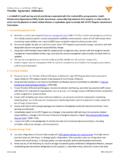
1 California Vaccines for Children (VFC) Program 2018 Program participation requirements at a Glance California Department of Public Health Immunization Branch 1 IMM-1240 (1/18) Requirement Summary Resources/Job Aids vaccine Management Plan Updated for 2018 Maintain a current and completed vaccine management plan (for routine and emergency situations) that includes practice-specific vaccine management guidelines and protocols, names of staff with temperature monitoring responsibilities, and completion dates of required EZIZ lessons for key practice staff. Designate a staff member responsible for updating the management plan. Review and update the plan at least once a year, when VFC Program requirements change, and when staff with designated vaccine management responsibilities change. Ensure all staff with assigned vaccine management responsibilities review, sign, and date the plan annually and whenever the management plan is updated.
2 Conduct regular vaccine management drills to maintain competency and readiness for emergency procedures, such as vaccine transport. EZIZ VFC Program requirements lesson vaccine Management Plan (IMM-1122) Key Practice Staff Designate on-site practice staff for each key role required by VFC, maintain key practice staff information updated in the practice s profile, and immediately report key practice staff changes by logging into MyVFCV accines. Changes to the Provider or Provider of Record Designee cannot be made online, and a Key Practice Staff Change Request form needs to be completed and submitted to the VFC Program . There are four required VFC roles: Provider of Record (POR): The physician-in-chief, medical director, or equivalent role that signs and agrees to the terms of the VFC Provider Agreement and the California VFC Program Provider Agreement Addendum and is ultimately accountable for the practice s compliance.
3 Must be a licensed MD, DO, NP, PA, pharmacist, or a Certified Nurse Midwife with prescription-writing privileges in California . Provider of Record Designee: The on-site person designated by the Provider of Record to sign VFC documents on his/her behalf and to assume responsibility for VFC matters in his/her absence. vaccine Coordinator: An on-site employee who is fully trained and responsible for implementing and overseeing the provider s vaccine management plan. Backup vaccine Coordinator: An on-site employee fully trained in the practice s vaccine management activities and fulfills the responsibilities of the vaccine Coordinator in his/her absence. Immunization Champion (optional): A staff member who goes above and beyond their normal duties to promote immunizations to patients and in the community. vaccine Coordinator Roles & Responsibilities (IMM-968) VFC Key Practice Staff Change Request Form (IMM-1166) California Vaccines for Children (VFC) Program 2018 Program participation requirements at a Glance California Department of Public Health Immunization Branch 2 IMM-1240 (1/18) Staff Training requirements Provider of Record and Designee, vaccine Coordinator and Backup, and other key practice staff who have immunization-related responsibilities must comply with federal VFC educational requirements and complete required annual EZIZ training lessons.
4 Additionally, the clinic s Provider of Record must ensure staff demonstrate competency in their assigned VFC responsibilities: All staff with temperature monitoring responsibilities must be properly trained on temperature monitoring, use of the practice s temperature monitoring devices, and required actions for out-of-range temperatures. Training must also include response to routine and emergency vaccine management situations as included in the clinic s vaccine management plans. Staff authorized to accept packages must be trained to notify vaccine Coordinators for vaccine deliveries. Clinical staff must be knowledgeable of and familiar with ACIP-recommended immunizations, including schedules, indications, dosages, and new products. New providers cannot enroll and existing providers cannot recertify until all key practice staff complete the required EZIZ lessons.
5 Staff training must be documented and included within the vaccine management plan. Documentation must include the staff member s name and date of training. Required training by role: *Test-out option available EZIZ Training Lessons California Vaccines for Children (VFC) Program 2018 Program participation requirements at a Glance California Department of Public Health Immunization Branch 3 IMM-1240 (1/18) VFC Eligibility Screening & Documentation Follow VFC Program requirements for patient eligibility screening and documentation: Screen all Children from birth through 18 years of age for VFC eligibility (Medi-Cal eligible, uninsured, American Indian/Alaska Native, and underinsured Children seen at a FQHC or RHC) prior to vaccine administration at every immunization visit. Document all elements of VFC s Patient Eligibility Screening Record form, including the screening date, VFC eligibility (Y/N), and any eligibility criterion (or criteria) if met.
6 Do not deny vaccine administration because the parent/guardian is unable to pay the administration fee. Keep all VFC eligibility records on file for three years. VFC Patient Eligibility Screening Record form (IMM-1111) VFC s Who s Eligible flier (IMM-1088) VFC Eligibility & Documentation requirements (IMM-1161) ACIP Recommendations & Standards VFC providers must offer all ACIP-recommended Vaccines for the VFC population they serve. Follow VFC Program requirements : Comply with recommendations about immunization schedules, dosages, and contraindications as established by the ACIP and included in the VFC Program . Offer all age-appropriate Vaccines according to patient populations served, and as identified and agreed upon in the practice s Recertification population profile. Administer VFC-supplied Vaccines only to Children who meet VFC eligibility criteria.
7 Distribute the current vaccine Information Statements (VIS) before vaccine administration. Maintain records in accordance with the National Childhood vaccine Injury Act (NCVIA), which includes reporting clinically significant adverse events to the vaccine Adverse Event Reporting System (VAERS). Acknowledge that revaccination is recommended if non-viable Vaccines have been administered to patients. Record information about each immunization given, including: the name of the vaccine the date it was given the route and administration site the lot number and manufacturer the name and title of the person who administered it the practice s name and address the VIS publication date and date VIS was provided CDC Recommended Immunization Schedules Instructions for using VIS Current vaccine Information Statements VAERS and VERP flyer (IMM-1153) VFC vaccine Fact Sheets California Vaccines for Children (VFC) Program 2018 Program participation requirements at a Glance California Department of Public Health Immunization Branch 4 IMM-1240 (1/18) Billing for vaccine Administration Immunize all VFC-eligible Children with VFC-supplied Vaccines at no charge to the patient for Vaccines .
8 Providers may charge VFC-eligible Children not covered by Medi-Cal ( uninsured, American Indian/Alaska Natives, and underinsured Children seen at a FQHC or RHC) up to the current federal maximum regional administration charge of $ per dose (not antigen) of vaccine . Waive the administration fee if the parent/guardian is unable to pay. For Medi-Cal Children , providers must bill Medi-Cal for vaccine administration fees and accept reimbursement rates set by Medi-Cal or the contracted Medi-Cal health plans. Never bill the difference between Medi-Cal s administration fee and the administration fee cap to the parent/guardian. Note: Pharmacies, urgent care and other specialty VFC providers agree to vaccinate all walk-in VFC-eligible Children and not refuse to vaccinate these Children based on a parent s inability to pay the administration fee. vaccine Storage Units Use or purchase refrigerators or freezers that comply with VFC vaccine storage unit requirements .
9 Very high volume providers must use pharmacy- or biologic-grade refrigerators. Other providers may use refrigerators and freezers that are pharmacy- or biologic-grade, commercial-grade, and household-grade stand-alone. Never use any of the following for vaccine storage: household-grade combination refrigerator-freezers, compact household-grade stand-alone refrigerators (with capacity 11 cubic feet or less), dormitory-style or bar-style combined refrigerator/freezers, manual defrost refrigerators, convertible units, or cryogenic (ultra-low) freezers, or any vaccine transport unit for routine storage (including coolers and battery-operated units). Dedicate vaccine refrigerators and freezers to vaccine storage. If storage of medications or biologics is necessary, store them below Vaccines on a different shelf. Never store food or beverages in vaccine storage units.
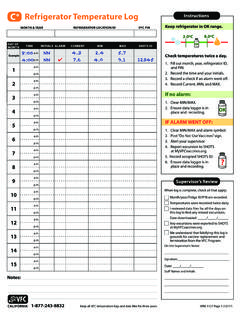
10 Purchase new vaccine refrigerators or freezers if existing storage units do not meet VFC Program requirements , or in the event of storage unit malfunctioning that resulted in spoiled Vaccines . EZIZ vaccine Storage requirements California Vaccines for Children (VFC) Program 2018 Program participation requirements at a Glance California Department of Public Health Immunization Branch 5 IMM-1240 (1/18) Digital Data Loggers * VFC providers are required to use data loggers to monitor storage unit temperatures. VFC providers must use digital data loggers or similar continuous temperature monitoring devices to monitor temperatures in any unit (refrigerator, freezer, or transport cooler) storing VFC supplied Vaccines . Data loggers must comply with VFC temperature monitoring device requirements . Ensure all data loggers include the following minimum features: a digital display of current, minimum, and maximum temperatures; minimum accuracy of F ( C); a buffered temperature probe (the one that comes with the device) immersed in a vial filled with up to 60mL liquid ( , glycol, ethanol, glycerin), loose media ( , sand, glass beads), or a solid block of material ( , Teflon , aluminum); an out-of-range temperature alarm; logging interval of at least 30 minutes; and memory storage of 4,000 readings or more.