Transcription of Call for Papers - unrisd.org
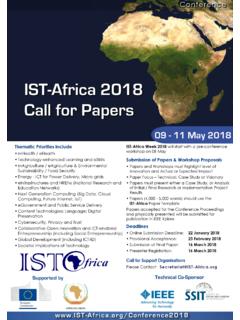
1 call for Papers Implementing the Sustainable Development Goals: What Role for Social and Solidarity Economy? The United Nations Inter-Agency Task Force on Social and Solidarity Economy (UNTFSSE) is launching this call for Papers to assess the contribution of SSE to inclusive and sustainable development, with a particular emphasis on local contexts. Organized by the United Nations Research Institute for Social Development (UNRISD), in its role as coordinator of the Task Force s recently established Knowledge Hub, the call for Papers aims to identify and mobilize research from different regions and territories that critically examines the role of SSE as a means of implementation for the Sustainable Development Goals (SDGs). Authors of the selected Papers will be invited to present their work at a conference at the United Nations Office at Geneva, planned for April 2019. Selected submissions will also gain visibility through publication as working Papers and think pieces.
2 As publications under the banner of the Task Force s Knowledge Hub, the pieces selected will have international impact and will contribute to UN efforts to scale up and promote SSE as means of implementation of the SDGs. Background Global crises related to finance, society and the environment have highlighted the need to consider alternative forms of economy, social relations and governance. In this context, policy makers, development practitioners and scholars are increasingly focusing their attention on the potential role that myriad forms of organizations and enterprises that make up the Social and Solidarity Economy (SSE) can play in inclusive and sustainable development. Social and Solidarity Economy refers to the production of goods and services by a broad range of organizations and enterprises that have explicit social and, often, environmental objectives. Guided by principles and practices of cooperation, solidarity, ethics and democratic self-management, SSE organizations typically includes cooperatives, mutual societies and other forms of social enterprise, self-help groups, community-based organizations, associations of informal economy workers, service-provisioning NGOs, solidarity finance schemes, among others.
3 While there is a growing body of research and knowledge on SSE, there has been little attempt to systematically analyse the contribution of SSE to inclusive and sustainable development. Much information and analysis remains dispersed and anecdotal. It can also be prone to romanticizing the role of SSE, lacking critical analysis of constraints and challenges. And there is a need for knowledge to be synthesized and presented in ways that can usefully inform policy making and advocacy on inclusive and sustainable development. The 2030 Agenda and its 17 Sustainable Development Goals (SDGs), agreed by all United Nations member states in 2015, provides a framework for tracking progress in relation to specific development goals, and in relation to more holistic and integrated patterns of development that avoid the trade-offs and contradictions associated with the development strategies often pursued in the past. Furthermore, the emphasis within the 2030 Agenda on national goals and targets leaves open the question of how the SDGs will be implemented at the local level and grounded in local realities.
4 UNTFSSE 2018 call for Papers Implementing the Sustainable Development Goals: What Role for Social and Solidarity Economy Research Themes and Questions The call invites researchers and practitioners to submit proposals for Papers related to two main issue areas: i. SSE as a means of implementation for the SDGs. Of interest are the ways in which SSE actors and institutions can facilitate the implementation of goals and targets associated with the SDGs, particularly in local settings. What works and why? What is the comparative advantage of SSE in relation to other forms of economy, in terms of minimizing trade-offs between different dimensions of development and promoting a more integrated approach? What actors and institutions are key for creating an enabling environment for SDG implementation through SSE? What is the scope for replicating positive initiatives in other local settings? Please note that Papers examining local experiences related to a specific organization or grassroots initiative should attempt to go beyond a focus on micro dynamics or the micro level and also consider interactions with national and regional actors and institutions, as well as the mechanisms and scope for scaling up and replicating small scale local initiatives ii.
5 Measuring SSE, its scale and impact. In a context where systematic data on SSE are still scarce, where definitions and indicators vary, and where statistics often fail to capture the diversity of SSE actors and impacts, the call aims to identify robust methodologies and innovative solutions for measuring SSE and its impacts. Papers , then, are expected to (i) demonstrate the concrete ways in which SSE supports the implementation of the SDGs, or (ii) identify and assess robust methodologies and innovative approaches to the measurement of SSE impact, in relation to SDGs. Papers are welcome to examine how SSE can be a means of fostering the integrated and holistic nature of sustainable development in order to avoid the trade-offs and contradictions of mainstream development approaches; and how the economic, social, environmental and cultural aspects of development are intertwined in SSE, as well as the role of democratic politics and governance. They can examine groups of SDGs or focus on individual Goals.
6 The organizing committee has identified the following themes and associated SDGs as particularly relevant to how SSE can contribute to achieving the 2030 Agenda: i. Ending poverty and hunger. SDGs 1 and 2 call for an end to poverty and hunger. This cluster focuses, in particular, on the role of SSE in food security, sustainable agriculture and improved nutrition. ii. Social protection. This cluster has a focus on the role of SSE in achieving SDGs 3 and 4 related to ensuring health and education for all. iii. Equality. SDGs 5 and 10 directly address the question of inequality, focusing on gender equality and the empowerment of women and girls, and the need to reduce inequality both between and within countries. How can SSE contribute to reducing inequalities? iv. People-centred growth. This cluster focuses on the role of SSE in addressing aspects of SDGs 8 and 9 related to employment, decent work, infrastructural development, innovation and productivity, and the future of work.
7 V. Environmental protection and sustainable production and consumption. This cluster focuses on the role of SSE related to aspects of environmental protection, the environmental retrofitting of economies and transforming consumption patterns (SDGs 7, 12, 13, 14 and 15). vi. Sustainable human settlements. SDGs 6 and 11 address sustainable and inclusive human settlements. This cluster looks at the role of SSE in access to clean water and sanitation, and rural-urban linkages favouring, for example, food security and fair trade. vii. Peaceful and inclusive societies and institutions. SDG 16 relates to developing effective, accountable and transparent institutions ( ) as well as ensuring responsive, inclusive, participatory and UNTFSSE 2018 call for Papers Implementing the Sustainable Development Goals: What Role for Social and Solidarity Economy representative decision making at all levels ( ); the role of SSE in post-conflict reconstruction is also pertinent.
8 Viii. Sustainable finance. SDG 17 aims to strengthen domestic resource mobilization and mobilize additional financial resources from multiple sources. Of interest for the call is the role of solidarity finance involving SSE actors and institutions in democratizing access to fair and affordable finance. Papers are expected to provide information and analysis on good practices, impacts and challenges in concrete settings by: describing the role of SSE (the actors and organizations involved, their activities) assessing impacts in relation to specific SDGs and targets identifying key enabling factors, contexts or ecosystems , including public policies, private sector and civil society support, resource endowments and forms of social and political organization identifying key constraints that impede progress, scaling up and the long-term sustainability of initiatives Submission Process The call for Papers is open from 1 June until midnight CEST on 31 August 2018.
9 To participate, please visit and follow the instructions to create an account and upload the following: Your contact information An extended abstract (500-1,000 words), outlining the main issues, hypotheses, arguments, country/regional focus, case studies to be considered, and structure of the paper CV Proposals (and Papers ) may be submitted in English, French, Portuguese or Spanish Successful candidates will be notified in September 2018 and invited to submit a draft paper (approximately 6,000 words), due no later than 30 December 2018. Some candidates will be invited to prepare shorter think pieces of approximately 1,500 words, instead of a paper , for publication and global dissemination via the UNTFSSE, UNRISD, and ILO SSE Academy websites and electronic newsletters. An international conference with policy makers and other stakeholders on SSE as a Means of Implementation for the Sustainable Development Goals is planned for April 2019 at the United Nations Office at Geneva.
10 Subject to funding, it is anticipated that travel and accommodation costs of selected paper presenters will be covered. Authors will be expected to revise draft Papers taking into account comments from UNRISD and the organizing committee. Subject to peer review, selected Papers will be published by the UNTFSSE Knowledge Hub, or in an edited volume through a commercial publisher, or as a special issue of an academic journal. They should, therefore, not be under consideration for publication elsewhere. For further information, see or contact