Transcription of Cambodia Environmental and Climate Change …
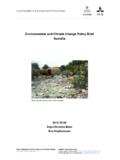
1 Cambodia Environmental and Climate Change Policy Brief Tour guide from the Community-Based Ecotourism (CBET) Committee of Chambok in front of an information board highlighting the ecosystem services provided by bats. Photo: G ran Ek Final 2013-09-09. G ran Ek Sida's Helpdesk for Environment and Climate Change Contact: G ran Ek Team Leader: Anders Ekbom Quality Manager: Eva Stephansson Executive Summary The Swedish Government has identified environment and Climate Change as one of three thematic priorities for development cooperation. This Environmental and Climate Change Policy Brief has been written as an input to the Swedish results strategy process for Cambodia , aiming to summarise the key Environmental challenges, constraints and opportunities and their links to development and poverty reduction in Cambodia . From this brief review it can be concluded Cambodia 's diverse ecosystems have been important for economic growth and contributed to improved living standards.
2 The rapid economic growth created employment opportunities which contributed to the decline in poverty headcount from % in 2004 to 20% in 20111, although poverty remains a challenge. Poverty in Cambodia is still mainly a rural problem and more a legacy of decades of internal conflicts and bad governance than lack of resources or opportunities. The manifestation of poverty is often linked to lack of access to good-quality natural resources and productive assets, secure land tenure, and access to markets. The rural poor are facing increasing challenges due to rapid decline in natural resources. The natural resources have not been managed in a sustainable or equitable manner, which has led to over-exploitation and depletion. The deforestation rate is among the highest in the world and is closely linked to other key Environmental problems such as land degradation and grabbing, extinction of wildlife, soil erosion, reduced water tables and general loss of biodiversity and ecosystem services leading to reduced resilience to disasters and Climate Change .
3 Due mainly to widespread deforestation and associated biodiversity loss, Cambodia is unlikely to achieve the MDG 7 on Environmental sustainability. In addition to the grave deforestation and biodiversity situation, surface water management, (now increasingly critical because of planned and actual dam building on the Mekong in combination with the implications of Climate Change ) land allocation and use, degradation of soil (driven by unsuitable agricultural practices in addition to deforestation) Climate Change impacts (affecting water regimes and increasing the risk for droughts and floods) are other Environmental issues of great concern. The rampant Environmental degradation poses significant constraints to key growth sectors such as agriculture (including fisheries), sustainable forestry and tourism. Loss of ecosystem services and Environmental degradation is largely unaccounted for in national accounts and statistics, which imply that real economic growth most likely is significantly lower than what the GDP growth rate indicates.
4 If the over-exploitation of current scope and scale continues it may undermine future socio-economic development, increase greenhouse gas emissions, reduce resilience and the ability to adapt to Climate Change , and may well induce social unrest and Improving governance aspects, including transparency and accountability, control of corruption, and effective implementation of policies and regulation, will be key for Cambodia to transition into a more sustainable development. There are plenty of opportunities for Sweden to support Cambodia to improve Environmental outcomes, either indirectly by improving respect for human rights and democracy governance in general, or through more targeted support to specific sectors. 1. World Bank (2012). 2. Particularly if land current land conversion issues are not settled. See for example ii The data, insights, advise and experiences collected during the review all point in the same direction - Sweden can still make a difference to promote a sustainable management of natural resources, effective Climate Change adaptation and a rapid poverty alleviation based on a green growth perspective.
5 The current areas of cooperation of Sweden in Cambodia - Human rights, Democracy, Education and Climate Change all present windows of opportunities for Environmental mainstreaming that can improve transparency, participation and accountability and other crucial aspects of policy implementation to promote good governance in Cambodia . For example can safeguarding rights of local communities to have an improved say on land concessions secure that forests and wetlands that provide significant ecosystem services are not destroyed, the decentralization reform can be supported to include increased empowerment and public participation on decision making on Climate Change adaptation in provinces and villages, UNICEF who Sweden cooperates with on basic education has developed practices on scaling up and mainstreaming Climate Change adaptation and disaster risk reduction into the education sector and discussing how an extended collaboration on environment and Climate Change mainstreaming jointly UNICEF-Sweden could be extended into the education sector is also an opportunity that shouldn't be missed.
6 In addition the policy brief suggests that Sweden open up a new area of cooperation in the next strategy Environment and Climate Change according to entry values presented by the Swedish Government for the recently started process to develop a Result Proposal for Cambodia . Because of the large deficiencies in both government capacity and funding for sustainable management of natural resources in the country there seems to be very little risk of over- crowding in this sector if Sweden should remain in and expand its engagement, an assertion supported by stakeholders interviewed during the review. Key initiatives in this area could include: - long-term funding to the Cambodian Climate Change Alliance (CCCA) and taking up coordination duties - supporting the gender mainstreaming component in the project on Local Governments and Climate Change (LGCC) to ensure that women's concerns on Climate Change and priorities for adaptation actions are - backing initiatives by forest communities directed at delivering carbon credits to the Voluntary Carbon Markets - funding NGOs that help communities set up Community Forestry projects - support to the Forestry Administration in establishing and managing Conservation areas - capacity building at the Ministry of Environment - joint programming with other donors on sustaining the ecosystem services of the Mekong and Tonle Sap - helping the Ministry of Mining and Energy to enhance rural electrification - assisting in the implementation of the Green Growth strategy, iii Table of Contents Executive Summary.
7 Ii 1. Introduction .. 1. 2. Key Environmental problems and their causes .. 2. 3. What are the effects of the Environmental problems?.. 6. Impacts on poverty .. 6. Impacts on economic development .. 8. Impacts on Public Health .. 9. 4. Policy framework and institutional capacity for managing Environmental challenges .. 10. Key actors .. 10. Policy and planning .. 11. International donors' priorities in the environment sector .. 13. Civil 13. Governance and implementation .. 13. 5. Risks and opportunities .. 15. Risks .. 15. Opportunities .. 16. 6. Past experience and future cooperation .. 17. 7. Conclusions and Issues for Sida to consider .. 18. Conclusions .. 18. Issues for Sida to consider - mainstreaming environment and Climate .. 19. Issues for Sida to consider - environment and Climate Change a new area of cooperation .. 20. References .. 25. Appendix 1: NRM and poverty alleviation voices from the ground .. 28. Appendix 2: Cambodia MDGS.
8 29. Appendix 3: NGOs playing an important role in natural resources management policies in Cambodia .. 32. Annex 4: Institutions and stakeholders visited during fact-finding mission .. 35. Annex 5: A summary of donor programs in the environment sector in Cambodia 2012- .. 36. Annex 6: Terms of reference .. 37. iv 1. Introduction The Swedish Government has identified environment and Climate Change as one of three thematic priorities for development cooperation. This is reinforced in the Swedish policy on environment and Climate Change in development cooperation concluding that these aspects are a central point of departure for all development cooperation 3. This Environmental and Climate Change Policy Brief has been written as an input to the Swedish results strategy process and in preparation of a new results strategy proposal for Cambodia . The results strategy is expected to cover the period 2014-2020. The Policy Brief takes as a point of departure the Millennium Development Goal 7: Ensure Environmental Sustainability, and aims to summarise the key Environmental challenges, constraints and opportunities and their links to development and poverty reduction in Cambodia , as well as to the government's Green Growth policy for 2013 to 2030 (see Annex 6 for TOR).
9 The intention is to facilitate integration of environment and Climate Change risks and opportunities into Swedish Development Cooperation. Opportunities for Sida and other development partners to supporting improved Environmental management are also briefly discussed. The brief has been prepared after a fact finding mission to Thailand and Cambodia in May 2013. followed by a desk Cambodia is endowed with a diversity of ecosystems and natural resources, which forms the basis of the high economic growth during the last decade. However, despite the many jobs created in manufacturing, construction and tourism, adequate numbers of good jobs have not materialized to lift large numbers of workers out of poverty, which is still widespread. Cambodia is largely a rural economy, with a young population. Amongst the major economic challenges for Cambodia over the next decade will be the creation of youth employment in urban areas and adequate earnings in the agricultural sector and informal economy5.
10 Other major challenges to economic growth as well as Environmental management include weak governance, such as corruption, abuse of power, and lack of transparency. Natural resources, on which many of the poor people depend, are exploited and land grabs, illegal logging, and opaque concessions are common problems. The low level of transparency combined with low educational levels obstructs accountability, which is particularly relevant for natural resource extraction as there often is a conflict between private gains and public wealth. Table 1 lists some reference indicators for Cambodia . 3. Swedish Government Offices, 2009. 4. The Environment and Climate Change policy brief has been developed by G ran Ek who wishes to acknowledge the invaluable help of Ms Soma Dor, National Programme Officer at the Embassy of Sweden in Phnom Penh, for organizing meetings with relevant stakeholders during the mission. The views expressed in this Environmental and Climate Change Policy Brief are those of the author and do not necessarily represent the views of Sida.