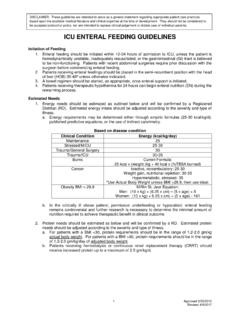
Transcription of Canadian Clinical Practice Guidelines 2015
1 Canadian Clinical Practice Guidelines 2015 Summary of Revisions to the Recommendations 1 May 25th 2015 # Topic Number of new RCTs Recommendation compared to 2013 2015 Recommendation 2013 Recommendation same upgraded downgraded n/a (new section) 1. The Use of enteral nutrition vs. Parenteral nutrition 4 X When considering nutrition support for critically ill patients, we recommend the use of enteral nutrition over parenteral nutrition in patients with an intact gastrointestinal tract. When considering nutrition support for critically ill patients, we strongly recommend the use of enteral nutrition over parenteral nutrition . 2. Early vs. delayed nutrient intake 0 X No changes from 2013. We recommend early enteral nutrition (within 24-48 hours following admission to ICU) in critically ill patients.
2 Nutritional Prescription: Use of Indirect Calorimetry vs. Predictive Equations 0 X No changes from 2013. There are insufficient data to make a recommendation on the use of indirect calorimetry vs. predictive equations for determining energy needs for nutrition or to guide when nutrition is to be supplemented in critically ill patients. Nutritional Prescription of enteral nutrition : Achieving Target Dose of enteral nutrition 2 X When starting enteral nutrition in critically ill patients, strategies to optimize delivery of nutrients (starting at target rate, volume-based feeding strategiesWhen starting enteral nutrition in critically ill patients, strategies to optimize delivery of nutrients (starting at target rate, higher threshold of gastric residual volumes, use of prokinetics and small bowel feedings) should be considered.)
3 , higher threshold of gastric residual volumes, use of prokinetics, concentrated feeding solutions and small bowel feedings) should be considered. Canadian Clinical Practice Guidelines 2015 Summary of Revisions to the Recommendations 2 May 25th 2015 # Topic Number of new RCTs Recommendation compared to 2013 2015 Recommendation 2013 Recommendation same upgraded downgraded n/a (new section) Intentional Underfeeding: Trophic Feeds vs Full Feeds 0 X No changes from 2013. In patients with Acute Lung Injury, an initial strategy of trophic feeds for 5 days should not be considered Intentional Underfeeding: Hypocaloric enteral nutrition 3 X Intentional underfeeding of calories (not protein) should be considered in patients at low nutrition -risk. However, this recommendation does not apply to patients at high nutrition risk.
4 There are insufficient data to make a recommendation on the use of hypocaloric enteral nutrition in critically ill patients. Composition of EN: Diets Supplemented with Arginine and Select Other Nutrients* 1 X No changes from 2013. We do not recommend diets supplemented with arginine and other select nutrients be used for critically ill patients. (i) Composition of EN: Fish Oils, Borage Oils and Antioxidants 1 X No changes from 2013. The use of an enteral formula with fish oils, borage oils and antioxidants in patients with Acute Lung Injury (ALI) and Acute Respiratory Distress Syndrome (ARDS) should be considered. (ii) Composition of EN: Fish oil supplementation 1 X No changes from 2013. There are insufficient data to make a recommendation on the supplementation of fish oils alone in critically ill patients Canadian Clinical Practice Guidelines 2015 Summary of Revisions to the Recommendations 3 May 25th 2015 # Topic Number of new RCTs Recommendation compared to 2013 2015 Recommendation 2013 Recommendation same upgraded downgraded n/a (new section) Composition of EN: Immune Enhancing Diets: Glutamine 3 X We recommend that enteral glutamine NOT be used in critically ill patients.
5 enteral glutamine should be considered in burn and trauma patients. There are insufficient data to support the routine use of enteral glutamine in other critically ill patients. We caution against the use of any glutamine in patients with shock and MOF given the possibility of harm as demonstrated by the results of the REDOXS study of combined enteral and parenteral glutamine. Composition of EN: Immune Enhancing Diets: Ornithine Ketoglutarate (OKG) 0 X No changes from 2013. There are insufficient data to make a recommendation regarding the use of ornithine ketoglutarate for burn patients and other critically ill patients. Composition of EN: (Carbohydrate/fat): High fat/low CHO 0 X No changes from 2013. There are insufficient data to recommend high fat/low CHO diets for critically ill patients.
6 Composition of EN: (Carbohydrate/fat): Low fat/high CHO 0 X No changes from 2013. There are insufficient data to recommend low fat/high CHO diets for critically ill patients. Composition of EN: High Protein vs. Low Protein 1 X No changes from 2013. There are insufficient data to make a recommendation regarding the use of high protein diets for head injured patients and other critically ill patients. Canadian Clinical Practice Guidelines 2015 Summary of Revisions to the Recommendations 4 May 25th 2015 # Topic Number of new RCTs Recommendation compared to 2013 2015 Recommendation 2013 Recommendation same upgraded downgraded n/a (new section) Strategies for optimizing and minimizing risks of EN: Protein vs. Peptides 0 X No changes from 2013.
7 When initiating enteral feeds, the use of whole protein formulas (polymeric) should be considered. Composition of enteral nutrition : pH 0 X No changes from 2013. There are insufficient data to make a recommendation regarding the use of low pH feeds in critically ill patients. Composition of enteral nutrition : Fibre 1 X No changes from 2013. There are insufficient data to support the routine use of fibre (soluble or insoluble) in enteral feeding formulas in critically ill patients. Strategies to Optimize Delivery and Minimize Risks of EN: Feeding Protocols 2 X A feeding protocol should be considered that incorporates strategies to optimize delivery of enteral nutrition in critically ill adult patients. An evidence based feeding protocol that incorporates prokinetics at initiation and a higher gastric residual volume (250 mls) and the use of post pyloric feeding tubes, should be considered as a strategy to optimize delivery of enteral nutrition in critically ill adult patients.
8 Strategies to Optimize Delivery and Minimize Risks of EN: Motility Agents 0 X No changes from 2013. In critically ill patients who experience feed intolerance (high gastric residuals, emesis), we recommend the use of a promotility agent. Given the safety concerns associated with erythromycin, the recommendation is made for metoclopramide. There are insufficient data to make a recommendation about the combined use of metoclopramide and erythromycin. Canadian Clinical Practice Guidelines 2015 Summary of Revisions to the Recommendations 5 May 25th 2015 # Topic Number of new RCTs Recommendation compared to 2013 2015 Recommendation 2013 Recommendation same upgraded downgraded n/a (new section) Strategies to Optimize Delivery and Minimize Risks of EN: Small Bowel Feeding vs.
9 Gastric 1 X No changes from 2013. Based on 11 level 2 studies, small bowel feeding compared to gastric feeding may be associated with a reduction in pneumonia in critically ill patients. In units where small bowel access is feasible, we recommend the routine use of small bowel feedings. In units where obtaining access involves more logistical difficulties, small bowel feedings should be considered for patients at high risk for intolerance to EN (on inotropes, continuous infusion of sedatives, or paralytic agents, or patients with high nasogastric drainage) or at high risk for regurgitation and aspiration (nursed in supine position). Finally, where obtaining small bowel access is not feasible (no access to fluroscopy or endoscopy and blind techniques not reliable), small bowel feedings should be considered for those select patients that repeatedly demonstrate high gastric residuals and are not tolerating adequate amounts of EN intragastrically.
10 Canadian Clinical Practice Guidelines 2015 Summary of Revisions to the Recommendations 6 May 25th 2015 # Topic Number of new RCTs Recommendation compared to 2013 2015 Recommendation 2013 Recommendation same upgraded downgraded n/a (new section) Strategies to optimize delivery and minimize risks of enteral nutrition : Body position 0 X No changes from 2013. Based on 1 level 1 and 1 level 2 study, we recommend that critically ill patients receiving enteral nutrition have the head of the bed elevated to 45 degrees. Where this is not possible, attempts to raise the head of the bed as much as possible should be considered. Strategies to Optimize the Delivery of EN: Threshold of Gastric Residual 1 X A gastric residual volume of either 250 or 500 mLs (or somewhere in between) and frequency of checking residuals either q4 or q8 hrs should be considered as a strategy to optimize delivery of enteral nutrition in critically ill patients.