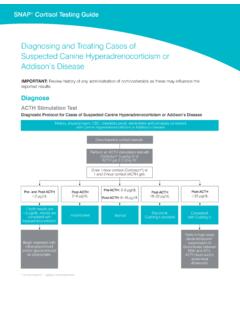
Transcription of Canine low dose dexamethasone suppression test protocol
1 1. Feldman EC, Nelson RW ed. Canine and Feline Endocrinology and Reproduction, 3rd Edition, 2004 ABN 67303247931 53 Glenvale Crescent Mulgrave Vic 3170 8003 Clayton Vic 3800 1300 838 522 Fax: (+61) 03 9562 0055 Canine low dose dexamethasone suppression test Test Use This protocol can be used as an aid in diagnosing and confirming clinical suspicions of hyperadrenocorticism (Cushing s syndrome) in dogs. If results of pituitary-adrenal testing confirm hyperadrenocorticism, the LDDST results can also be used as an aid in discriminating between pituitary and adrenal dependant hyperadrenocorticism. Note: Although the LDDST is the preferred method of confirming hyperadrenocorticism in dogs, no test is perfect and hence results should always be interpreted in light of the clinical picture and results of other testing.
2 When dogs are chosen for a LDDST based on consistent changes in the history, physical examination and database results (clinical pathology profile, urinalysis), the sensitivity approaches 99%. When not suffering from clinical illness, < 5% of dogs with other polyuria/polydipsia syndromes (diabetes mellitus, diabetes insipidus, hypercalcaemia, chronic renal failure) have abnormal LDDST results. Animals with evidence of clinical illness can however have misleading LDDST results. It is hence recommended to postpone any endocrine testing in ill animals until they are stable. protocol Patient preparation. The animal should preferably be fasted before collection. Pituitary-adrenal function testing is best performed in a healthy, non-stressed animal.
3 Given the circumstances leading to testing, this is rarely achievable, however, minimizing stress/illness is nonetheless recommended. Note also therapy with corticosteroids can alter the pituitary-adrenal axis, hence where possible should be avoided, especially in the previous 48-72 hours. i) Collect blood into a plain or SST for a baseline cortisol and clearly label as the resting or 0 hr sample. ii) Administer mg/kg of dexamethasone IV iii) Collect post- dexamethasone blood into a plain or SST and again clearly label with appropriate time. Samples should be collected at both 4 hours and 8 hours post- dexamethasone administration iv) Submit all three samples (resting, 4 hour and 8 hour post- dexamethasone ) together to the laboratory for testing.
4