Transcription of Carboguard 890 - Carboline
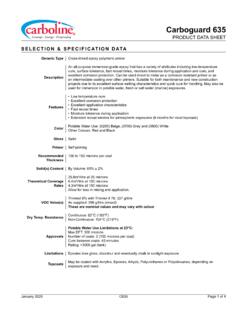
1 Carboguard 890 PRODUCT DATA SHEET January 2019890 Page 1 of 4 SELECTION & SPECIFICATION DATA Generic TypeCycloaliphatic Amine Epoxy DescriptionHighly chemical resistant epoxy mastic coating with exceptionally versatile uses in all industrialmarkets. Self-priming and suitable for application over most existing coatings, and tightly adherentto rust. Serves as stand-alone system for a variety of chemical environments and is also designedfor various immersion conditions. Features Excellent chemical resistance Surface tolerant characteristics Conventional and low-temperature versions Self-priming and primer / finish capabilities Very good abrasion resistance VOC compliant to current AIM regulations Suitable for use in USDA inspected facilities ColorRefer to Carboline Colour Guide.
2 Certain colours may require multiple coats for hiding. FinishGloss (70-85) PrimerSelf-priming. Dry Film Thickness 100 to 150 m per coat150 to 200 m Over light rust and for uniform gloss over inorganic zincs. Do not exceed 250microns in a single coat. Excessive film thickness over inorganic zincs may increase damage duringshipping or erection. Solid(s) ContentBy volume 75% 2% Theoretical /litre at 100 /litre at 125 /litre at 150 mAllow for loss in mixing and application VOC Value(s)Thinner # 2:10% - 276g/lThinner # 33: 10% - 291g/lAs supplied: 217g/lUse Thinner # 76 up to 5% for Carboguard 890 where non-photochemically reactive solvents arerequired.
3 These are nominal values and may vary with colour. Dry Temp. Resistance Continuous: 149 CNon-Continuous: 177 CDiscolouration and loss of gloss occurs above 93 C but does not affect performance. Under InsulationResistance Continuous: 149 CDiscolouration and loss of gloss occurs above 93 C but does not affect performance. LimitationsDo not apply over latex coatings. For immersion projects, use only factory made material in specialcolours. Consult Technical Service for lose gloss, discolour and eventually chalk in sunlight 890 PRODUCT DATA SHEET January 2019890 Page 2 of 4 SUBSTRATES & SURFACE preparation GeneralSurface must be clean and dry. Remove all dirt, dust, oil and all other contaminants.
4 SteelImmersion: ISO 8501 Sa2 Non-immersion: ISO 8501 Sa2 40 to 75 m ISO 8501 St2 or St3 are suitable cleaning methods for mild environments. Galvanized SteelPrime with specific Carboline primers as recommended by your Carboline sales to the specific primer s Product Data Sheet for requirements. Concrete or CMUC oncrete must be cured 28 days at 25 C and 50% relative humidity or equivalent. Prepare surfacesin accordance with ASTM D4258 Surface Cleaning of Concrete and ASTM D4259 AbradingConcrete. Voids in concrete may require surfacing. Mortar joints should be cured a minimum of 15days. Drywall & PlasterJoint compound and plaster should be fully cured prior to coating application.
5 Previously PaintedSurfacesLightly sand or abrade to roughen surface and degloss the surface. Existing paint must attain aminimum 3A rating in accordance with ASTM D3359 X-Cut adhesion DATA (TYPICAL VALUES) Test MethodSystemResultsAbrasion (ASTM D4060)Blasted steel 1ct Epoxy Pr 1 ct. 89085mg loss after 1000 cycles,CS17 wheel 1000gm loadAdhesion (ASTM D3359)Blasted steel 1 ct. 8905 AFlame & Smoke (ASTM E84)2 cts. 8905 Flame 5 Smoke Class APencil Hardness (ASTM D3363 Blasted steel 2cts. 890 Greater than 8 HSalt Fog (ASTM B117)Blasted steel 1 ct. IOZ 1 ct. 890No effect on plane, no rust in scribeand no undercutting after 4000 hoursSalt Fog (ASTM B117)Blasted steel 2 cts.)
6 890No effect on plane, rust in scribe. at scribe after 2000 hoursScrub Resistance (ASTM D2486)Blasted steel 1 ct. 89093% gloss retained after 10,000cycles w/ liquid scrub medium Test reports and additional data available upon written & THINNING MixingPower mix separately, then combine and power mix. DO NOT MIX PARTIAL KITS. ThinningSpray: Up to 10% with Thinner # 2 Brush: Up to 12% with Thinner # 33 Roller: Up to 12% with Thinner # 33 Carboline Thinner # 33 can be used for spray in hot / windy conditions. Use of thinners other thanthose supplied or recommended by Carboline may adversely affect product performance and voidproduct warranty, whether expressed or implied.
7 * See VOC values for thinning limits. Ratio1:1 Ratio (A to B) Pot Life3 Hours at 25 C. Pot life ends when coating loses body and begins to sag. Pot life times will be lessat higher 890 PRODUCT DATA SHEET January 2019890 Page 3 of 4 APPLICATION EQUIPMENT GUIDELINES Listed below are general equipment guidelines for the application of this product. Job site conditions may require modificationsto these guidelines to achieve the desired results. Spray ApplicationThis is a high solids coating and may require adjustments in spray techniques. Wet film thickness iseasily and quickly achieved. Conventional SprayPressure pot equipped with dual regulators, 10mm minimum material hose, fluid tip andappropriate air cap.
8 Airless SprayPump Ratio: 45:1 (min*)GPM Output: (min)Material Hose: 10mm (min)Tip Size: .017 Output PSI: 2100-2300 Filter Size: 60 mesh* Teflon packings are recommended and available from the pump manufacturer. Brush & Roller(General)Multiple coats may be required to obtain desired appearance, recommended dry film thickness andadequate hiding. Avoid excessive re-brushing or rerolling. For best results, tie-in within 10 minutesat 25 C. BrushUse a medium bristle brush. RollerUse a short-nap synthetic roller cover with phenolic CONDITIONS ConditionMaterialSurfaceAmbientHumidityM inimum10 C (50 F)10 C (50 F)10 C (50 F)0%Maximum32 C (90 F)52 C (126 F)43 C (109 F)90% This product simply requires the substrate temperature to be above the dew point.
9 Condensation due to substrate temperaturesbelow the dew point can cause flash rusting on prepared steel and interfere with proper adhesion to the substrate. Specialapplication techniques may be required above or below normal application SCHEDULE Surface to RecoatDry to Recoat& Topcoat w/other finishesFinal Cure GeneralFinal Cure Immersion10 C (50 F)12 Hours24 Hours3 DaysNR16 C (61 F)8 Hours16 Hours2 Days10 Days24 C (75 F)4 Hours8 Hours1 Day5 Days32 C (90 F)2 Hours4 Hours16 Hours3 Days Relative Humidity: 50%Higher film thickness, insufficient ventilation or cooler temperatures will require longer cure times and could result in solvententrapment and premature failure.
10 Excessive humidity or condensation on the surface during curing can interfere with the cure,can cause discoloration and may result in a surface haze. Any haze or blush must be removed by water washing before high humidity conditions, it is recommended that the application be done while temperatures are increasing. Maximumrecoat / topcoat times are 30 days for epoxies and 90 days for polyurethanes at 25 C. If the maximum recoat times havebeen exceeded, the surface must be abraded by sweep blasting or sanding prior to the application of additional 890 PRODUCT DATA SHEET January 2019890 Page 4 of 4 CLEANUP & SAFETY CleanupUse Thinner # 2. In case of spillage, absorb and dispose of in accordance with local applicableregulations.