Transcription of Caregiver PCAFc Eligibiity FAQs
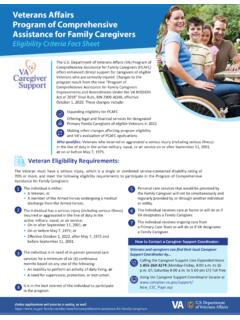
1 July 31, 2020 1 Department of Veterans Affairs Program of Comprehensive Assistance for Family Caregivers Final Rule Eligibility Criteria for Serious Injury and In Need of Personal Care Services Frequently Asked Questions has VA revised the eligibility criteria for the Program of Comprehensive Assistancefor Family Caregivers ( PCAFc ) with respect to the definitions of serious injury and inneed of personal care services ?Under VA s final rule, Veterans (to include qualifying service members) will have to meet both of the following criteria to be eligible for PCAFc . Among other applicable eligibility criteria, the Veteran must: a)have a single or combined service-connected disability rating by the Department ofVeterans Affairs (VA) of 70% or more. This requirement is included in thedefinition of serious injury; andb)be in need of personal care services (requiring in-person personal care services) for aminimum of six continuous months based on any one of the following:oan inability to perform an activity of daily living (ADL)oa need for supervision, protection, or : Definitions for serious injury, in need of personal care services, inability to perform an ADL, and need for supervision, protection, or instruction, are provided in responses to questions 2, 4, 6, and 8, respectively.
2 Did VA revise the definition of serious injury?Under the final rule, the term serious injury, is defined to mean any service-connected disability that is: a)Rated at 70% or more by VA; orb)Combined with any other service-connected disability or disabilities, and a combined ratingof 70% or more is assigned by includes any service-connected disability regardless of whether it resulted from an injury, illness, or disease. The serious injury would have to be incurred or aggravated in the line of duty in the active military, naval, or air service: a)On or after September 11, 2001;b)Effective on the expansion date specified in a future Federal Register document, on or beforeMay 7, 1975*; orc)Effective two years after the expansion date specified in a future Federal Register document,after May 7, 1975 and before September 11, 2001**.* Expansion of PCAFc to eligible Veterans who incurred or aggravated a serious injury in the lineof duty in the active military, naval, or air service on or before May 7, 1975, will begin when theJuly 31, 2020 2 Secretary of Veterans Affairs certifies to Congress that a required information technology system has been fully implemented in October 2020.
3 ** Expansion of PCAFc to eligible Veterans who incurred or aggravated a serious injury in the line of duty in the active military, naval, or air service between May 7, 1975 and September 11, 2001, will begin two years after the date the Secretary of Veterans Affairs certifies to Congress that a required information technology system has been fully implemented. 3. Is PCAFc eligibility based solely on the 70% VA disability rating? No. Having a qualifying serious injury is only one component of PCAFc eligibility. 4. How does VA define in need of personal care services ? Under the final rule, this means that the eligible Veteran requires in-person personal care services from another person, and without such personal care services, alternative in-person caregiving arrangements (including respite care or assistance of an alternative Caregiver ) would be required to support the eligible Veteran s safety. 5. Does the qualifying serious injury have to be connected to the Veteran s need for personal care services?
4 Under the final rule, VA will no longer require a connection between the need for personal care services and the qualifying serious injury. VA believes decoupling serious injury and the need for personal care services is necessary, as in most cases, the eligible Veteran has multiple conditions that may warrant a need for personal care services. Veterans needs may be so complex that it can be difficult to determine what specific condition out of many causes the need for personal care services. For example, an individual may have leg pain due to a service-connected spinal cord injury but be able to manage his or her symptoms. After a number of years, the individual is diagnosed with diabetes unrelated to his or her military service. Over time, the individual develops neuropathy in his or her lower extremities, which results in the individual being unable to complete his or her ADLs independently. The onset of neuropathy could be related to either the spinal cord injury or diabetes.
5 6. How does VA define a Veteran s inability to perform an ADL? Under the final rule, inability to perform an ADL means the Veteran or servicemember requires personal care services each time he or she completes one or more of the ADLs listed below. Requiring assistance with an ADL only some of the time does not constitute an inability to perform an ADL under this definition. VA considers the following ADLs when determining PCAFc eligibility: a) Dressing or undressing oneself; b) Bathing; c) Grooming oneself in order to keep oneself clean and presentable; d) Adjusting any special prosthetic or orthopedic appliance, that by reason of the particular disability, cannot be done without assistance (this does not include the adjustment of July 31, 2020 3 appliances that nondisabled persons would be unable to adjust without aid, such as supports, belts, lacing at the back, etc.); e) Toileting or attending to toileting; f) Feeding oneself due to loss of coordination of upper extremities, extreme weakness, inability to swallow, or the need for a non- oral means of nutrition; g) Mobility (walking, going up stairs, transferring from bed to chair, etc.
6 7. Is a Veteran s eligibility impacted if the qualifying ADL is not performed every day? VA recognizes that not all ADLs need to be performed on a daily basis. For example, bathing is included in the definition of inability to perform an ADL but may not be required every day. An eligible Veteran may be able to maintain health and wellness by adhering to a less frequent bathing routine. Therefore, VA defines an inability to perform an ADL to mean that the individual requires personal care services each time he or she completes one or more qualifying ADLs. 8. How does VA define need for supervision, protection, or instruction ? Under the final rule, this means that an individual has a functional impairment that directly impacts the individual s ability to maintain his or her personal safety on a daily basis. This definition focuses on functional impairment instead of specific symptoms and diagnoses. VA will not be restricted in which functional impairments it considers for purposes of this definition.
7 The following examples were provided in the supplementary information of VA s March 6, 2020, proposed rule to explain this shift in focus: a) A Veteran with dementia may be physically capable of washing his or her hands or taking a bath but may be unable to use the appropriate water temperature and may thus require step- by-step instruction or sequencing in order to maintain his or her personal safety on a daily basis. b) A Veteran with schizophrenia who has active delusional thoughts that lead to unsafe behavior ( , setting a fire, walking into traffic) may require another individual to provide supervision or instruction to ensure his or her personal safety on a daily basis. 9. Why does VA now define serious injury to include illnesses and diseases? VA s explanation of this change is set forth in the final rule. Among other things, VA explained the challenges VA has experienced with the current definition of serious injury, including inconsistent eligibility determinations by VA providers, and potential challenges associated with alternative approaches.
8 VA believes that, to the extent the statutory language allows, the statute should be construed in a manner that minimizes the potential for complex and time-consuming eligibility determinations and disparate treatment of Veterans with similar service-connected conditions and similar medical needs arising from those conditions. The most equitable and reasonable approach to resolving these challenges is to recognize any service-connected disability as an injury for purposes of PCAFc . In doing so, the term serious injury accounts for the signature disabilities of earlier conflicts, including illnesses and diseases, such as diseases presumed to be the result of herbicide exposure in Vietnam and other places and chronic multi-symptom illness experienced by Persian Gulf Veterans. Caregivers of Veterans with illnesses and diseases incurred or aggravated in the line of duty, regardless of service era, will benefit from PCAFc assistance in the same manner as caregivers of Veterans with July 31, 2020 4 injuries, such as traumatic brain injury and spinal cord injury.
9 Along with the other changes in this definition, VA believes the new definition of serious injury supports transparency in PCAFc eligibility decisions and improves understanding by Veterans, service members, and their caregivers.