Transcription of Castles: Overview - BBC
1 Castles: OverviewContentsLearning Outcomes and Curriculum LinksPage 2 Overview of learning outcomes and links to UK Castles: Background Information and imagesPage 3 Background information about Norman castles, ideal for introducingthe subject to the Activity: Where s the best place to build a castle ?Page 5A short interactive activity to introduce why and where castles were on Activity 1: Build a Norman CastlePage 8 Instructions for a creative session to build a motte and bailey castle ,including on Activity 2: Design a Norman castle FlyerPage 13 Use sourcing, researching and creative skills to advertise a Norman and Review QuestionsPage 15 Note: For more background information on the Norman invasion and the Battle of Hastings,please see the Battle of Hastings lesson key Teacher guidance.
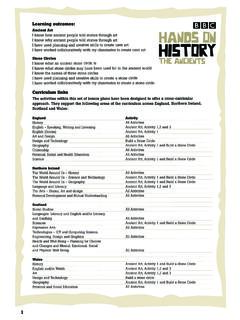
2 Instructions, informationand support to help you run your lesson. Class resources to be handed out to pupilsor put on your interactive whiteboard. Suggested timings for the session. These can beadapted for the age and skills of your class. The Hands on activities can be extended into outcomes:I know where Normans built know why Normans built know what a Norman motte and bailey castle know all of the key parts of a motte and bailey know how to research a local have used planning and creative skills to build a castle /design a have worked collaboratively with my classmates to build a castle /design a LinksThe activities within this set of lesson plans have been designed to offera cross-curricular approach.
3 They support the following areas of the curriculumacross England, Northern Ireland, Scotland and Wales:EnglandActivityHistory (The Norman invasion)All ActivitiesEnglishHands on Activity 2 Art and DesignHands on Activity 1 and 2 Design and TechnologyHands on Activity 1 and 2 GeographyIntroductory ActivityNorthern IrelandThe World Around Us HistoryAll ActivitiesThe World Around Us Science and TechnologyHands on Activity 1 The World Around Us GeographyIntroductory activityLanguage and LiteracyHands on Activity 2 The ArtsHands on Activity 1 and 2 ScotlandSocial Studies (The Medieval Wars of Independence)
4 AllActivitiesLiteracy and EnglishHands on Activity 2 Expressive ArtsHands on Activity 2 SciencesHands on Activity 1 Social StudiesHands on Activity 2 WalesHistory (The Age of Princes)All ActivitiesEnglish and/or WelshHands on Activity 2 Art and DesignHands on Activity 1 and 2 Design and TechnologyHands on Activity 1 GeographyIntroductory Activity Castles2 Teacher IntroductionThe Norman motte and bailey castles were quick to construct. William probably broughtthree ready-made wooden towers with him from Normandy to erect at Pevensey,Hastings and Dover (a bit like a flat-pack kit!)
5 The original settlements were strong, but were also easy to attack and burn rams could be used on the wooden fences around the bailey and planks of woodplaced over the ditches so soldiers could just climb inside. Later many parts of the castlesand fences were rebuilt out of stone to make them stronger and more difficult to burn can still see many of these stone ruins (mound) a large mound of earth, had steep sides to make it difficult for attackersto run up and attack the castle . The motte wasn t a natural hill, but was man-made.
6 Mottesranged from 25 to 80 foot high. To create the motte at Tonbridge castle 50,000 tonnesof earth were (compound) a simple enclosure filled with residential wooden buildings,animals and food that ranged from one to three acres in size. The bailey enclosurewas also surrounded by a wooden palisade (defensive wall) which often had a walkwayhalf-way up so that soldiers could keep the motte and bailey were surrounded by a ditch often filled with water and,in some cases, sections of rivers were diverted into it. On the opposite side of the motteto the bailey thorn bushes and brambles were added to deter (lookout tower and central strong point) On top of the motte a timbertower (later replaced in stone) was built to be the strong point of the castle and theresidence of its owner, usually an important Norman nobleman.
7 The tower was surroundedby a wooden palisade (defensive wall). From the top of the tower you could see anypotential characteristics: Large and intimidating for local Anglo-Saxon residents Usually a square centre with four corner turrets and a stone walkway for soldiersto keep watch including spaces to fire arrows through. Very thick walls which made it difficult to use a battering ram to attack. The entrance was on the first floor with stairs that could be knocked downif the castle was threatened. When people were attacking a stone keep they would use a trebuchet (siege engine)to fire large boulders at the walls.
8 As the walls were square it was also possible to diga tunnel through the motte up to the corner of the tower, using wood to stop the tunnelcollapsing, they would then fill the tunnel with material such as pig fat and set it on fire would burn the central wooden buildings and make the tower the next page is an image of Clifford s Tower a fantastic Norman motte and baileycastle remains are still visible today. Also included is an original Hands on Historyillustration showing how a Norman castle would originally have looked.
9 You canuse these images on your interactive white board or as hand-outs to introducethe subject. Castles: Background Information3 Clifford s Tower4 Where s the Best Place to Build a castle ?1. Introduce Norman castles, using the Background Information notes and imagesincluded in this Discuss as a class whether or not the physical geography of a particular placeis important to deciding where to build a Ask the class to imagine they are William, Duke of Normandy s engineers who designedand built his castles to secure the local area after their battle with the them to imagine that Norman spies have sent descriptions of potential places tobuild castles along the Put the Location Cards on the interactive white board or print out and shareas a As you look at each image together ask the class to point out good and bad pointsof each location for building their Use the Teacher Guidance Notes to ensure each key point is Once you have discussed each
10 Image, draw conclusions together on ideal This activity is a great starter before building your own motte and bailey castle (Hands on activity 1) or designing flyers for local castle sites (Hands on activity 2). Castles: Introductory Activity45mins5 Image A The site has a good view of the sea and any potential invaders. The cliffs would make it difficult for an invader to land unnoticed. An invader could not climb up the cliff face easily. People living inland could see the castle which would act as a warning to B Nearby woodland would provide wood for building and fires.