Transcription of Catecholaminergic Polymorphic What are the Ø …
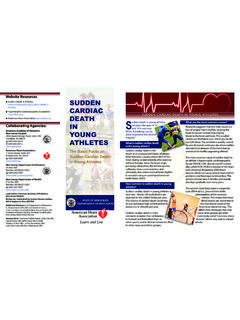
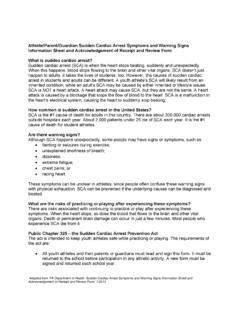
1 1 sudden CARDIAC ARREST (SCA) AWARENESS FORM The Basic Facts on sudden Cardiac Arrest Website Resources: American Heart Association: Lead Author: Arn old Fenrich, MD and Benjamin Levine, MD Additional Reviewers: UIL Medical Advisory Committee Revised 2016 What is sudden Cardiac Arrest? Occurs suddenly and often withoutwarning. An electrical malfunction (short-circuit) causes the bottom chambersof the heart (ventricles) to beatdangerously fast (ventriculartachycardia or fibrillation) anddisrupts the pumping ability of theheart. The heart cannot pump blood to thebrain, lungs and other organs of thebody. The person loses consciousness(passes out) and has no pulse. Death occurs within minutes if nottreated immediately. What causes sudden Cardiac Arrest?
2 Inherited (passed on from family) conditions present at birth of t he heart muscle: Hypertrophic Cardiomyopathy hypertrophy (thickening) of the left ventricle; the most common cause of sudden cardiac arrest in athletes in the Arrhythmogenic Right Ventricular Cardiomyopathy replacement of part of the right ventricle by fat and scar; the most common cause of sudden cardiac arrest in Italy. Marfan Syndrome a disorder of the structure of blood vessels that makes them prone to rupture; often associated with very long arms and unusually flexible joints. Inherited conditions present at birth of the electrical system: Long QT Syndrome abnormality in the ion channels (electrical system) of the heart. Catecholaminergic Polymorphic Ventricular Tachycardia and Brugada Syndrome other types of electrical abnormalities that are rare but run in families.
3 NonInherited (not passed on from the family, but still present at birth) conditions: Coronary Artery Abnormalities abnormality of the blood vessels that supply blood to the heart muscle. This is t he second most common cause of sudden cardiac arrest in athletes in the Aortic valve abnormalities failure of the aortic valve (the valve between the heart and the aorta) to develop properly; usually causes a loud heart murmur. Non -compaction Cardiomyopathy a condition where the heart muscle does not develop normally. Wolff -Parkinson-White Syndrome an extra conducting fiber is present in the heart s electrical system and can increase the risk of arrhythmias. Conditions not present at birth but acquired later in life: Commotio Cordis concussion of the heart that can occur from being hit in the chest by a ball, puck, or fist.
4 Myocarditis infection or inflammation of the heart, usually caused by a virus. Recreational/Performance-Enhancing drug use. Idiopathic: Sometimes the underlying cause of the sudden Cardiac Arrest is unknown, even after autopsy. What are the symptoms/warning signs of sudden Cardiac Arrest? Fainting/blackouts (especiallyduring exercise) Dizziness Unusual fatigue/weakness Chest pain Shortness of breath Nausea/vomiting Palpitations (heart is beatingunusually fast or skipping beats) Family history of sudden cardiacarrest at age < 50 ANY of these symptoms and warning signs that occur while exercising may necessitate further evaluation from your physician before returning to practice or a game. What is the treatment for sudden Cardiac Arrest? Time is critical and an immediate response is vital.
5 CALL 911 Begin CPR Use an Automated ExternalDefibrillator (AED)What are ways to screen for sudden Cardiac Arrest? The American Heart Association recommends a pre-participation history and physical including 14 important cardiac elements. The UIL Pre -Participation Physical Evaluation Medical History form includes ALL 14 of these important cardiac elements and is mandatory annually. 2 What are the current recommendations for screening young athletes? The University Interscholastic League requires use of the specific Preparticipation Medical History form on a yearly basis. This process begins with the parents and student-athletes answering questions about symptoms during exercise (such as chest pain, dizziness, fainting, palpitations or shortness of breath); and questions about family health history.
6 It is important to know if any family member died suddenly during physical activity or during a seizure. It is also important to know if anyone in the family under the age of 50 had an unexplained sudden death such as drowning or car accidents. This info rmation must be provided annually because it is essential to identify those at risk for sudden cardiac death. The University Interscholastic League requires the Preparticipation Physical Examination form prior to junior high athletic participation and again prior to the 1st and 3rd years of high school participation. The required physical exam includes measurement of blood pressure and a careful listening examination of the heart, especially for murmurs and rhythm abnormalities. If there are no warning signs reported on the health history and no abnormalities discovered on exam, no additional evaluation or testing is recommended for cardiac issues/concerns.
7 Are there additional options available to screen for cardiac conditions? Additional screening using an electrocardiogram (ECG) and/or an echocardiogram (Echo) is readily available to all athletes from their personal physicians, but is not mandatory, and is generally not recommended by either the American Heart Association (AHA) or the Ame rican College of Cardiology (ACC). Limitations of additional screening include the possibility (~10%) of false positives , which leads to unnecessary stress for the student and parent or guardian as well as unnecessary restriction from athletic participation. There is also a possibility of false negatives , since not all cardiac conditions will be identified by additional screening. When should a student athlete see a heart specialist?
8 If a qualified examiner has concerns, a referral to a child heart specialist, a pediatric cardiologist, is recommended. This specialist may perform a more thorough evaluation, including an electrocardiogram (ECG), which is a graph of the electrical activity of the heart. An echocardiogram, which is an ultrasound test to allow for direct visualization of the heart structure, may also be done. The specialist may also order a treadmill exercise test and/or a monitor to enable a longer recording of the heart rhythm. None of the testing is invasive or uncomfortable. Can sudden Cardiac Arrest be prevented just through proper screening? A proper evaluation (Preparticipation Physical Evaluation Medical History) should find many, but not all, conditions that could cause sudden death in the athlete.
9 This is because some diseases are difficult to uncover and may only develop later in life. Others can develop following a normal screening evaluation, such as an infection of the heart muscle from a virus. This is why a medical history and a review of th e famil y health history nee d to be performed on a yearly basis. With proper screening and evaluation, most cases can be identified and prevented. Why have an AED on site during sporting events The only effective treatment for ventricular fibrillation is immediate use of an automated external defibrillator (AED). An AED can restore the heart back into a normal rhythm. An AED is also life -saving for ventricular fibrillation caused by a blow to the chest over the heart (commotio cordis).
10 Texas Senate Bill 7 requires that at any school sponsored athletic event or team practice in Texas public high schools the following must be available: An AED is in an unlocked locationon school property within areasonable proximity to the athleticfield or gymnasium All coaches, athletic trainers, PEteacher, nurses, band directors andcheerleader sponsors are certified incardiopulmonary resuscitation(CPR) and the use of the AED. Each school has a developed safetyprocedure to respond to a medicalemergency involving a American Academy of Pediatrics recommends the AED should be placed in a central location that is accessible and ideally no more than a 1 to 1 1 /2 minute walk from any location and that a call is made to activate 911 emergency system while the AED is being retrieved.