Transcription of ccountability to Affected Populations
1 A ccountability to A ffected Populations Making humanitarian action more effective credit: IRIN/Jodi Hiltion, OCHA/Christophe Verhellen, OCHA/NicoleLawrnece, OCHA/Pierre Peron IASC Taskforce on Accountability to Affected Populations : Co-Chaired by WFP and World Vision International IASC AAP Tools |2. Page 3. The Commitments on AAP. 4-5. Summary of Key IASC Decisions on AAP. 1. The Accountability Analysis and Planning Tool 6-12. A synthesis of key industry standards and frameworks, namely the HAP Standard, the Sphere Core Standards, the People In Aid Code, the Global Humanitarian Platform's Principles of Partnership and CDA's Do No Harm Framework with the draft IASC. operational framework and accountability commitments to form a meta- framework for understanding in greater depth what each of the commitments should mean in practice.
2 2. The AAP Self-assessment Tool 13-20. The self-assessment tool breaks down each of the indicators within the analysis and planning tool to provide practical assistance for any user group to understand and measure them. 3. The Rapid Cluster Accountability Review Tool 21-23. This brief tool provides some key and focused areas for assessment from an HCT, cluster, or interagency perspective. IASC Taskforce on Accountability to Affected Populations IASC AAP Tools |3. The IASC Commitments on Accountability to Affected Populations (CAAP). The Commitments on AAP. In December 2011, the IASC Principals endorsed the following 5 commitments: Leaders of humanitarian organizations2 will undertake to: Leadership/Governance: Demonstrate their commitment to accountability to Affected Populations by ensuring feedback and accountability mechanisms are integrated into country strategies, programme proposals, monitoring and evaluations, recruitment, staff inductions, trainings and performance management , partnership agreements, and highlighted in reporting.
3 Transparency: Provide accessible and timely information to Affected Populations on organizational procedures, structures and processes that affect them to ensure that they can make informed decisions and choices, and facilitate a dialogue between an organisation and its Affected Populations over information provision. Feedback and complaints: Actively seek the views of Affected Populations to improve policy and practice in programming, ensuring that feedback and complaints mechanisms are streamlined, appropriate and robust enough to deal with (communicate, receive, process, respond to and learn from) complaints about breaches in policy and stakeholder dissatisfaction. Participation: Enable Affected Populations to play an active role in the decision-making processes that affect them through the establishment of clear guidelines and practices to engage them appropriately and ensure that the most marginalised and Affected are represented and have influence.
4 Design, monitoring and evaluation: Design, monitor and evaluate the goals and objectives of programmes with the involvement of Affected Populations , feeding learning back into the organisation on an ongoing basis and reporting on the results of the process. 1. Tools developed by FAO in consultation with the IASC Sub Group on Accountability to Affected Populations and with the input of participating Quality and Accountability Initiatives and humanitarian agencies as noted below. 2. Excepting the Red Cross and Red Crescent movement, who have their own commitments in place IASC Taskforce on Accountability to Affected Populations IASC AAP Tools |4. Summary of Key IASC Decisions on AAP. At their meeting in April 2011, the IASC Principals acknowledged the fundamental importance of accountability to Affected Populations . They agreed to integrate accountability to Affected Populations into their individual agencies' statements of purpose as well as their policies.
5 Further, they requested that the Sub Group on Accountability to Affected Populations (part of the IASC Cluster Sub Working group and comprising a diverse representation of UN agencies, NGOs and quality and accountability initiatives), develop a proposal for inter-agency mechanisms that would enable improved participation, information provision, feedback and complaints handling. The Sub Group compiled a draft operational framework through collaboration with a wide group of stakeholders, in addition to drawing from current industry standards on accountability and quality in humanitarian work, in particular, the Sphere Minimum Standards3 and the HAP 2010 Standard in Accountability and Quality Management4. The framework aims to highlight some of the bottom line . accountability activities and indicators that should be in place at each stage of the project cycle.
6 As a complement to the framework, the Principals endorsed the statement of accountability commitments in December 2011, also prepared by the Sub Group. The CAAP aims to establish a shared understanding of the broad tenets of accountability to Affected Populations and is intended for integration within policy, guiding documentation and practice. Over the course of three meetings in 2011, in February, April and December, the IASC Principals therefore discussed the issue of accountability to Affected Populations in some depth and made a number of binding decisions, complementary to the CAAP,. Members of the IASC are committed to: Incorporate the Commitments on Accountability to Affected Populations (CAAP) into all relevant statements, policies and operational guidelines and to promote them with operational partners, within the HCT and amongst cluster members.
7 Establish a clear organizational statement of commitments to AAP. Develop a plan and put these commitments into practice, including incorporating them in staff inductions and clearly within agreements made with operational partners, ensuring that roles and responsibilities are clearly defined. Systematically include participation of Affected population in all needs assessment (in conjunction with the rolling out of the NATF consolidated needs assessment approach), as well as monitoring, review and evaluation processes (including IA-RTE). Include Affected Populations in programme/operations planning and review. Facilitate the provision of feedback from Affected people on the services and protection offered by their agencies, including a complaints mechanism. Provide information to Affected people about services and support available in local languages and ensure that in any new disaster, information on the emergency situation, availability and nature of humanitarian 3.
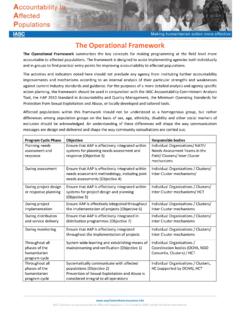
8 4. IASC Taskforce on Accountability to Affected Populations IASC AAP Tools |5. responses is systematically communicated to Affected Populations using relevant communication mechanisms. Designate a senior focal point on protection from sexual exploitation and abuse (PSEA), develop a PSEA. work plan and report back on progress. Tools to aid in meeting the commitments Measuring and monitoring progress against the commitments and the operational framework The commitments are clear as to the key areas where attention should be focussed. The draft operational framework sets out the basis for a practical plan of action covering each stage of the project cycle for individual agencies and collectively across the IASC membership. The following tools are intended as a bridge between the two: planning aids for agencies and clusters to travel from the general guidance of the commitments to the detail of a tailored and prioritised operational framework at an individual or inter-agency level, as aids to assist in monitoring progress, and in educating stakeholders in what is involved in accountability to Affected Populations .
9 These tools were initially developed at FAO and then shared widely for comment and input. In addition to feedback from colleagues in peer UN agencies WFP and UNICEF, the tools reflect detailed input generously offered by the following agencies: ALNAP (Active Learning Network for Accountability and Performance). infoasaid (consortium of Internews and BBC Media Action). CDA Collaborative Learning Projects (incl Do No Harm and The Listening Project). People In Aid The Sphere Project HAP (the Humanitarian Accountability Partnership). IASC Taskforce on Accountability to Affected Populations IASC AAP Tools |6. Purpose of the Tool Understanding where an organisation, a network of organisations, a cluster or other coordination mechanism, is at with respect to current and accepted industry standards and expectations is a first step in identifying strengths and gaps in policy and practice, and in mapping out a way forward that is realistic, achievable, sustainable and that will bring real gains.
10 The analysis and planning tool represents a selective synthesis of key industry standards and frameworks, namely the HAP Standard, the Sphere Core Standards, the People In Aid Code, the Global Humanitarian Platform's Principles of Partnership5 and CDA's Do No Harm Framework6 with the draft IASC operational framework and accountability commitments to form a meta-framework for understanding in greater depth what each of the commitments should mean in practice. It highlights some of the basic and globally agreed upon fundamentals of quality and accountability in humanitarian service delivery, forming a contemporary answer to the question, if accountability to Affected Populations was being done well, what would that look like? This tool is not in itself an industry standard, however, it draws upon the core and common themes and issues across the standards that apply directly or indirectly to the concept of accountability to Affected Populations and borrows heavily from the indicators and requirements therein to guide measurement of performance and current status.