Transcription of CDA INFANT/TODDLER SAMPLE CURRICULUM
1 C. Mincemoyer, , Better Kid Care Program DirectorSupported and produced with funds from the Office of Child Development and Early Learning, a joint office of the Pennsylvania Departments of Education and Public Welfare, and the Penn State Cooperative Extension Better Kid Care Program. 341 North Science Park Road - Suite 208, State College, PA 16803; Phone 1-800-452-9108. Web site: 2012 The Pennsylvania State UniversityVisit Penn State Extension on the web: publication is available in alternative media on Pennsylvania State University is committed to the policy that all persons shall have equal access to programs, facilities, admission, and employment without regard to personal charac-teristics not related to ability, performance, or qualifications as determined by University policy or by state or federal authorities. It is the policy of the University to maintain an academic and work environment free of discrimination, including harassment.
2 The Pennsylvania State Uni-versity prohibits discrimination and harassment against any person because of age, ancestry, color, disability or handicap, national origin, race, religious creed, sex, sexual orientation, gender identity or veteran status. Discrimination or harassment against faculty, staff or students will not be tolerated at The Pennsylvania State University. Direct all inquiries regarding the nondis-crimination policy to the Affirmative Action Director, The Pennsylvania State University, 328 Boucke Building, University Park, PA 16802-2801, Tel (814) 865-4700/V, (814) 863-1150 INFANT/TODDLER SAMPLE CURRICULUMCDA INFANT/TODDLER SAMPLE CURRICULUMCDA INFANT/TODDLER SAMPLE CURRICULUM ..1 CDA 1 ..3 CDA 2 ..4 CDA 3 ..6 CDA 4 ..8 CDA 5 ..9 CDA 6 ..10 CDA 7 ..11 CDA 8 ..12 CDA INFANT/TODDLER SAMPLE CURRICULUM1 CDA INFANT/TODDLER SAMPLE CURRICULUM The CDA INFANT/TODDLER SAMPLE CURRICULUM provides a suggested list of specific lessons to take in completing the required 120 formal education hours needed for the CDA credential we organized the lessons for you so you didn t have to!
3 CDA candidates use this option if desired or can put together their own list of lessons to meet the required 120 hours. For more information, visit and click on Child Development Associate (CDA). THE LESSONS ( CURRICULUM )The Better Kid Care CDA INFANT/TODDLER SAMPLE CURRICULUM :l Is organized by the eight CDA Subject Areas as defined by the CDA Council for Professional Recognition (outlined below)l Reflects the CDA Functional Areas as defined by the CDA Council for Professional Recognition (outlined below.) l Contains Better Kid Care professional developmento Includes Lessons by Mail and On Demand (online) lessons that meet the required 120 hours of formal education hours needed to apply for the CDA credential, including the minimum required 10 hours in each subject area. THE READINGSA long with completing the 120 hours of professional development lessons, there are Readings included in the CDA INFANT/TODDLER CURRICULUM . The Readings are short articles that embrace and extend the CDA learning process.
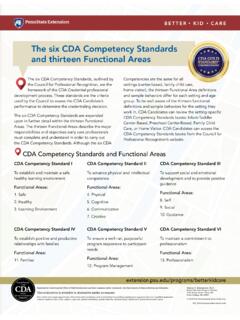
4 These research based articles provide in-depth information relevant to working with children and families, increasing your knowledge in child development, and better preparing you for the CDA CDA SUBJECT AREASCDA 1 Planning a safe and healthy learning environmentCDA 2 Steps to advance children s physical and intellectual developmentCDA 3 Positive ways to support children s social and emotional developmentCDA 4 Strategies to establish productive relationships with familiesCDA 5 Strategies to manage an effective program operationCDA 6 Maintaining a commitment to professionalism CDA 7 Observing and recording children s behaviorCDA 8 Principles of Child Development and learningCDA INFANT/TODDLER SAMPLE CURRICULUM2 Lessons and Readings: hr. = number of hours OD = Lessons in On Demand (online) M= Lessons by MailNotes:13 CDA FUNCTIONAL AREAS (extended knowledge of the subject areas)Functional Area 1: Safe Candidate provides a safe environment to prevent and reduce Area 2: Healthy Candidate promotes good health and nutrition and provides an environment that contributes to the prevention of illness.
5 Functional Area 3: Learning Environment Candidate uses space, relationships, materials, and routines as resources for constructing an interesting, secure, and enjoyable environment that encourages and fosters trust, play, exploration, interaction, and Are 4: Physical Candidate provides a variety of developmentally appropriate equipment, learning experiences, and teaching strategies to promote the physical development (fine motor and gross motor) of Area 5: Cognitive Candidate provides activities and opportunities that encourage curiosity, explortation, and problem-solving appropriate to the developmental levels and learning styles of children. Functional Area 6: Communication Candidate actively communicates with children and provides opportunities and support for children to understand, acquire, and use verbal and nonverbal means of communicating thoughts and feelings. Functional Area 7: Creative Candidate provides opportunities that encourage children to play with sound, rhythm, language, materials, space, and ideas in individual ways and to express their creative abilities.
6 Functional Area 8: Self Candidate provides a warm, positive, supportive relationship with each child, and helps each child learn about and take pride in his or her individual and cultural identity. Functional Area 9: Social Candidate helps each child feel accepted in the group, helps children learn to communicate and get along with others, and encourages feelings of empathy and mutual respect among children and Area 10: Guidance Candidate provides a supportive environment and uses effective strategies to help all children learn and practice appropriate and acceptable behaviors as individuals and as a group, and effectively provides support for children with persistent challenging Area 11: Families Candidate establishes a positive, cooperative relationship with each child s family, engages in two-way communication with families, encourages their involvement in the program, and supports the child s relationship with his or her family. Functional Area 12: Program Management Candidate is a manager who uses all available resources to ensure an effective operation.
7 The candidate is a competent organizer, planner, record keeper, communicator, and a cooperative Area 13: Professionalism Candidate makes decisions based on knowledge of research-based early childhood practices, promotes high-quality child care services, and takes advantage of opportunities to improve knowledge and competence, both for personal and professional growth and for the benefit of children and families. CDA INFANT/TODDLER SAMPLE CURRICULUM3 Lessons and Readings: hr. = number of hours OD = Lessons in On Demand (online) M= Lessons by MailNotes:CDA INFANT/TODDLER SAMPLE CURRICULUM (2012) 120 HOURSAll lessons can be accessed from the Better Kid Care Distance Education page Lessons and Readings hr. = number of hours OD = Lessons in On Demand (online) M= Lessons by MailCDA 1 Planning a safe, healthy, learning environment (15 hours)Safe Lessonsl your # 1 Priority: Keeping Children Healthy and Safe (2 hr. OD & M)l The Ups and Downs of Outdoor Play (2 hr.)
8 M)Readingsl Be Vigilant for Children - Recognizing Signs of Abuse ( )l Safe Sleeping for Babies ( )HealthyLessonsl Super Snacks (1 hr. OD)l Snack Time = Learning Time (2 hr. OD)l Prevent Childhood Obesity with Healthy Eating (2 hr. OD)l Eating Times: The Ups and Downs (2 hr. M)Readingsl Sweet Dreams Part 1: Thinking about Sleep ( )l Sweet Dreams Part 2: Sleep Recommendations ( )l Move On: Reversing Children s Sedentary Lifestyles Part 1 ( )l Keep Kids Healthy ( )l Stress: Seeing with Optimism ( )CDA INFANT/TODDLER SAMPLE CURRICULUM4 Lessons and Readings: hr. = number of hours OD = Lessons in On Demand (online) M= Lessons by MailNotes:Learning Environment (CDA 1)Lessonsl Changing Spaces (2 hr. M)l Improving Transition Times (2 hr. M)Readingsl Infant Environment: Let s Take a Closer Look ( )l Creating a Peaceful Environment for Young Children ( )l Creating a Sense of Place: Considering Routine, Ritual, and Belonging ( )l Outdoor Spaces ( )l Rock on!
9 Creating Rock Gardens with Young Children ( )CDA 2 Steps to advance children s physical and intellectual development (16 hours)Physical Lessonsl Fighting Children s Obesity Through Active Play (2 hr. M OD)l Active Kids are Learning Kids (2 hr. M )Readingsl Brain Dance Part 1: Children s Natural Explorations through Movement ( )l Brain Dance Part 2: Awareness of Movement, Awareness of Learning ( )l Lots of Active Play ( )l Move On: Reversing Children s Sedentary Lifestyles Part 2 ( )CDA INFANT/TODDLER SAMPLE CURRICULUM5 Lessons and Readings: hr. = number of hours OD = Lessons in On Demand (online) M= Lessons by MailNotes:Cognitive (CDA 2)Lessonsl Understanding and Supporting Children s Physical and Cognitive Development (2 hr. OD & M)l What Does Brain Research tell us About Infant Care? (2 hr. OD & M)l What Does Time Mean to Children? (2 hr. OD)Readingsl Intentional Early Language Development ( )l Creating Opportunities for English Language Learners: 4 Action Plans ( )l Talking with Babies ( )l Developmental Language Suggestion ( )l The Language Connection ( )l See, Scribble, Print: Encouraging Young Children to Make their Mark ( )l Early Literacy: 10 Views to Contemplate ( )Communication (CDA 2)Lessonsl Communicating With Children (2 hr.)
10 M)Readingsl Our Words Matter ( )l Tips on Communicating ( )l Caregiver Sensitivity: The capacity to recognize and respond to children s needs ( )CDA INFANT/TODDLER SAMPLE CURRICULUM6 Lessons and Readings: hr. = number of hours OD = Lessons in On Demand (online) M= Lessons by MailNotes:Creative (CDA 2)Lessonsl Art Appreciation 101 for Young Children (2 hr. M)l Sparking Kids Curiosity (2 hr. OD & M)Readings l Art Wonderful! ( )l Children s Art ( )l The Joy of Music! ( )l Painting with Young Children: There s More to the Picture ( )l Play With Clay ( )CDA 3 Positive ways to support children s social and emotional development (24 hours)SelfLessonsl See as a Child, Feel as a Child (2 hr. M)l All by Myself: Self Help Skills in Child Care (1 hr. OD)l Creating the Bond Attachment (1 hr. OD)Readingsl Self Regulation: Searching Intentional Practices - Part 1 ( )l Self Regulation: Searching Intentional Practices - Part 2 ( )l Giving Children Choices ( )l Entering and Sustaining Play ( )l Toilet Learning ( )CDA INFANT/TODDLER SAMPLE CURRICULUM7 Lessons and Readings: hr.