Transcription of CEL 41 (2008) - Gender-based violence action plan
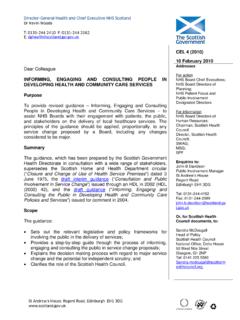
1 Abcde abc a Healthcare Policy and Strategy Directorate Patients and Quality Division abcdefghijklmnopqrstu CEL 41 (2008) 29th September 2008 Addresses For action Chief Executives, NHS Boards Chief Executives, Special Health Boards For information Chief Executives, Local Authorities Scottish Partnership Forum SWAG COSLA Dear Colleague Gender-based violence action plan Summary 1. The Annex to this letter sets out expectations for Boards to develop a 3 year action plan (2008 2011) to address gender based violence and supersedes previous guidance issued in 2003 Domestic Abuse Guidelines for Healthcare Workers in NHS Scotland.
2 action 2. Chief Executives must ensure that: this letter and the attached guidance are brought to the attention of, and implemented by, all appropriate staff and in particular ensure that they develop and deliver a 3 year action plan with specific and measurable goals across the priority areas identified; and contact details for a senior member of the Executive team appointed to lead on this area of work are passed to Katie Cosgrove by 17 October (see panel for contact details).
3 3. This plan will address the following 4 key areas: Implementation of Routine Enquiry of abuse within priority settings Dissemination of revised guidance on abuse for staff. Production of an employee policy on Gender-based violence . Multi-agency collaboration. 4. Undertaking this work will assist Boards meet their legislative obligations to promote gender equality as detailed in the Equality Act 2006. To facilitate this process we have agreed a package of support including the appointment of a national team, the development of a suite of resources and tools, and funding to promote the plan internally within each board 5.
4 An evaluation of this work will take place over the 3 year implementation period. Yours sincerely DEREK FEELEY Enquiries to: Sandra Falconer St Andrew s House Regent Road Edinburgh EH1 3DG Tel: 0131-244 2399 Fax: 0131-244 2989 or Katie Cosgrove National Programme Manager Tel: 0141 201 4971 Gender-based violence action plan guidance FOR HEALTH BOARDS A. INTRODUCTION 1. This guidance details our aims and objectives in relation to tackling Gender-based violence over the next 3 years, the contribution of health boards towards realising these, and the support available to do so.
5 Some further explanatory notes on Gender-based violence and routine enquiry of abuse are included in Appendices 1 and 2 of the guidance . B. BACKGROUND 2. Addressing Gender-based violence falls within our legislative obligations to promote gender equality as detailed in the Equality Act (2006), and within our responsibility to implement both the cross governmental Strategic Framework on violence Against Women and the Strategic Approach for Survivors of Childhood Sexual Abuse. The National Domestic Abuse Delivery plan for Children and Young People developed under the auspices of Getting It Right for Every Child (GIRFEC) also includes a range of actions that have implications for the NHS, in particular the inclusion of a programme of routine enquiry of domestic abuse.
6 3. As a profound public health issue it is also an important part of our endeavour to address health inequalities as identified in Better Health, Better Care and in Equally Well, the report issued by the Ministerial Task Force on Health Inequalities. 4. Gender-based violence encompasses the spectrum of abuse experienced disproportionately by women and perpetrated predominantly by men domestic abuse, rape and sexual assault, childhood sexual abuse, sexual harassment, stalking, commercial sexual exploitation, and harmful traditional practices such as female genital mutilation (FGM), forced marriage and so-called honour crimes.
7 Given the range of health problems associated with abuse, its impact on health services is substantial and cuts across the majority of health service settings. The NHS has a pivotal role in the appropriate identification and management of this issue since virtually all survivors of abuse, both female and male, will interact with health services at some point, either on their own or on their children s behalf. 5. NHSS cotland is committed to making tangible, sustainable progress in tackling this issue.
8 To do so we intend to adopt an incremental approach over the next 3 years, concentrating on the areas and settings where presentations of people affected by Gender-based violence are highest, and which work closely with the most vulnerable people within our communities. The priority areas for attention will therefore be mental health, sexual & reproductive health, A&E, primary care, addictions, and maternity services. Appropriate linkage with work on child protection and homelessness will also be prioritised given the overlaps with these areas.
9 6. Most health boards have made some inroads in relation to domestic abuse but progress on other forms of abuse is more fragmented. The focus of this 1 guidance is to consolidate these gains and establish a co-ordinated and consistent national approach to the identification and management of Gender-based violence . It outlines the minimum requirements essential to realise the goal of an NHS that understands and discharges its responsibility in this important area. C. AIM AND OBJECTIVES OF guidance Aim 7.
10 Our aim is to adopt a systems approach to ensure that the NHS in Scotland fully recognises and meets its responsibilities around Gender-based violence as a service provider, employer and partner agency. Objectives 8. The scale of the task and the existing pressures upon health services require the adoption of an incremental approach to change, hence the decision to prioritise the areas of Mental Health, Sexual & Reproductive Health, A&E, Addictions, Primary care, Addictions, and Maternity services. Linkage with work on Homelessness and Child Protection will also be included in this approach.