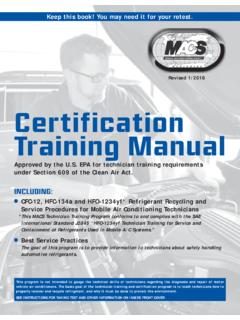
Transcription of Certification Training Manual
1 Keep this book! You may need it for future reference. Revised 05/2021. Certification Training Manual Approved by the EPA for technician Training requirements under Section 609 of the Clean Air Act. INCLUDING: CFC-12, HFC-134a and HFO-1234yf* Refrigerant Recycling and Service Procedures for Mobile Air Conditioning Technicians * This MACS Technician Training Program conforms to and complies with the SAE International Standard J2845 HFO-1234yf Technician Training for Service and Containment of Refrigerants Used in Mobile A/C Systems.. Best Service Practices The goal of this program is to provide information to technicians about safely handling automotive refrigerants. This program is not intended to gauge the technical skills of technicians regarding the diagnosis and repair of motor vehicle air conditioners. The basic goal of the technician Training and Certification program is to teach technicians how to properly recover and recycle refrigerant, and why it must be done to protect the environment.
2 SEE INSTRUCTIONS FOR TAKING TEST AND OTHER INFORMATION ON INSIDE FRONT COVER. Certification Training Manual . Important Notes! Do not mix up tests or exchange tests with other individuals at your place of business. All tests are coded with names matching assigned numbers. Please review your test upon completion. Any questions marked with more than one answer will be scored as in- correct. Any question not marked will be scored as incorrect. Completely fill in the block ( ) to the left of the correct answer. Do NOT mark with a check (4) or an x (7). General Information and Instructions You have registered for MACS Certification in REFRIGERANT RECYCLING & SERVICE PROCEDURES FOR MO- BILE AIR CONDITIONING TECHNICIANS. Following are the steps* necessary for you to complete the prescribed Training : * The following instructions apply to technicians taking the MACS Training course by mail or online.
3 Those participating in a classroom program should follow the instructions of their trainer/proctor. Tests given in a classroom setting must be closed-book tests. The required score for passing closed- book tests is lower than that required for passing the open-book test. 1. Read the instruction Manual that came with your recovery/recycling service equipment (and review the Training video, if provided). Then read this Manual cover to cover. Re-read as necessary to gain full compre- hension of the material presented. 2. Take the test. The test is an untimed, open-book test, so you may refer to the Training Manual as often as nec- essary to research answers to the questions posed. (Note, however, that you must correctly answer a minimum of 21 of the 25 questions to earn Certification .) You must complete the test by yourself, without assistance from anyone, and submit it for scoring.
4 (See 4 below.). 3. Complete and sign the Identification and Statement of Testing Conditions block on your test. Note: A reprint charge will be incurred if information provided is not legible. 4. Mail your test in the self-addressed envelope provided to: MACS-EIF, Box 88, Lansdale, PA 19446. 5. MACS-EIF will advise MACS of your test results. 6. MACS will advise you of your score and, providing that you have attained a passing score, will issue a cer- tificate and a wallet-sized card, indicating that you have successfully completed this MACS Certification Training program. Enclosed: Test with identification information to be mailed to scoring facility. Self-addressed return envelope (MACS-EIF). Important - Please note: Tests must be returned for scoring within 90 days of the date they are issued. MACS as- sumes no responsibility for tests submitted for scoring after this 90-day period.
5 MACS will charge an additional fee for re-issuing tests which are lost, misplaced or destroyed. Note: The MACS office is open from 8:30 until 5:00 Eastern Time. 2021 MOBILE AIR CLIMATE SYSTEMS ASSOCIATION. Certification Training Manual This publication is protected under the copyright laws MACS makes no representations or warranties concern- of the United States and all other applicable interna- ing the information contained herein or the applications tional laws and treaties. All rights are reserved, includ- described or referred to in this publication. MACS spe- ing resale rights. No part of this publication may be cifically disclaims any implied warranties, including the reproduced or transmitted in any form, by any means warranties of merchantability or fitness for any particu- (electronic, photocopying, recording, or otherwise) lar purpose.
6 MACS shall in no event be liable for any loss without the prior written permission of Mobile Air Cli- of profit, business interruption or any other commercial mate Systems Association (MACS). damage, including without limitation, special, inciden- tal, consequential, or other damages arising out of the Unauthorized use, reproduction or distribution of this use or inability to use the presentations or applications publication, or any portion of it, may result in severe described or referred to herein. civil and criminal penalties, and will be prosecuted to the maximum extent possible under the law. If you received The identification of any product, technique, firm or this publication from anyone other than MACS, then you business entity in this publication does not constitute have received a pirated copy. We would appreciate it if an endorsement by MACS.
7 Any company names, prod- you would notify us of the situation. ucts, product names, emblems, logos, images, trade- marks, service marks or trade dress appearing in this The information contained in this publication is based publication are the property of their respective owners on technical data and tests, and is intended for use by and are used solely in an editorial fashion. All such persons with technical skill at their own discretion and items are protected under federal laws of the United risk. While the author(s) and publisher have made every States and international agreements; unauthorized use reasonable effort to insure the accuracy of the infor- is prohibited. mation in this publication, they assume no responsibil- ity for errors or omissions. Please remember that your If you wish to contact MACS about this publication, particular situation may differ from any examples illus- please refer to the information listed below.
8 Trated here, and so you should adjust your use of the information and any recommendations in this publica- tion accordingly. Box 88. 225 S. Broad Street Lansdale, PA, 19446. Voice: 215-631-7020 Fax: 215-631-7017. E-mail: Website: MACS and the MACS logo are registered trademarks of the Mobile Air Climate Systems Association. All Rights Reserved. Printed in the 1990 - 2021 Mobile Air Climate Systems Association 2021 Mobile air climate Systems Association I. Certification Training Manual Foreword World vehicle manufacturers are currently required to meet international regulatory requirements to use lower global warming potential (GWP) refrigerants in new vehicle A/C systems. This MACS Technician Training Program conforms to and complies with the SAE International standard J2845, HFO-1234yf Technician Training for Service and Containment of Refrigerants Used in Mobile A/C Systems.
9 Some of the practices, techniques, procedures, tools, information and equipment required to service HFO-1234yf and other alternative refrigerant systems are different from those commonly used on CFC-12 and HFC-134a systems. No technician should perform service or repair on a mobile air conditioning system without being trained to handle the refrigerant the system contains. While SAE standards are voluntary and developed through industry consensus, historically the Environmental Protection Agency has incorporated SAE standards into federal regulations by reference. Additionally, some individual states require compliance with SAE standards, particularly those related to safety. For example, many states refer to SAE J639, Safety Standards for Motor Vehicle Refrigerant Vapor Compression Systems in various laws and regulations.
10 MACS acknowledges and thanks the EPA, SAE International, and the industry's many manufacturers and suppliers who allowed their data and products to appear in this Manual . Standard J639: Safety Standards for Motor Vehicle Refrigerant Vapor Compression Systems Issuing Committee: SAE International Interior Climate Control Steering Committee This SAE Standard applies to refrigerant vapor compression systems that provide cooling and/or heating for passenger cars, light trucks and commercial vehicles (on and off road) that use automotive type mobile air con- ditioning (MAC) systems. Large trucks, buses and other vehicles that do not use typical automotive A/C systems or use refrigerants not listed in this document are not covered by this standard. This standard covers any vehicle with a MAC system using a belt or electric motor driven compressor.