Transcription of Ch. 19 Study Guide AP US History Theme: Summary
1 Ch. 19 Study Guide AP US History Drifting Toward Disunion 1854-1861. Theme: A series of major North-South crises in the late 1850s culminated in the election of the antislavery Republican Lincoln to the presidency in 1860. His election caused seven southern states to secede from the union and form the Confederate States of America. Summary : The 1850s were punctuated by successive confrontations that deepened sectional hostility until it broke out in the Civil War. Harriet Beecher Stowe's Uncle Tom's Cabin fanned northern antislavery feeling.
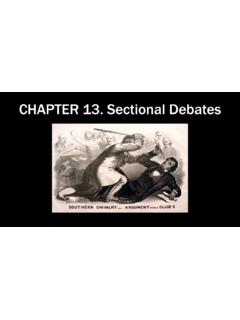
2 In Kansas, proslavery and antislavery forces fought a bloody little preview of the Civil War. Buchanan's support of the proslavery Lecompton Constitution alienated moderate northern Democrats like Douglas. Congressman Brooks' beating of senator Sumner aroused passions in both sections. The 1856 election signaled the rise of the sectionally based Republican Party. The Dred Scott case delighted the South, while northern Republicans pledged defiance. The Lincoln-Douglas debates of 1858 deepened the national controversy over slavery. John Brown's raid on Harpers Ferry made him a heroic martyr in the North but caused outraged southerners to fear a slave uprising.
3 The Democratic Party split along sectional lines, allowing Lincoln to win the four-way 1860. election. Seven southern states quickly seceded and organized the Confederate states of America. As southerners optimistically cast off their ties to the hated North, lame-duck President Buchanan proved unable to act. The last-minute Crittenden Compromise effort failed because of Lincoln's opposition. Key Terms: Harriet Beecher Stowe Dred Scott decision Uncle Tom's Cabin Roger B. Taney Hinton R. Helper Panic of 1857. The Impending Crisis of the South Lincoln-Douglas debates New England Emigrant Aid Society Freeport Doctrine John Brown Harpers Ferry raid Pottawatomie Creek massacre John C.
4 Breckenridge "Bleeding Kansas" Constitutional Union party Lecompton Constitution John Bell Sumner-Brooks affair Abraham Lincoln James Buchanan Jefferson Davis John C. Freemont Crittenden Compromise American (Know-Nothing) party Thought Provokers:: 1. How did "bleeding Kansas" serve as a preview of the Civil War? 2. Lincoln-Douglas debates: Compare and Contrast the two candidates in the Illinois senatorial election of 1858 and their positions on slavery in new territories. How did the debates affect the slavery controversy and the election of 1860?
5 3. The U. S. government had a History of avoiding secession with the passage of several compromises. Relate the Crittenden Compromise to these legislative landmarks. Why did this diplomatic/democratic solution fail in 1860-1861? Identification Supply the correct identification for each numbered description. _____ 1. A powerful, personal novel that altered the course of American politics _____ 2. Book by a southern writer that argued that slavery oppressed poor whites _____ 3. Rifles paid for by New England abolitionists and brought to Kansas by antislavery pioneers _____ 4.
6 Term that described the territory where a small-scale civil war erupted in 1856. _____ 5. Tricky proslavery document designed to bring Kansas into the Union but blocked by Stephen A. Douglas _____ 6. Anti-immigrant party headed by former President Fillmore that competed with republicans and Democrats in the election of 1856. _____ 7. Controversial Supreme Court ruling that blacks had no rights and that Congress could not prohibit slavery in the territories _____ 8. Sharp economic decline that increased northern demands for a high tariff and convinced southerners that the North was economically vulnerable _____ 9.
7 Thoughtful political discussions during an Illinois Senate campaign that sharply defined national issues concerning slavery _____ 10. Middle-of-the-road party of elderly politicians that sought compromise in the 1860 but carried only three border states _____ 11. First states to secede from the Union in December 1860. _____ 12. A new political entity that proclaimed its independence in Montgomery, Alabama, in 1861. _____ 13. A last-ditch plan to save the Union by providing guarantees for slavery in the territories _____ 14. Four-way race for the presidency that resulted in the election of a sectional minority president _____ 15.
8 Period between Lincoln's election and his inauguration, during which the ineffectual President Buchanan remained in office Putting Things in Order Put the following events in correct order by numbering them from 1 to 5. ____ A black slave's attempt to win freedom produces a controversial Supreme Court decision ____ A newly organized territory becomes a bloody battleground between proslavery and antislavery forces ____ The hanging of a financially violent abolitionist makes him a martyr in the North and a hated symbol in the South ____ A black Republican whose minority sectional victory in a presidential election provokes southern secession ____ The fictional tale of a black slave's vicious treatment by the cruel Simon Legree touched millions of
9 Northerners' hearts and creates stronger opposition to slavery ____ A group of states calling itself a new southern nation declares its independence and chooses its first president Matching People, Places and Events Match the person, place or event in the left column with the proper description in the right column by inserting the correct letter on the blank line. ____1. Harriet Beecher Stowe A. Southern congressman whose bloody attack on a northern senator fueled sectional hatred ____2. Hinton R. Helper B. Leading northern Democrat whose ____3.
10 New England Emigrant Aid Company presidential hopes fell victim to the conflict over slavery ____4. John Brown C. Black slave whose unsuccessful attempt to ____5. James Buchanan win his freedom deepened the sectional controversy ____6. Charles Sumner D. Former United States senator who in 1861. ____7. Preston Brooks became the president of what called itself a new nation ____8. John C. Fremont E. The little woman who wrote the book that ____9. Dred Scott made this great war (the Civil War). ____10. Harpers Ferry, Virginia F. Fanatical and bloody-minded abolitionist martyr admired in the North and hated in the ____11.