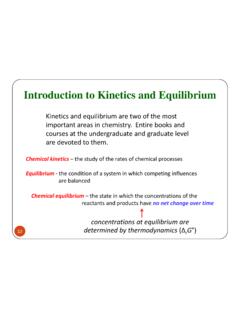
Transcription of Chapter 05 - Thermochemistry
1 1 Chapter 5 ThermochemistryLearning Outcomes: Interconvert energy units Distinguish between the system and the surroundings in thermodynamics Calculate internal energy from heat and work and state sign conventions of these quantities Explain the concept of a state function and give examples Calculate Hfrom Eand P V Relate qpto Hand indicate how the signs of qand Hrelate to whether a process is exothermic or endothermic Use thermochemical equations to relate the amount of heat energy transferred in reactions in reactions at constant pressure ( H) to the amount of substance involved in the reactionHeatEnergy used to cause the temperature of an object to used to cause an object that has mass to F d Energyis the ability to do work or transfer heat.
2 Thermodynamicsis the study of energy and its transformations. Thermochemistryis the study of chemical reactions and the energy changes that involve potential energy The most important form of potential energy in molecules is electrostatic potential energy, Eel:where k= 109J m/C2 Electron 10-19C The unit of energy commonly used is the Joule:Attraction between ions Electrostatic attraction occurs between oppositely charged ions. Energy is released when chemical bonds are formed; energy is consumed when chemical bonds are Law of Thermodynamics Energy can be converted from one form to another, but it is neither created nor destroyed. Energy can be transferred between the system and surroundings.
3 Chemical energy is converted to heat in grills. Sunlight is converted to chemical energy in green plants. There are many examples of conversion of energy from one form to and Surroundings The systemincludes the molecules of interest. The surroundingsare everything else. In Thermochemistry we study the exchangeof energy between the system and surroundings. open system matter and energy can be exchanged with the surroundings closed system - exchange energy--but not matter--with the surroundings. isolated system - neither matter nor energy may be exchanged with EnergyThe internal energy of a system is the sum of all kinetic and potential energies of all components of the system; we call it E.
4 E= Efinal EinitialBy definition, the change in internal energy, E, is the final energy of the system minus the initial energy of the system: E= Efinal Einitial E< 0, Efinal< Einitialthe system releasedenergy to the Quantities: Three Parts1) A number, 2) a unit, 3) a sign A positive E results when the system gains energy from the surroundings. A negative E results when the system loses energy to the surroundings. When energy is exchanged between the system and the surroundings, it is exchanged as either heat (q) or work (w). That is, E= q+ of Heat between System and SurroundingsWhen heat is absorbed by the system from the surroundings, the process is of Heat between System and SurroundingsWhen heat is released by the system into the surroundings, the process is FunctionsThe internal energy of a system is independent of the path by which the system achieved that energy, E, is a state Functionsqand ware notstate functions.
5 Eis the same whether the battery is shorted out or is discharged by running the fan. qand ware different in the two P V1L atm= atm= 13148 ExampleCalculate the work (in J) associated with the expansion of a gas from 44 mL to 63 mL at a constant pressure of 14 Enthalpy is a thermodynamic function equal to the internal energy plus pressure volume:H= E+ PVWhen the system changes at constant pressure, the change in enthalpy, H, is H= (E+ PV)This can be written H= E+ P VSince E= q+ wand w= P V, we can substitute these into the enthalpy expression: H= E+ P V H= (q+w) w H= qThe enthalpy change, H, is defined as the heat gained or lost by the system under constant pressure.
6 H= qp15169 Properties of Enthalpy1. Enthalpy is a state Enthalpy is an extensive Enthalpy is reversible. The enthalpy change for a reaction is equal in magnitude, but opposite in sign, to H for the reverse reaction. 4. Hfor a reaction depends on the stateof the products and the stateof the and Exothermic A process is endothermicwhen His positive (>0). A process is exothermicwhen His negative (<0). H = Hfinal Hinitialor H = Hproducts HreactantsEnthalpies of ReactionThis quantity, H, is called the enthalpy of reaction, or the heat of thermochemical equationis an equation for which His given:2 H2(g) + O2(g) 2 H2O(l) H= kJH2(g) + O2(g) H2O(l) H= kJThe enthalpy changes assume the coefficients are moles of the substances192011 Calorimetry Calorimetry, the measurement of heat released or absorbed by a chemical reaction.
7 A calorimeter is the device used to measure heat The quantity of heat transferredby the reaction causes a change in temperatureof the Capacity and Specific Heat The amount of energy required to raise the temperature of a substance by 1 K (1 C) isits heat capacity (Cin units of J/K). We define specific heat capacity(or simply specific heat; Csor sin units of J/g K) as the amount of energy required to raise the temperature of 1 g of a substance by 1 K. If the amount is one mole, it is the molar heat s=qm TC =q T212212 Because the specific heat for water is well known ( J/g K), we can measure qfor the reaction with this equation:qsoln=Cs m T = -qrxnThe calorimeter and its contents are the surroundings, so qsolnis found from the mass, heat capacity, and temperature the heat changefor the systemConstant Pressure CalorimetryA metal pellet with mass g, originally at C, is dropped into 125 g of water originally at C.
8 The final temperature of both the pellet and the water is C. Calculate the heat capacity C (in J/ C) and specific heat capacity Cs(in J/g C) of the pellet. The specific heat of water is J/g 200. g of a AgNO3solution mixes with 150. g of NaIsolution, g of AgI precipitates, and the temperature of the solution rises by Assume 350. g of solution and a specific heat capacity of J/g oC. Calculate Hfor the following:Ag+(aq) + I-(aq) AgI(s)Bomb Calorimetry Because the volume in the bomb calorimeter is constant, what is measured is really the change in internal energy, E, not H. For most reactions, the difference is small. The heat absorbed (or released) by the water is a very good approximation of the enthalpy change for the reaction.
9 Qrxn= Ccal T252614 ExampleHess s Law His known for many reactions, but it is inconvenient to measure Hfor every reaction in which we are interested. However, we can calculate Husing published Hvalues and the properties of enthalpy. Hess s law states that If a reaction is carried out in a series of steps, Hfor the overall reaction will be equal to the sum of the enthalpy changes for the individual steps. His a state function272815 Hess s LawMost H values are labeled Ho, and measured under standard conditions P = 1 atm (but for gases P = 1 bar) T = usually K ( oC) Concentration = 1 mol/LUsing Hess s law -when two or more thermochemical equations are added, the enthalpy change of the resulting equation is the sum of those for the added (s) + O2(g) CO2(g) H= kJCO2(g) CO(g) + O2(g) H= + kJC(s) + O2(g) CO(g) H= kJGiven the thermochemical equations2WO2(s) + O2(g) 2WO3(s) H= -506 kJ2W(s) + 3O2(g) 2WO3(s) H= -1686 kJcalculate the enthalpy change for.
10 2W(s) + 2O2(g) 2WO2(s)Example293016 Enthalpies of Formation An enthalpy of formation, Hf, is defined as the enthalpy change for the reaction in which a compound is made from its constituent elements in their elemental Enthalpy of Formation Only one enthalpy value is needed for each substance, called the standard enthalpy of formation. The standard enthalpy of formation is the enthalpy change when one moleof a substance in its standard state is formed from the most stable form of the elements in their standard State Enthalpy changes depend on the temperature and pressure at which they are measured When applying Hess s law, all values must refer to the same conditions of pressure and temperature The standard state of a substance at a specified temperature is the pure form at 1 atm pressure Tabulated values for enthalpy refer to the standard state, usually at a temperature of 25oC313217 Standard Enthalpy of Formation The symbol used for standard enthalpy of formation is Hfo.