Transcription of CHAPTER 10 DRAINAGE - nra.co.za
1 CHAPTER DRAINAGE system manages both surface and subsurface water coming off the road surface and from the surrounding countryside. The purpose of the system is to ensure that the road and its surrounds are free from standing water at all times and to have sufficient capacity to prevent the road from being overtopped. The principal elements of the system are:Crossfall on the road and shoulders to permit free flow off the road. Main problems are slacks, ruts, flat or obstructed shoulders, or shoulders with edge build drains, parallel to the road, which collect run-off from both the road and countryside.
2 Main problems are standing water often caused by silting up, lack of capacity and and culverts which permit crossflow of water under the road and provide outlets for the side drains. Main problems are blockage, lack of capacity and poor drains which lead water out of side drains onto lands sloping away from the road. Main problems are blockage or ponding at the entrance of the which channelise water flow particularly into culverts. Main problems are erosion, breeching and poor off/catchwater drains situated along the crests of cuttings to reduce sheet flow down cut faces from higher lying ground and prevent cut erosion.
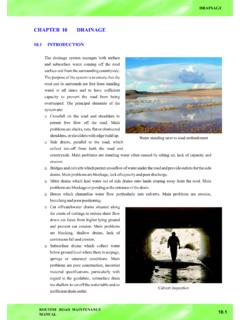
3 Main problems are blocking, shallow drains, lack of continuous fall and drains which collect water below ground level where there is seepage, springs or saturated conditions. Main problems are poor construction, incorrect material specifications, particularly with regard to the geofabric, subsurface drain too shallow to cut off the water table and an inefficient drain standing next to road embankmentCulvert inspectionDRAINAGEROUTINE ROAD berms on the road edge particularly on fills. Main problems are damaged or broken berms which result in concentrated water flow from the road onto general many road failures are caused by failure in the DRAINAGE system in combination with heavy wheel loads.
4 Even the best foundation material will fail if subjected to poor DRAINAGE . On national roads the foundation layers have, in most cases, been well designed and construction carefully supervised. It follows therefore that when road failures are repaired, care must be taken to investigate whether the DRAINAGE system is functioning road maintenance contracts, sufficient funds must be made available for the cleaning of DRAINAGE structures. The following sections describe the DRAINAGE aspects that must be attended to on an annual basis. If efficiently carried out, the work will become easier and more economical to do as the years rain presents an ideal opportunity to make sure that the DRAINAGE system is working correctly.
5 So don't stay in the office, go out on the road and observe. Where flooding of the road occurs detailed notes should be made of the location and SANRAL informed. This is particularly important where this occurs regularly and there is a likelihood that the DRAINAGE structure has insufficient capacity. The detailed inspection in loco of cut catchwater drains (ie. climb up and inspect) is essential to ensure that failures in the early stages are rectified before major damage new developments take place adjacent to the road reserve, it is essential that stormwater management is appropriate.
6 SANRAL must be informed immediately the Route Manager notices problems in this regardWater stands on the road surface or road shoulder and does not drain away. Slacks due to settlement/subsidence. Rutting in wheel tracks on flat grades. Flat or high gravel shoulders and/or windrows or vegetation on the gravel shoulder preventing DRAINAGE . Blocked weepholes/scuppers on grades, particularly at superelevation MAINTENANCESTANDING WATER (ON ROAD SURFACE)Description Causes Water standing in wheel ROAD MAINTENANCEMANUALCan be either isolated (slacks) or extensive (ruts, high shoulders and vegetation).
7 Standing water on the road surface is dangerous to traffic (aquaplaning and loss of control) and can also result in wetting up of the pavement Correctly identify the cause of the standing water. Repairs should then be carried out as described in the various sections on Road Pavement and Gravel water is a cause of pavement distress and aquaplaning. Localised problems must be addressed and chutes are mainly used to control sheetflow on the road and to ensure safe discharge into the side DRAINAGE system. Problems are associated with mechanical damage, inadequate capacity, poorly placed chutes, fill settlement or obstructions in chutes.
8 Kerbs are damaged by vehicle impact. Lack of capacity is often due to outlets being spaced too far perform poorly because they are badly aligned, have gaps because of fill settlement or carry too much water and overtop because the inlets are spaced too far in kerbs and chutes causes water to jump out of channel resulting in erosion of the road on high fills resulting in chutes not being positioned at low Response TimeRepairsCaution KERBS AND CHUTESD escription Causeslayers which normally leads to pavement failures. As a result all areas of standing water should be treated as soon as possible and especially before the start of the next wet season.
9 Where the areas are extensive this cannot be handled under routine maintenance and SANRAL should be informed immediately and warning signs erected. 11111 Asphalt berm below guardrail atchute ROAD MAINTENANCEMANUALE xtent Response Time Repairs SIDE DRAINSD escription Causes Extent Isolated problem. Should be dealt with routinely. If left too long can cause erosion, settlement and failure of the fill. Replace damaged kerbs. Check inlet spacing and where necessary place extra chutes. Check alignment and nesting of chutes and relocate where drains are important links in the road DRAINAGE system.
10 The most common problems associated with side drains are standing water, lack of capacity and erosion. Standing water on flat gradientsBlockage due to loose material (often from eroding cut faces), vegetation and blocked culverts. This is a particular problem with V-shaped earth of capacity caused by silting up with material from surrounding land or very flat/shallow drains particularly in cuts where the underlying material may be hard on steep grades and where the drain floor is in fine erodible lined sidedrains resulting in the ingress of water into the pavement activities next to or under the drains.