Transcription of Chapter 12 Introduction to Three Dimensional Geometry
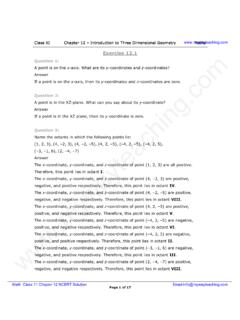
1 Class XI Chapter 12 introduction to three dimensional geometry Maths Page 1 of 17 Exercise Question 1: A point is on the x axis. What are its y coordinates and z coordinates? Answer If a point is on the x axis, then its y coordinates and z coordinates are zero. Question 2: A point is in the XZ plane. What can you say about its y coordinate? Answer If a point is in the XZ plane, then its y coordinate is zero. Question 3: Name the octants in which the following points lie: (1, 2, 3), (4, 2, 3), (4, 2, 5), (4, 2, 5), ( 4, 2, 5), ( 4, 2, 5), ( 3, 1, 6), (2, 4, 7) Answer The x coordinate, y coordinate, and z coordinate of point (1, 2, 3) are all positive. Therefore, this point lies in octant I. The x coordinate, y coordinate, and z coordinate of point (4, 2, 3) are positive, negative, and positive respectively. Therefore, this point lies in octant IV. The x coordinate, y coordinate, and z coordinate of point (4, 2, 5) are positive, negative, and negative respectively.
2 Therefore, this point lies in octant VIII. The x coordinate, y coordinate, and z coordinate of point (4, 2, 5) are positive, positive, and negative respectively. Therefore, this point lies in octant V. The x coordinate, y coordinate, and z coordinate of point ( 4, 2, 5) are negative, positive, and negative respectively. Therefore, this point lies in octant VI. The x coordinate, y coordinate, and z coordinate of point ( 4, 2, 5) are negative, positive, and positive respectively. Therefore, this point lies in octant II. The x coordinate, y coordinate, and z coordinate of point ( 3, 1, 6) are negative, negative, and positive respectively. Therefore, this point lies in octant III. The x coordinate, y coordinate, and z coordinate of point (2, 4, 7) are positive, negative, and negative respectively. Therefore, this point lies in octant VIII. Downloaded from from Class XI Chapter 12 introduction to three dimensional geometry Maths Page 2 of 17 Question 4: Fill in the blanks: Answer (i) The x axis and y axis taken together determine a plane known as.
3 (ii) The coordinates of points in the XY plane are of the form. (iii) Coordinate planes divide the space into octants. Downloaded from from Class XI Chapter 12 introduction to three dimensional geometry Maths Page 3 of 17 Exercise Question 1: Find the distance between the following pairs of points: (i) (2, 3, 5) and (4, 3, 1) (ii) ( 3, 7, 2) and (2, 4, 1) (iii) ( 1, 3, 4) and (1, 3, 4) (iv) (2, 1, 3) and ( 2, 1, 3) Answer The distance between points P(x1, y1, z1) and P(x2, y2, z2) is given by (i) Distance between points (2, 3, 5) and (4, 3, 1) (ii) Distance between points ( 3, 7, 2) and (2, 4, 1) (iii) Distance between points ( 1, 3, 4) and (1, 3, 4) (iv) Distance between points (2, 1, 3) and ( 2, 1, 3) Downloaded from from Class XI Chapter 12 introduction to three dimensional geometry Maths Page 4 of 17 Question 2: Show that the points ( 2, 3, 5), (1, 2, 3) and (7, 0, 1) are collinear.
4 Answer Let points ( 2, 3, 5), (1, 2, 3), and (7, 0, 1) be denoted by P, Q, and R respectively. Points P, Q, and R are collinear if they lie on a line. Downloaded from from Class XI Chapter 12 introduction to three dimensional geometry Maths Page 5 of 17 Here, PQ + QR = PR Hence, points P( 2, 3, 5), Q(1, 2, 3), and R(7, 0, 1) are collinear. Question 3: Verify the following: (i) (0, 7, 10), (1, 6, 6) and (4, 9, 6) are the vertices of an isosceles triangle. (ii) (0, 7, 10), ( 1, 6, 6) and ( 4, 9, 6) are the vertices of a right angled triangle. (iii) ( 1, 2, 1), (1, 2, 5), (4, 7, 8) and (2, 3, 4) are the vertices of a parallelogram. Answer (i) Let points (0, 7, 10), (1, 6, 6), and (4, 9, 6) be denoted by A, B, and C respectively. Here, AB = BC CA Thus, the given points are the vertices of an isosceles triangle. (ii) Let (0, 7, 10), ( 1, 6, 6), and ( 4, 9, 6) be denoted by A, B, and C respectively.
5 Downloaded from from Class XI Chapter 12 introduction to three dimensional geometry Maths Page 6 of 17 Therefore, by Pythagoras theorem, ABC is a right triangle. Hence, the given points are the vertices of a right angled triangle. (iii) Let ( 1, 2, 1), (1, 2, 5), (4, 7, 8), and (2, 3, 4) be denoted by A, B, C, and D respectively. Downloaded from from Class XI Chapter 12 introduction to three dimensional geometry Maths Page 7 of 17 Here, AB = CD = 6, BC = AD = Hence, the opposite sides of quadrilateral ABCD, whose vertices are taken in order, are equal. Therefore, ABCD is a parallelogram. Hence, the given points are the vertices of a parallelogram. Question 4: Find the equation of the set of points which are equidistant from the points (1, 2, 3) and (3, 2, 1). Answer Let P (x, y, z) be the point that is equidistant from points A(1, 2, 3) and B(3, 2, 1). Accordingly, PA = PB x2 2x + 1 + y2 4y + 4 + z2 6z + 9 = x2 6x + 9 + y2 4y + 4 + z2 + 2z + 1 Downloaded from from Class XI Chapter 12 introduction to three dimensional geometry Maths Page 8 of 17 2x 4y 6z + 14 = 6x 4y + 2z + 14 2x 6z + 6x 2z = 0 4x 8z = 0 x 2z = 0 Thus, the required equation is x 2z = 0.
6 Question 5: Find the equation of the set of points P, the sum of whose distances from A (4, 0, 0) and B ( 4, 0, 0) is equal to 10. Answer Let the coordinates of P be (x, y, z). The coordinates of points A and B are (4, 0, 0) and ( 4, 0, 0) respectively. It is given that PA + PB = 10. On squaring both sides, we obtain On squaring both sides again, we obtain 25 (x2 + 8x + 16 + y2 + z2) = 625 + 16x2 + 200x 25x2 + 200x + 400 + 25y2 + 25z2 = 625 + 16x2 + 200x 9x2 + 25y2 + 25z2 225 = 0 Thus, the required equation is 9x2 + 25y2 + 25z2 225 = 0. Downloaded from from Class XI Chapter 12 introduction to three dimensional geometry Maths Page 9 of 17 Exercise Question 1: Find the coordinates of the point which divides the line segment joining the points ( 2, 3, 5) and (1, 4, 6) in the ratio (i) 2:3 internally, (ii) 2:3 externally. Answer (i) The coordinates of point R that divides the line segment joining points P (x1, y1, z1) and Q (x2, y2, z2) internally in the ratio m: n are.
7 Let R (x, y, z) be the point that divides the line segment joining points( 2, 3, 5) and (1, 4, 6) internally in the ratio 2:3 Thus, the coordinates of the required point are. (ii) The coordinates of point R that divides the line segment joining points P (x1, y1, z1) and Q (x2, y2, z2) externally in the ratio m: n are . Let R (x, y, z) be the point that divides the line segment joining points( 2, 3, 5) and (1, 4, 6) externally in the ratio 2:3 Thus, the coordinates of the required point are ( 8, 17, 3). Question 2: Downloaded from from Class XI Chapter 12 introduction to three dimensional geometry Maths Page 10 of 17 Given that P (3, 2, 4), Q (5, 4, 6) and R (9, 8, 10) are collinear. Find the ratio in which Q divides PR. Answer Let point Q (5, 4, 6) divide the line segment joining points P (3, 2, 4) and R (9, 8, 10) in the ratio k:1. Therefore, by section formula, Thus, point Q divides PR in the ratio 1:2.
8 Question 3: Find the ratio in which the YZ plane divides the line segment formed by joining the points ( 2, 4, 7) and (3, 5, 8). Answer Let the YZ planedivide the line segment joining points ( 2, 4, 7) and (3, 5, 8) in the ratio k:1. Hence, by section formula, the coordinates of point of intersection are given by On the YZ plane, the x coordinate of any point is zero. Thus, the YZ plane divides the line segment formed by joining the given points in the ratio 2:3. Downloaded from from Class XI Chapter 12 introduction to three dimensional geometry Maths Page 11 of 17 Question 4: Using section formula, show that the points A (2, 3, 4), B ( 1, 2, 1) and are collinear. Answer The given points are A (2, 3, 4), B ( 1, 2, 1), and. Let P be a point that divides AB in the ratio k:1. Hence, by section formula, the coordinates of P are given by Now, we find the value of k at which point P coincides with point C.
9 By taking, we obtain k = 2. For k = 2, the coordinates of point P are. , is a point that divides AB externally in the ratio 2:1 and is the same as point P. Hence, points A, B, and C are collinear. Question 5: Find the coordinates of the points which trisect the line segment joining the points P (4, 2, 6) and Q (10, 16, 6). Answer Let A and B be the points that trisect the line segment joining points P (4, 2, 6) and Q (10, 16, 6) Downloaded from from Class XI Chapter 12 introduction to three dimensional geometry Maths Page 12 of 17 Point A divides PQ in the ratio 1:2. Therefore, by section formula, the coordinates of point A are given by Point B divides PQ in the ratio 2:1. Therefore, by section formula, the coordinates of point B are given by Thus, (6, 4, 2) and (8, 10, 2) are the points that trisect the line segment joining points P (4, 2, 6) and Q (10, 16, 6). Downloaded from from Class XI Chapter 12 introduction to three dimensional geometry Maths Page 13 of 17 NCERT Miscellaneous Solutions Question 1: Three vertices of a parallelogram ABCD are A (3, 1, 2), B (1, 2, 4) andC ( 1, 1, 2).
10 Find the coordinates of the fourth vertex. Answer The Three vertices of a parallelogram ABCD are given as A (3, 1, 2), B (1, 2, 4), and C ( 1, 1, 2). Let the coordinates of the fourth vertex be D (x, y, z). We know that the diagonals of a parallelogram bisect each other. Therefore, in parallelogram ABCD, AC and BD bisect each other. Mid point of AC = Mid point of BD x = 1, y = 2, and z = 8 Thus, the coordinates of the fourth vertex are (1, 2, 8). Question 2: Find the lengths of the medians of the triangle with vertices A (0, 0, 6), B (0, 4, 0) and (6, 0, 0). Downloaded from from Class XI Chapter 12 introduction to three dimensional geometry Maths Page 14 of 17 Answer Let AD, BE, and CF be the medians of the given triangle ABC. Since AD is the median, D is the mid point of BC. Coordinates of point D == (3, 2, 0) Thus, the lengths of the medians of IABC are. Question 3: If the origin is the centroid of the triangle PQR with vertices P (2a, 2, 6), Q ( 4, 3b, 10) and R (8, 14, 2c), then find the values of a, b and c.