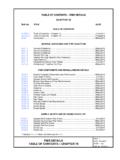
Transcription of Chapter 15 – Drainage Design Memoranda
1 Chapter 15 Drainage Design Memoranda TABLE OF CONTENTS. DDM1 Type of Structure Selection is now in VDM , Culvert End Treatment is in DDM2 Basic Drainage Description Formats for Hydraulic Plan Items now are in the VDM DDM3 Minor Structure Excavation is now in the VDM at and DDM4 Drainage Design at Railroads is now in the VDM at DDM5 Underdrain is now in the VDM at DDM6 Board Policies on Participation by Towns, Cities and Counties is now in IIM 146. DDM7 VDOT Procedures for Documentation and Notification of Activities in FEMA-Mapped Floodplains DDM8 VDOT Expanded Procedures for Estimating Bridge Scour Using a Variable D50 with Depth VIRGINIA DEPARTMENT OF TRANSPORTATION. LOCATION AND Design DIVISION. Drainage Design MEMORANDUM. GENERAL SUBJECT: NUMBER: Drainage INSTRUCTIONS DDM-7. SPECIFIC SUBJECT: DATE: OCTOBER 15, 2015. VDOT PROCEDURE FOR DOCUMENTATION and NOTIFICATION OF ACTIVITIES IN FEMA-MAPPED SUPERSEDES: FLOODPLAINS N/A.
2 APPROVAL: Jeffrey S. Bragdon, State Hydraulics and Utilities Engineer EFFECTIVE DATE. Unless identified otherwise within this DDM, the information contained in this DDM is effective upon receipt. PURPOSE. This DDM establishes minimum requirements for projects including roadway construction and maintenance that are located within Special Flood Hazard Areas (SFHA) Zone A, AE and VE as mapped on a Federal Emergency Management Agency (FEMA) Flood Insurance Rate Map (FIRM). These requirements require the engineer to fully document, to the extent necessary, compliance with FEMA. practices and principles; VDOT standards, guidance and specifications; state and federal regulatory requirements; and all appropriate and necessary construction considerations. This DDM further references a Quality Assurance/Quality Control (QA/QC) process by which all work in the FEMA floodplain will be reviewed for consistency with this DDM and any applicable regulatory requirements.
3 Drainage Design Memorandum DDM-7. Sheet 2 of 4. REFERENCES. The following editions apply when referenced in this DDM: o Virginia Code Section o Governors Executive Memorandum 2-97. POLICY. This section amends and revises the existing VDOT procedures with respect to work in FEMA Designated Floodplains as discussed in Chapter 12 of the VDOT Drainage Manual. PROCEDURE. VDOT Hydraulics Staff will review all projects that will be submitted for environmental permits to assess the potential impact on flooding. At VDOT's discretion, the assessment on flooding impact may be qualitative (Engineering Judgment) or quantitative (Engineering Analysis). Documentation regarding this assessment of the potential impacts will be included with the Joint Permit Application (JPA). developed by VDOT to manage the environmental permit process. The Department of Conservation & Recreation (DCR) is included in the distribution of the JPA.
4 Any maintenance or construction activity that will restore or maintain the originally- designed hydraulic capacity of a VDOT asset that is present in the FEMA Mapped Floodplain, will not require additional coordination with DCR or the localities beyond what is included in the JPA. This would include, but is not limited to: o stream bank stabilization;. o reconstruction and stabilization of roadway embankments;. o bridge scour repairs and associated fill;. o bridge deck replacements;. o substructure repairs that may involve additional concrete or steel to reinforce the structure;. o bridge and structure maintenance and repair; and o bridge and structure replacement with a Hydraulically Equivalent Replacement Structure (HERS). Drainage Design Memorandum DDM-7. Sheet 3 of 4. When an Engineering Analysis of flooding impact will be performed on a project within a Zone AE, VDOT will request supporting hydraulic data from FEMA to use as a starting point for the analysis.
5 VDOT will independently evaluate the hydrology for the purposes of comparison. The engineer will update the hydraulic model, as needed, to reflect the results of the VDOT survey and bridge Design or construction. In the event that there is a discrepancy between the FEMA data and the Engineering Analysis, the VDOT data will take precedence. Any discrepancies will be noted and documented for future use but will not require a CLOMR submission. The hydraulic model and supporting documentation shall be forwarded to the Locality implementing the National Flood Insurance Program (NFIP) in that jurisdiction and DCR's Division of Dam Safety & Floodplain Management, upon their request. VDOT Design Policy is written such that it will support the goals of DCR to preserve the capacity of the floodplain to carry the 100-year flood and exceed the minimum requirements of the NFIP: o VDOT will limit impacts to the 100-year flood elevation to a cumulative ' for work that is performed within FEMA Zone A areas, provided there is no adverse impact to offsite structures.
6 Any impacts may require coordination with the community. o VDOT will limit impacts to the 100-year flood elevation to ' for work that is performed within FEMA Zone AE areas. If the impact limits noted above cannot be met, VDOT will coordinate with the NFIP. community regarding the impact and determine the subsequent course of action. This may include supplemental surveys, a Conditional Letter of Map Revision (CLOMR), and as needed, a Letter of Map Revision (LOMR). REPORTING AND DOCUMENTATION. For projects determined by using engineering judgement to have no adverse hydraulic impact as discussed above will require no additional coordination with the Locality or DCR. except for the abbreviated Hydraulic Commentary provided in the JPA. For projects located in a FEMA Designated A, AE, V or VE Zone, where a detailed hydraulic analysis has been performed, VDOT will: Modify the current documentation practices to include a comparison of the published and VDOT-determined discharges, including the published, revised existing and proposed condition flood elevations.
7 Drainage Design Memorandum DDM-7. Sheet 4 of 4. Upon review and approval by the Hydraulics Staff the Preliminary Bridge Report based on the preliminary bridge Design will be submitted to the Project Manager and the Central Office Hydraulics Section. This will include the LD293, FEMA FIRM ette, the preliminary Bridge Front Sheet and preliminary Roadway Plan and Profile. The Central Office Hydraulics Staff will notify the Locality and DCR upon completion of the preliminary H&HA and provide that documentation for their use. In the event that the impact limits noted above are not met, there will be additional coordination with the locality regarding the need to engage in the CLOMR and LOMR process. If there is a difference between the VDOT and FEMA data and the existing versus proposed analyses shows that it meets the 100-year impact limits set above, this will not require a CLOMR / LOMR to update the FIRM and FIS.
8 Upon receipt of the VDOT information, DCR and the Locality may coordinate with FEMA, as needed, regarding areas where the published FIS appears to be erroneous. In the event that there are changes in the final Design that warrant modification of the analysis, the preliminary Bridge Report will be reissued to the PM and the Central Office Hydraulics Section. The Central Office will distribute copies to DCR and the Locality. Upon approval of the final bridge Design and scour analyses by the Hydraulics Staff a Final Bridge Report will be submitted to the PM and the Central Office Hydraulics Section and will include the LD293, FEMA FIRM ette, the Bridge Front Sheet, Roadway Plan and Profile, the hydraulic model, scour computations and scour plot. The Central Office Hydraulics Staff will distribute the final Bridge Report to the Locality and DCR. Survey data and engineering computations will be provided upon request.
9 If required by this document, a CLOMR will be submitted at this time. These provisions are limited to projects where VDOT is the designated permittee. For VDOT-funded projects, where the environmental permits are held by others ( , Locally Administered Projects, Design Build Contractors, PPTAs, etc.), they will be responsible for independent coordination with the community with regards to Floodplain Development. VDOT will establish a centralized repository for the hydraulic analyses to facilitate requests made by DCR or FEMA for specific studies. In the event that CLOMR is submitted it will be necessary that the project schedule and budget be modified to accommodate the submission of a LOMR at project completion. This will include an as-built survey and possible modification to the hydraulic modeling as needed. VIRGINIA DEPARTMENT OF TRANSPORTATION. LOCATION AND Design DIVISION. Drainage Design MEMORANDUM.
10 GENERAL SUBJECT: NUMBER: Drainage INSTRUCTIONS DDM-8. SPECIFIC SUBJECT: DATE: VDOTS EXPANDED PROCEDURE FOR ESTIMATING. BRIDGE SCOUR USING A VARIABLE D50 WITH SUPERSEDES: DEPTH AND ESTIMATED D50 BASED ON BEDROCK N/A. CORE MATERIAL. APPROVAL: Jeffrey S. Bragdon, State Hydraulics and Utilities Engineer EFFECTIVE DATE. Unless identified otherwise within this DDM, the information contained in this DDM is effective upon receipt. PURPOSE. This DDM applies to a hydraulic evaluation of a steady state flow condition that will provide the maximum theoretical scour. At this time, VDOT does not provide general guidance for the use of the scour computations that take into account long term variable flow as it applies to cohesion or abrasion. These approaches may be considered on a case-by-case basis at the discretion of VDOT staff. The methods provided in HEC-18, 5th edition, were largely developed in isolation to one another and there are significant gaps between the theory as presented, and the hydraulic and geotechnical conditions found in the field.