Transcription of Chapter 15 Transformer Design
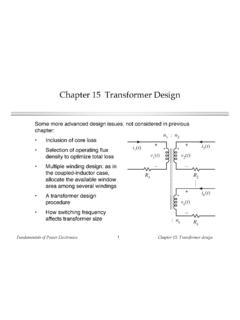
1 Fundamentals of Power ElectronicsChapter 15: Transformer design1 Chapter 15 Transformer DesignSome more advanced Design issues, not considered in previouschapter: Inclusion of core loss Selection of operating fluxdensity to optimize total loss Multiple winding Design : as inthe coupled-inductor case,allocate the available windowarea among several windings A Transformer designprocedure How switching frequencyaffects Transformer sizen1 : n2: nkR1R2Rk+v1(t) +v2(t) +vk(t) i1(t)i2(t)ik(t)Fundamentals of Power ElectronicsChapter 15: Transformer design2 Chapter 15 Transformer Transformer Design : Basic A step-by-step Transformer Design AC inductor SummaryFundamentals of Power ElectronicsChapter 15: Transformer Transformer Design :Basic ConstraintsCore lossTypical value of for ferrite materials.
2 Or B is the peak value of the ac component of B(t), , the peak ac fluxdensitySo increasing B causes core loss to increase rapidlyThis is the first constraintPfe=Kfe( B) AclmFundamentals of Power ElectronicsChapter 15: Transformer design4 Flux densityConstraint #2 Flux density B(t) is related to theapplied winding voltage accordingto Faraday s Law. Denote the volt-seconds applied to the primarywinding during the positive portionof v1(t) as 1: 1=v1(t)dtt1t2 This causes the flux to change fromits negative peak to its positive Faraday s law, the peak valueof the ac component of flux density isTo attain a given flux density,the primary turns should bechosen according toarea 1v1(t)t1t2t B= 12n1 Acn1= 12 BAcFundamentals of Power ElectronicsChapter 15.
3 Transformer design5 Copper lossConstraint #3 Allocate window area between windings in optimum manner, asdescribed in previous section Total copper loss is then equal toPcu= (MLT)n12 Itot2 WAKuItot=njn1Ij j=1kwithEliminate n1, using result of previous slide:Note that copper loss decreases rapidly as B is increasedPcu= 12 Itot24Ku(MLT)WAAc21 B2 Fundamentals of Power ElectronicsChapter 15: Transformer design6 Total power loss4. Ptot = Pcu + PfePtot=Pfe+PcuThere is a value of Bthat minimizes the totalpower lossPcu= 12 Itot24Ku(MLT)WAAc21 B2 Pfe=Kfe( B) Aclm BPowerlossPtotCopper loss PcuCore loss PfeOptimum BFundamentals of Power ElectronicsChapter 15: Transformer design75.
4 Find optimum flux density BPtot=Pfe+PcuGiven thatThen, at the B that minimizes Ptot, we can writeNote: optimum does not necessarily occur where Pfe = Pcu. Rather, itoccurs wheredPtotd( B)=dPfed( B)+dPcud( B)=0dPfed( B)= dPcud( B)Fundamentals of Power ElectronicsChapter 15: Transformer design8 Take derivatives of core and copper lossNow, substitute intoand solve for B:Optimum B for agiven core andapplicationPcu= 12 Itot24Ku(MLT)WAAc21 B2 Pfe=Kfe( B) AclmdPfed( B)= Kfe( B) 1 AclmdPcud( B)= 2 12 Itot24Ku(MLT)WAAc2( B) 3dPfed( B)= dPcud( B) B= 12 Itot22Ku(MLT)WAAc3lm1 Kfe1 +2 Fundamentals of Power ElectronicsChapter 15.
5 Transformer design9 Total lossSubstitute optimum B into expressions for Pcu and Pfe. The total loss is:Rearrange as follows:Left side: terms depend on coregeometryRight side: terms depend onspecifications of the applicationPtot=AclmKfe2 +2 12 Itot24Ku(MLT)WAAc2 +2 2 +2+ 22 +2 WAAc2( 1)/ (MLT)lm2/ 2 +2+ 22 +2 +2 = 12 Itot2 Kfe2/ 4 KuPtot +2/ Fundamentals of Power ElectronicsChapter 15: Transformer design10 The core geometrical constant KgfeDefineDesign procedure: select a core that satisfiesAppendix D lists the values of Kgfe for common ferrite coresKgfe is similar to the Kg geometrical constant used in Chapter 14: Kg is used when Bmax is specified Kgfe is used when B is to be chosen to minimize total lossKgfe=WAAc2( 1)/ (MLT)lm2/ 2 +2+ 22 +2 +2 Kgfe 12 Itot2 Kfe2/ 4 KuPtot +2/ Fundamentals of Power ElectronicsChapter 15: Transformer Step-by-steptransformer Design procedureThe following quantities are specified, using the units noted.
6 Wire effective resistivity ( -cm)Total rms winding current, ref to priItot(A)Desired turns ratiosn2/n1, n3/n1, pri volt-sec 1(V-sec)Allowed total power dissipationPtot(W)Winding fill factorKuCore loss exponent Core loss coefficient Kfe(W/cm3T )Other quantities and their dimensions:Core cross-sectional areaAc(cm2)Core window areaWA(cm2)Mean length per turnMLT(cm)Magnetic path length le (cm)Wire areas Aw1, ..(cm2)Peak ac flux density B (T)Fundamentals of Power ElectronicsChapter 15: Transformer core sizeSelect a core from Appendix D that satisfies this may be possible to reduce the core size by choosing a core materialthat has lower loss, , lower 12 Itot2 Kfe2/ 4 KuPtot +2/ 108 Fundamentals of Power ElectronicsChapter 15: Transformer peak ac flux densityAt this point, one should check whether the saturation flux density isexceeded.
7 If the core operates with a flux dc bias Bdc, then B + Bdcshould be less than the saturation flux density the core will saturate, then there are two choices: Specify B using the Kg method of Chapter 14, or Choose a core material having greater core loss, then repeatsteps 1 and 2 B=108 12 Itot22Ku(MLT)WAAc3lm1 Kfe1 +2 Fundamentals of Power ElectronicsChapter 15: Transformer design143. and turnsPrimary turns:Choose secondary turns according todesired turns ratios:n2=n1n2n1n3=n1n3n1n1= 12 BAc104 Fundamentals of Power ElectronicsChapter 15: Transformer design155.
8 And wire sizes 1=n1I1n1 Itot 2=n2I2n1 Itot k=nkIkn1 ItotFraction of window areaassigned to each winding:Choose wire sizes accordingto:Aw1 1 KuWAn1Aw2 2 KuWAn2 Fundamentals of Power ElectronicsChapter 15: Transformer design16 Check: computed Transformer modeliM,pk= 12 LMR1= n1(MLT)Aw1R2= n2(MLT)Aw2 Predicted magnetizinginductance, referred to primary:Peak magnetizing current:Predicted winding resistances:n1 : n2: nkR1R2 Rki1(t)i2(t)ik(t)LMiM(t)LM= n12 AclmFundamentals of Power ElectronicsChapter 15: Transformer 1: Single-output isolatedCuk converter100 W fs = 200 kHzD = = 5Ku = Ptot = WUse a ferrite pot core, with Magnetics Inc.
9 P material. Lossparameters at 200 kHz areKfe = = + +V5 V Vg25 Vn : 1I20 AIg4 A+v2(t) v1(t)+i1(t)i2(t) vC2(t) ++ vC1(t) Fundamentals of Power ElectronicsChapter 15: Transformer design18 Waveformsv1(t)i1(t)i2(t)DTsArea 1VC1 nVC2D'TsI/n IgI nIgApplied primary volt-seconds: 1=DTsVc1=( ) (5 sec ) (25 V)= V secApplied primary rmscurrent:I1=DIn2+D'Ig2=4 AApplied secondary rmscurrent:I2=nI1=20 ATotal rms windingcurrent:Itot=I1+1nI2=8 AFundamentals of Power ElectronicsChapter 15: Transformer design19 Choose core sizeKgfe ( 10 6)( 10 6)2(8)2( )2 ( ) ( ) core data of Appendix D lists 2213 pot core withKgfe = smaller pot core is not large of Power ElectronicsChapter 15: Transformer design20 Evaluate peak ac flux densityThis is much less than the saturation flux density of T.
10 Values of B in the vicinity of T are typical for ferritedesigns that operate at frequencies in the vicinity of 100 kHz. B=108( 10 6)( 10 6)2(8)22( )( )( )( )3( )1( )( )1 TeslaFundamentals of Power ElectronicsChapter 15: Transformer design21 Evaluate turnsn1=104( 10 6)2( )( )= turnsn2=n1n= turnsIn practice, we might selectn1 = 5and n2 = 1 This would lead to a slightly higher flux density and slightly of Power ElectronicsChapter 15: Transformer design22 Determine wire sizesFraction of window area allocated to each winding.