Transcription of CHAPTER 3
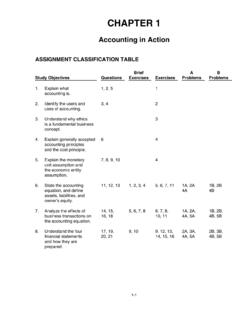
1 CHAPTER 3. Adjusting the Accounts ASSIGNMENT CLASSIFICATION TABLE. Brief A B. Study Objectives Questions Exercises Exercises Problems Problems *1. Explain the time period 1 1. assumption. *2. Explain the accrual basis 2, 3, 4, 5 2, 3, 10. of accounting . *3. Explain the reasons for 6, 7 1. adjusting entries. *4. Identify the major types 8, 18 2, 8 4, 6, 11. of adjusting entries. *5. Prepare adjusting entries 8, 9, 10, 3, 4, 5, 6 5, 6, 7, 8, 1A, 2A, 3A, 1B, 2B, 3B, for deferrals. 11, 12, 13, 9, 10, 11, 4A, 5A, 6A 4B, 5B. 18, 19, 20 12, 13, 15. *6. Prepare adjusting entries 8, 14, 15, 7 5, 6, 7, 8, 1A, 2A, 3A, 1B, 2B, 3B, for accruals. 16, 17, 18, 9, 10, 11, 4A, 5A, 6A 4B, 5B. 19, 20 12, 13, 15. *7. Describe the nature and 21 9, 10 10, 11, 12, 1A, 2A, 3A, 1B, 2B, 3B, purpose of an adjusted 13, 14 5A, 6A 5B.
2 Trial balance. *8. Prepare adjusting 22 11 16, 17 6A. entries for the alternative treatment of deferrals. *Note: All asterisked Questions, Exercises, and Problems relate to material contained in the appendix to the CHAPTER . 3-1. ASSIGNMENT CHARACTERISTICS TABLE. Problem Difficulty Time Number Description Level Allotted (min.). 1A Prepare adjusting entries, post to ledger accounts, Simple 40 50. and prepare an adjusted trial balance. 2A Prepare adjusting entries, post, and prepare adjusted Simple 50 60. trial balance and financial statements. 3A Prepare adjusting entries and financial statements. Moderate 40 50. 4A Prepare adjusting entries. Moderate 30 40. 5A Journalize transactions and follow through accounting Moderate 60 70.
3 Cycle to preparation of financial statements. *6A* Prepare adjusting entries, adjusted trial balance, Moderate 40 50. and financial statements using appendix. 1B Prepare adjusting entries, post to ledger accounts, Simple 40 50. and prepare an adjusted trial balance. 2B Prepare adjusting entries, post, and prepare adjusted Simple 50 60. trial balance and financial statements. 3B Prepare adjusting entries and financial statements. Moderate 40 50. 4B Prepare adjusting entries. Moderate 30 40. 5B Journalize transactions and follow through accounting Moderate 60 70. cycle to preparation of financial statements. 3-2. Correlation Chart between Bloom's Taxonomy, Study Objectives and End-of- CHAPTER Exercises and Problems Study Objective Knowledge Comprehension Application Analysis Synthesis Evaluation *1.
4 Explain the time period assumption. Q3-1 E3-1. *2. Explain the accrual basis of accounting . Q3-2 Q3-4 Q3-5 E3-10 E3-2. Q3-3 E3-3. *3. Explain the reasons for adjusting entries. Q3-6 BE3-1. Q3-7. *4. Identify the major types of adjusting entries. Q3-8 Q3-18 BE3-8 E3-6. BE3-2 E3-4 E3-11. *5. Prepare adjusting entries for deferrals. Q3-8 Q3-18 E3-9 P3-4A E3-15. Q3-9 BE3-3 E3-10 P3-5A. BLOOM'S TAXONOMY TABLE. Q3-10 BE3-4 E3-11 P3-6A. Q3-11 BE3-5 E3-12 P3-1B. Q3-12 BE3-6 E3-13 P3-2B. Q3-13 E3-5 E3-15 P3-3B. Q3-19 E3-6 P3-1A P3-4B. Q3-20 E3-7 P3-2A P3-5B. 3-3. E3-8 P3-3A. *6. Prepare adjusting entries for accruals. Q3-8 Q3-17 Q3-16 E3-10 P3-4A E3-15. Q3-14 Q3-18 E3-11 P3-5A. Q3-15 BE3-7 E3-12 P3-6A. Q3-19 E3-5 E3-13 P3-1B.
5 Q3-20 E3-6 E3-15 P3-2B. E3-7 P3-1A P3-3B. E3-8 P3-2A P3-4B. E3-9 P3-3A P3-5B. *7. Describe the nature and purpose of an Q3-21 BE3-9 E3-10 P3-2A P3-2B. adjusted trial balance. BE3-10 E3-11 P3-3A P3-3B. E3-14 E3-12 P3-5A P3-5B. E3-13 P3-6A. P3-1A P3-1B. *8. Prepare adjusting entries for the alternative Q3-22 BE3-11 E3-17. treatment of deferrals. E3-16 P3-6A. Broadening Your Perspective Communication Financial Reporting Decision Making All About You Comparative Analysis Across the Ethics Case Exploring the Web Organization ANSWERS TO QUESTIONS. 1. (a) Under the time period assumption, an accountant is required to determine the relevance of each business transaction to specific accounting periods. (b) An accounting time period of one year in length is referred to as a fiscal year.
6 A fiscal year that extends from January 1 to December 31 is referred to as a calendar year. accounting periods of less than one year are called interim periods. 2. The two generally accepted accounting principles that relate to adjusting the accounts are: The revenue recognition principle, which states that revenue should be recognized in the accounting period in which it is earned. The matching principle, which states that efforts (expenses) be matched with accomplishments (revenues). 3. The law firm should recognize the revenue in April. The revenue recognition principle states that revenue should be recognized in the accounting period in which it is earned. 4. Information presented on an accrual basis is more useful than on a cash basis because it reveals relationships that are likely to be important in predicting future results.
7 To illustrate, under accrual accounting , revenues are recognized when earned so they can be related to the economic environment in which they occur. Trends in revenues are thus more meaningful. 5. Expenses of $4,500 should be deducted from the revenues in April. Under the matching principle efforts (expenses) should be matched with accomplishments (revenues). 6. No, adjusting entries are required by the revenue recognition and matching principles . 7. A trial balance may not contain up-to-date information for financial statements because: (1) Some events are not journalized daily because it is not efficient to do so. (2) The expiration of some costs occurs with the passage of time rather than as a result of daily transactions.
8 (3) Some items may be unrecorded because the transaction data are not known. 8. The two categories of adjusting entries are deferrals and accruals. Deferrals consist of prepaid expenses and unearned revenues. Accruals consist of accrued revenues and accrued expenses. 9. In the adjusting entry for a prepaid expense, an expense is debited and an asset is credited. 10. No. Depreciation is the process of allocating the cost of an asset to expense over its useful life in a rational and systematic manner. Depreciation results in the presentation of the book value of the asset, not its market value. 11. Depreciation expense is an expense account whose normal balance is a debit. This account shows the cost that has expired during the current accounting period.
9 Accumulated depreciation is a contra asset account whose normal balance is a credit. The balance in this account is the depreciation that has been recognized from the date of acquisition to the balance sheet date. 12. Equipment .. $18,000. Less: Accumulated 6,000 $12,000. 3-4. Questions CHAPTER 3 (Continued). *13. In the adjusting entry for an unearned revenue, a liability is debited and a revenue is credited. *14. Asset and revenue. An asset would be debited and a revenue would be credited. *15. An expense is debited and a liability is credited. *16. Net income was understated $200 because prior to adjustment, revenues are understated by $900 and expenses are understated by $700. The difference in this case is $200 ($900 $700).
10 *17. The entry is: Jan. 9 Salaries Payable .. 2,000. Salaries 3,000. Cash .. 5,000. *18. (a) Accrued revenues. (d) Accrued expenses or prepaid expenses. (b) Unearned revenues. (e) Prepaid expenses. (c) Accrued expenses. (f) Accrued revenues or unearned revenues. *19. (a) Salaries Payable. (d) Supplies Expense. (b) Accumulated Depreciation. (e) Service Revenue. (c) Interest Expense. (f) Service Revenue. *20. Disagree. An adjusting entry affects only one balance sheet account and one income statement account. *21. Financial statements can be prepared from an adjusted trial balance because the balances of all accounts have been adjusted to show the effects of all financial events that have occurred during the accounting period.