Transcription of Chapter 3 Air quality standards
1 Chapter 3 air quality standards and objectivesAt a glanceAir quality limits and thresholds are fundamental to effective air quality management. ambient air quality limits serve to indicate what levels of exposure to pollution are generally safe for most people, including the very young and the elderly, over their lifetimes. While the World Health Organization (WHO) provides scientific guidance to all countries on the levels of pollution that adversely affect human health, its work does not take into consideration the socio-economic conditions prevalent within any country. As a result, the WHO produces guidelines that a country can then use to inform the development of its own standards .
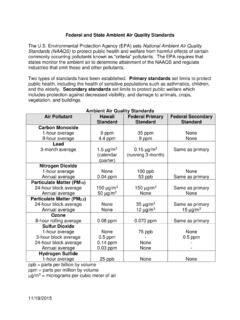
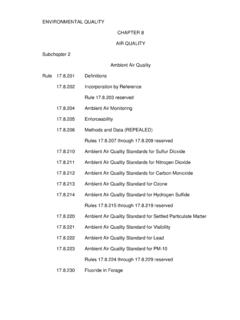
2 The pollutants for which South Africa has set air quality limits include particulate matter, sulphur dioxide, nitrogen dioxide, carbon monoxide, lead, ozone, benzene, and the deposition of dust. The health impacts of the criteria pollutants, for which limits have been set, are briefly air quality LIMITS FOR CRITERIA POLLUTANTS .. 18 Suspended particulate matter .. 18 Sulphur dioxide .. 20 Oxides of nitrogen .. 23 Carbon monoxide .. 23 Ozone .. 23 Benzene .. 24 Dust deposition .. 25 Metals .. air quality THRESHOLDS FOR NON-CRITERIA POLLUTANTS .. 27 Health-based air quality thresholds.
3 27 Odour thresholds .. DEFINITION OF HIGH POLLUTION DAYS .. 29 air quality standards and objectives17the national air quality guideline values established in the 1990s, and have become dated and in need of Department of Environmental Affairs and Tourism (DEAT) has been reviewing and revising the national air quality standards published in the AQA, to ensure that these limits adequately protect human health and welfare. The review process began with the gazetting of a new interim guideline for SO2 in December 2001, and this revised level was then included in the AQA. Subsequently, the DEAT engaged the South African Bureau of standards (SABS) to facilitate the development of further health-based ambient air quality standards .
4 Two documents were compiled during this process: SANS 69:2004 South African National Standard Framework for setting & implementing national ambient air quality standards , and SANS 1929:2005 South African National Standard ambient air quality Limits for common pollutants. The latter includes limits for particulate matter less than 10 m in aerodynamic diameter (PM10), dust deposition, SO2, NO2, O3, CO, Pb, and benzene (C6H6). These SANS documents were finalized and published in 2004 and 2005. The adoption of the air quality limits documented in SANS 1929:2005 is under consideration by the Department.
5 Finalizing these standards and having them accepted as national standards requires permissible frequencies of exceedance and compliance time-frames to be established. The health impacts of criteria pollutants are briefly discussed below, and national air quality limits published locally for such pollutants are compared to widely-referenced limits published by other countries and international organizations. (For further details on the health and ecological impacts of common pollutants, see DEAT, 2006c.) Suspended particulate matterThe potential of particles to be inhaled and deposited in the lungs is a function of the aerodynamic characteristics of these particles in the air, and it is related to their size, shape, and density.
6 Their impact on human health largely depends on (i) particle characteristics, especially particle size and chemical composition, and (ii) the duration, frequency, and magnitude of people s exposure to them. air quality limits and thresholds are fundamental to effective air quality management, as they link the potential source of atmospheric emissions with the user of that air at the downwind receptor site1. ambient air quality limits serve to indicate what levels of exposure to pollution are generally safe for most people, including vulnerable groups, over their entire lifetimes. Such limits are typically set for common air pollutants that are usually emitted into the atmosphere, sometimes in large quantities, through various industrial and other processes, and for which health and environmental impacts are relatively fine particulate matter, sulphur dioxide (SO2), nitrogen dioxide (NO2), carbon monoxide (CO), lead (Pb), and ozone (O3) are classified by most countries as criteria pollutants , and air quality limits are set for all of them (see below).
7 Such limits are not published for all possible air pollutants to which the public may be exposed, but are typically set only for common ones that are known to have detrimental effects. For constituents of air that are listed as pollutants but for which no limits are promulgated, dose-response thresholds have been published by public health bodies such as the WHO (see below). air quality indexing systems are often used to communicate the extent and acceptability of air-pollution levels in a concise and readily understandable way, and are able to integrate information across a range of chemical compounds (specifically those relating to air pollution, such as SO2) and averaging periods.
8 The creation of bands, in the approach adopted by the UK, for example, helps to classify 24-hour periods into low , medium , high , and very high air pollution days. Although various indexing systems are currently in use in different parts of South Africa, no single national air quality index had been adopted for national implementation by the end of 2004. The simple air quality classification system used in this report is outlined in air quality LIMITS FOR CRITERIA POLLUTANTSN ational air quality standards are given in Schedule 2 of the National Environmental Management: air quality Act (AQA) (Act no.)
9 39 of 2004). They largely reflect 1. A downwind receptor site is any site downwind of a source of pollution sometimes specific receptor sites are identified as communities, or as buildings or areas (such as a school), where people (or specified ecosystems) are affected by that particular source of is concern about PM10 and because of the potential health risks that they pose, given that such fine particles are able to be deposited in, and cause damage to, the lower airways and gas-exchanging portions of the lungs18 The deposition of particles in different regions of the human respiratory system depends on their size.
10 Nasal openings allow large dust particles to enter the nose, along with much finer airborne particulates. The larger particles are deposited on the hairs in the nose or at the bends of the nasal passages. Smaller particles (PM10) pass through the nasal region and are deposited in the windpipe and lung (tracheobronchial and pulmonary) regions. As they hit the bronchial walls, particles are removed from the inhaled air. When the airflow decreases near the terminal bronchi, the smallest particles are removed by Brownian motion, which pushes them to the alveolar membrane2 (CEPA/FPAC Working Group, 1998; Dockery & Pope, 1994).