Transcription of Chapter 3 Cellular Structure and Function Worksheets
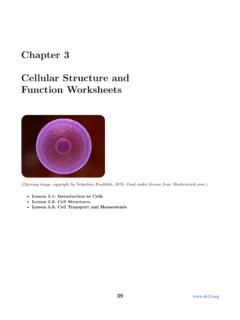
1 Chapter 3 Cellular Structure andFunction Worksheets (Opening image copyright by Sebastian Kaulitzki, 2010. Used under license from ) Lesson : Introduction to Cells Lesson : Cell Structures Lesson : Cell Transport and to CellsLesson : True or FalseName_____ Class_____ Date_____Write true if the statement is true or false if the statement is 1. All organisms are made of more than one 2. Early microscopes created by Leeuwenhoek were almost as strong as modern light 3. Proteins are made on 4. Prokaryotic cells have a 5. The plasma membrane forms the physical boundary between the cell and its 6. For cells, a smaller size is more 7. Compared to eukaryotic cells, prokaryotic cells are very 8. Organelles are located within the 9. Viruses are similar to prokaryotic 10. All cells have a plasma membrane, cytoplasm, and 11.
2 DNA is located in the nucleus of prokaryotic 12. Organelles allow eukaryotic cells to carry out more functions than prokaryotic 13. Viruses are considered living 14. Most cells are about the size of the period at the end of this 15. Observation of cork helped in the discovery of : Critical ReadingName_____ Class_____ Date_____Read these passages from the text and answer the questions that Types of CellsThere is another basic cell Structure that is present in many but not all living cells: the nucleus. Thenucleusof a cell is a Structure in the cytoplasm that is surrounded by a membrane (the nuclear membrane)and contains DNA. Based on whether they have a nucleus, there are two basic types of cells: prokaryoticcells and eukaryotic CellsProkaryotic cellsare cells without a nucleus. The DNA in prokaryotic cells is in the cytoplasm ratherthan enclosed within a nuclear membrane.
3 Prokaryotic cells are found in single-celled organisms, such asbacteria. Organisms with prokaryotic cells are calledprokaryotes. They were the first type of organismsto evolve and are still the most common organisms CellsEukaryotic cellsare cells that contain a nucleus. Eukaryotic cells are usually larger than prokaryoticcells, and they are found mainly in multicellular organisms. Organisms with eukaryotic cells are calledeukaryotes, and they range from fungi to people. Eukaryotic cells also contain other organelles besidesthe nucleus. Anorganelleis a Structure within the cytoplasm that performs a specific job in the called mitochondria, for example, provide energy to the cell, and organelles called vacuoles storesubstances in the cell. Organelles allow eukaryotic cells to carry out more functions than prokaryotic : Prokaryotes or Eukaryotes?
4 Virusesare tiny particles that may cause disease. Human diseases caused by viruses include the commoncold and flu. Do you think viruses are prokaryotes or eukaryotes? The answer may surprise you. Virusesare not cells at all, so they are neither prokaryotes nor contain DNA but not much else. They lack the other parts shared by all cells, including a plasmamembrane, cytoplasm, and ribosomes. Therefore, viruses are not cells, but are they alive? All livingthings not only have cells; they are also capable of reproduction. Viruses cannot reproduce by , they infect living hosts, and use the hosts cells to make copies of their own DNA. For thesereasons, most scientists do not consider viruses to be living What is one main difference between prokaryotic and eukaryotic cells?2. Give an example of a prokaryotic What is an organelle?
5 Give three examples. (Hint: See the Eukaryotic Cell figure in the FlexBook.) Describe the nucleus. What can be found inside the nucleus?5. Are viruses alive? Discuss why or why : Multiple ChoiceName_____ Class_____ Date_____Circle the letter of the correct in prokaryotic cells include the(a)mitochondria.(b)cytoskeleton.(c)Go lgi complex.(d)none of the major difference between prokaryotic and eukaryotic cells is that(a)prokaryotic cells have a flagellum.(b)eukaryotic cells have a nucleus.(c)prokaryotic cells have cytoplasm.(d)eukaryotic cells have Hooke was the first person to observe cells. He observed these cells in(a)a piece of cork.(b)a slice of honeycomb.(c)human blood.(d)plaque from his own size is limited by the(a)amount of cytoplasm.(b)cell s ability to get rid of wastes.(c)the size of the nucleus.
6 (d)the size of the plasma spikes on pollen grains probably(a)allow the pollen grain to stick to insects.(b)allow the pollen grain to fly through the air.(c)protect the pollen grain from being eaten.(d)allow insects to stick to the pollen cells have the following:(a)plasma membrane, cytoplasm, and ribosomes.(b)plasma membrane, nucleus, and DNA.(c)DNA, ribosomes, and cell wall.(d)plasma membrane, cytoplasm, and first microscopes were made around(a)1965.(b)1665.(c)1950.(d) cell theory states that(a)all organisms are made of one or more cells.(b)all cells come from already existing cells.(c)all the life functions of organisms occur within cells.(d)all of the : Vocabulary IName_____ Class_____ Date_____Match the vocabulary word with the proper 1. organism that has cells containing a nucleus and other organelles_____ 2.
7 An organelle inside eukaryotic cells where the DNA is located_____ 3. cell without a nucleus_____ 4. a Structure within the cytoplasm of a cell that is enclosed within a membrane and performs aspecific job_____ 5. phospholipid bilayer that surrounds and encloses a cell_____ 6. first person to use the word cell _____ 7. tiny, non-living particles that may cause disease_____ 8. the material inside the plasma membrane of a cell_____ 9. cell that contains a nucleus and other organelles_____ 10. organelle where proteins are made_____ 11. discovered human blood cells_____ 12. a single-celled organism that lacks a nucleusTermsa. Anton van Leeuwenhoekb. cytoplasmc. eukaryoted. eukaryotic celle. nucleusf. organelleg. plasma membraneh. prokaryotei. prokaryotic cellj. ribosomek. Robert Hookel. : Vocabulary IIName_____ Class_____ Date_____Fill in the blanks with the appropriate All organisms are made up of one or more All cells have certain parts in common, including a plasma membrane, _____, _____-_____, and Proteins are made on the A _____ is a typical prokaryotic _____ cells are usually larger than _____ Leeuwenhoek discovered _____ by looking at the plaque from his own _____ contain DNA, but do not contain cytoplasm or In an eukaryotic cell, DNA is found in the _____ is the genetic instructions that cells need to make The plasma membrane is a bilayer of _____ that surrounds a A cell s shape is generally related to the cell s _____ are cells without a : Critical WritingName_____ Class_____ Date_____Thoroughly answer the question below.
8 Use appropriate academic vocabulary and clear and and contrast eukaryotic cells with prokaryotic cells. Include at least 5 specific similarities StructuresLesson : True or FalseName_____ Class_____ Date_____Write true if the statement is true or false if the statement is 1. The water-hating hydrophobic tails of the phospholipid bilayer face the outside of the 2. The cytoplasm essentially acts as a skeleton inside the 3. Roundworms have organ system-level organization, in which groups of organs work togetherto do a specific 4. Plant cells have special structures that are not found in animal cells, including a cell membrane,a large central vacuole, and 5. Centrioles help organize chromosomes before cell 6. Ribosomes can be found attached to the endoplasmic 7. ATP is made in the 8. Many of the biochemical reactions of the cell occur in the 9.
9 Animal cells have chloroplasts, organelles that capture light energy from the sun and use it tomake 10. Small hydrophobic molecules can easily pass through the plasma 11. In cell-level organization, different cells are specialized for different 12. The flagella on your lung cells sweep foreign particles and mucus toward the mouth and 13. Mitochondria contains its own 14. The plasma membrane is a single phospholipid layer that supports and protects a cell andcontrols what enters and leaves 15. The cytoskeleton is made from thread-like filaments and : Critical ReadingName_____ Class_____ Date_____Read these passages from the text and answer the questions that MembraneThe plasma membrane forms a barrier between the cytoplasm inside the cell and the environment outsidethe cell. It protects and supports the cell and also controls everything that enters and leaves the allows only certain substances to pass through, while keeping others in or out.
10 The ability to allowonly certain molecules in or out of the cell is referred to as selective permeability or semipermeability. Tounderstand how the plasma membrane controls what crosses into or out of the cell, you need to know BilayerThe plasma membrane is composed mainly of phospholipids, which consist of fatty acids and phospholipids in the plasma membrane are arranged in two layers, called a phospholipid bilayer. Asshown in the figure below, each phospholipid molecule has a head and two tails. The head loves water(hydrophilic) and the tails hate water (hydrophobic). The water-hating tails are on the interior of themembrane, whereas the water-loving heads point outwards, toward either the cytoplasm or the fluid thatsurrounds the cell. Molecules that are hydrophobic can easily pass through the plasma membrane, if theyare small enough, because they are water-hating like the interior of the membrane.