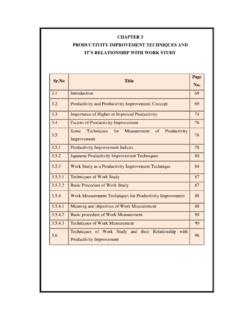
Transcription of CHAPTER 4 STOP WATCH TIME STUDY AND MOST: …
1 CHAPTER 4 STOP WATCH time STUDY AND most : work measurement TECHNIQUES Title Page No. Introduction 98 Stop WATCH time STUDY Method 98 Meaning of time STUDY 98 time STUDY Techniques/Types 99 Stop WATCH time STUDY Method 100 Evolution of Stop WATCH time STUDY Method 101 Importance and Uses of Stop WATCH time STUDY 103 Procedure for conducting stop WATCH time STUDY 103 Methods of timing using Stopwatch 106 Equipments used to measure time using Stop WATCH 106 Major Companies using Stop WATCH time STUDY method 107 most work measurement technique 108 Concept of most work measurement technique 108 Evolution of most work measurement technique 110 Importance of most work measurement
2 technique 112 The most systems 113 Basic most Method 115 Basic most work measurement technique 116 Selection of Basic most General Move sequence Model 116 Parameters of Basic most General Move Sequence Model 117 Phases of Basic most General Move sequence Model 117 Steps to observe the Phases of parameter for Basic most General Move sequence Model 118 Procedure of Basic most Method 119 Major Companies using most work measurement Techniques 119 98 CHAPTER 4 STOP WATCH time STUDY AND most : work measurement TECHNIQUES Introduction: CHAPTER 3 attempts to know what is productivity, productivity improvement, work STUDY and work measurement and their relationship with improved productivity.
3 Whereas, an attempt is made in this CHAPTER to introduce stop WATCH time STUDY and most measurement technique . The concepts of Stop WATCH time STUDY and most , evolution and history, importance, uses and types is covered in this CHAPTER . Therefore, the objective of this CHAPTER is to know and understand above cited aspects with respect to Stop WATCH time STUDY method and most and to achieve this present CHAPTER is arranged as follows: Introduction Stop WATCH time STUDY Method most work measurement technique Stop WATCH time STUDY Method: Meaning of time STUDY : time STUDY is the technique of establishing an allowed time standard to perform a given task, based upon measurement of work content of the prescribed method, with due allowance for fatigue and personal and unavoidable delays1.
4 ILO defines time STUDY as a work measurement technique for recording the times and rates of working for the elements of specified job carried out under specified conditions, and for analyzing the data so as to obtain the time necessary for carrying out the job at a defined level of performance2. According to Meyers (2002)3, time standards can be defined as the time required to produce a product at a work station with the three 99 conditions: (1) a qualified, well-trained operator, (2) working at a normal pace, and (3) doing a specific task. time STUDY Techniques/Types: time STUDY is usually referred to as work measurement and it involves the technique of establishing an allowed time standard to perform a given task, based on measurement of the work content of the prescribed method and with due allowance for fatigue, personal or unavoidable delays.
5 Establishes time values are a step in systematic procedure of developing new work centers and improving methods in existing work centers. Chart presents time STUDY techniques. Chart time STUDY Techniques by Source Source time STUDY Techniques 1 Barnes, (1980) Standard Data work Sampling Predetermined time Standard System (PTS) Stopwatch time STUDY 2 Niebel, (1993) Stopwatch time STUDY Computerized Data Collection Standard Data Fundamental motion Data work Sampling and Historical Data 3 Lawrences, (2000) time STUDY Standard Data Systems Predetermined time Systems (PTS) work Sampling Physiological work measurement Labor Reporting 4 Meyers and Stewart, (2002) Predetermined time Standard System(PTSS)
6 Stopwatch time STUDY work Sampling Standard Data Expert Opinion and Historical Data 5 Niebel and Freivalds, (2003) time STUDY Standard Data and Formulas Predetermine time Systems work Sampling Indirect and Expense Labor Standards Source: Nor Diana Hashim, time STUDY Method Implementation in Manufacturing Industry , A Report, Universiti Technikal Malaysia, Melaka, 2008, 100 To do time STUDY various experts provided with the various techniques of time STUDY which are summarized in chart The time technique is discussed by five different sources. most of the technique had a same method but differ by name. The detail descriptions on the techniques are shown as below: Stopwatch time STUDY Method: work STUDY is divided in two groups in order to gain higher productivity.
7 First group is a group of method studies which are used to simplify the job and develop more ergonomic methods of doing it. Second group is a group of work measurements which are used to find the time required to carry out the operation at a defined level of activity (Russell, Taylor, 2005a) 4. Stopwatch time STUDY measures how long it takes an average worker to complete a task at a normal pace. A normal operator is defined as a qualified, thoroughly experienced operator who is working under conditions as they customarily prevail at the work station, at a pace that is neither fast nor slow, but representative of an average.
8 The actual time taken by the above-average operation must be increased, and the time taken by the below-average must be reduced to the value representative of normal performance. Performance rating is a technique for equitably determining the time required to perform a task by the normal operator after the observed values of the operation under STUDY have been recorded (Nakayama, 2002)5. Hence, when a work is measured with the stop WATCH device it is known as stop WATCH time STUDY method. Stop WATCH time STUDY method is a technique of establishing an allowed time standard to perform a given task with the help of stop WATCH along with due allowance.
9 When a stop WATCH is used as a work measurement technique to record times and rates of working for the element of specified job carried out under specified conditions and for analyzing the data so as to obtain the time necessary to carry a specified job at specified level of performance is referred to as stop WATCH time STUDY method. Frederick W. Taylor started to develop time STUDY in 1881 when he started measuring time at a machine shop at home with stopwatch and clipboard. That was the beginning of time STUDY . Even Taylor used stopwatch, as basic tool for recording time , present 101 tools hasn t changed much. Today besides standard tools of time STUDY , stopwatch and clipboard, we use digital stopwatches, computers, barcodes and accustudy software (Izetbegovic, 2007)6.
10 Evolution of Stop WATCH time STUDY Method: The Chart showed the major evolution milestone of time STUDY in the industry. This is given according to year and the person that contribute to the evolution of the time STUDY technique . 102 Chart Major Evolution Milestones of time STUDY Year Person Contribution 1 1760 Jean Rodolphe Perronet- French engineer Extensive time studies on the manufacture of No. 6 common pins and arrived at a standard of 494 per hour ( hrs/1000). 2 1820 Charles W. Babbage- an English economist Conducted time studies on manufacture of No. 11 common pins. It has determined that one pound (5,546 pins) should be produced in 7, 6892 hours ( hrs.)