Transcription of Chapter 5 The Shoulder Joint
1 1 McGraw-Hill Higher Education. All rights reserved. 5-1 Chapter 5 The Shoulder JointManual of Structural Floyd, EdD, ATC, CSCS McGraw-Hill Higher Education. All rights reserved. 5-2 The Shoulder Joint Shoulder Joint is attached to axi al skeleton via the clavicle at SC Joint Scapula movement usually occ urs with movement of humerus Humeral flexion & abd uction req uire scapula elevation, rot ation upward, & a bd uction Humeral adduction & extensi on resul ts in scapula depression, rot ation downward, & a d duction Scapula abd uction occ urs with humeral internal rotation & h orizontal a dductio n Scapula add uction occ urs with humeral external rotation & h orizontal a bductio n McGraw-Hill Higher Education.
2 All rights reserved. 5-3 The Shoulder Joint Wide range of motion of the s ho ulder Joint in many different planes re quires a significant amount of laxity Common to have instability pr o blems Rotator cuff impingement Subluxatio ns& dislocatio ns The price of mobility is reduce d stability The more mobile a joi nt is, the less stable it is & the more stable it is, the les s mobile McGraw-Hill Higher Education. All rights reserved. 5-4 Bones Scapula, clavicle, & humerus serve as attachments for Shoulder Joint muscles Scapular landmarks supraspinat us fossa infraspinatus foss a subscapul arfossa spine of t he scap ula glenoid c avity coracoidprocess acromionprocess inferior angleFrom Seeley RR, Stephens TD, Tate P: Anatomy and physiology, ed 7, New York, 2006, McGraw-Hill McGraw-Hill Higher Education.
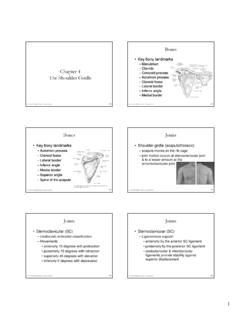
3 All rights reserved. 5-5 Bones Scapula, clavicle, & humerus serve as attachments for Shoulder Joint muscles Humeral landmarks Head Greater tubercle Lesser tubercle Intertuberculargro ove Deltoid tub erosity McGraw-Hill Higher Education. All rights reserved. 5-6 Bones Key bony landmarks Acromionprocess Glenoid fossa Lateral border Inferior angle Medial border Superior angle Spine of the scapula 2 McGraw-Hill Higher Education. All rights reserved. 5-7 Glenohumeral Joint multiaxial ball-&-socket enarthrodial McGraw-Hill Higher Education. All rights reserved. 5-8 Glenohumeral Joint Glenoid labrum slightly enhances stability McGraw-Hill Higher Education.
4 All rights reserved. 5-9 Glenohumeral Joint Glenohumeral ligaments provide stability especially anteriorly & inferiorly inferior glenohumeral ligament McGraw-Hill Higher Education. All rights reserved. 5-10 Glenohumeral Joint Ligaments are quite lax until extreme ranges of motion reached due to wide range of motion involved Stability is sacrificed to gain mobility McGraw-Hill Higher Education. All rights reserved. 5-11 Glenohumeral Joint Determining exact range of each movement is difficult due to accompanying Shoulder girdle movement McGraw-Hill Higher Education. All rights reserved. 5-12 Glenohumeral Joint 90 to 95 degrees abduction 0 degrees adduction, 75 degrees anterior to trunk3 McGraw-Hill Higher Education.
5 All rights reserved. 5-13 Glenohumeral Joint 40 to 60 degrees of extension 90 to 100 degrees of flexion McGraw-Hill Higher Education. All rights reserved. 5-14 Glenohumeral Joint 70 to 90 degrees of internal & external rotation McGraw-Hill Higher Education. All rights reserved. 5-15 Glenohumeral Joint 45 degrees of horizontal abduction 135 degrees of horizontal adduction McGraw-Hill Higher Education. All rights reserved. 5-16 Glenohumeral Joint Frequently injured due to anatomical design shallowness of glenoid fossa laxity of ligamentous structures lack of strength & endurance in muscles anterior or anteroinferior glenohumeral subluxations & dislocations common posterior dislocations rare posterior instability problems somewhat common McGraw-Hill Higher Education.
6 All rights reserved. 5-17 Glenohumeral Joint Rotator cuff is frequently injured Subscapularis, supraspinatus, infraspinatus, & teres minor muscles attach to the front, top, & rear of humeral head point of insertion enables humeral rotation vital in maintaining humeral head in correct approximation within glenoid fossa while more powerful muscles move humerus through its wide range of motion McGraw-Hill Higher Education. All rights reserved. 5-18 Pairing of Shoulder girdle & Shoulder Joint movementsAbduction (protraction)Horizontal adductionAdduction (retraction)Horizontal abductionAdduction (retraction)External rotationAbduction (protraction)Internal rotationDepression/downward rotationExtensionElevation/upward rotationFlexionDownward rotationAdductionUpward rotationAbductionShoulder girdleShoulder joint4 McGraw-Hill Higher Education.
7 All rights reserved. 5-19 Movements Abduction upward lateral movement of humerus out to the side, away from body Adduction downward movement of humerus medially toward body from abduction McGraw-Hill Higher Education. All rights reserved. 5-20 Movements Flexion movement of humerus straight anteriorly Extension movement of humerus straight posteriorly McGraw-Hill Higher Education. All rights reserved. 5-21 Movements Horizontal adduction (transverse flexion) movement of humerus in a horizontal or transverse plane toward & across chest Horizontal abduction (transverse extension) movement of humerus in a horizontal or transverse plane away from chest McGraw-Hill Higher Education.
8 All rights reserved. 5-22 Movements External rotation movement of humerus laterally around its long axis away from midline Internal rotation movement of humerus medially around its long axis toward midline McGraw-Hill Higher Education. All rights reserved. 5-23 Movements Diagonal abduction movement of humerus in a diagonal plane away from midline of body Diagonal adduction movement of humerus in a diagonal plane toward midline of body McGraw-Hill Higher Education. All rights reserved. 5-24 Muscles Intrinsic glenohumeral muscles Originate on scapula & clavicle Deltoid, Coracobrachialis, Teres major Rotator cuff group subscapularis, supraspinatus, infraspinatus, & teres minor Extrinsic glenohumeral muscles latissimus dorsi & pectoralis major5 McGraw-Hill Higher Education.
9 All rights reserved. 5-25 Muscles Anterior Pectoralis major Coracobrachialis Subscapularis Superior Deltoid SupraspinatusFrom Shier D, Butler J, Lewis R: Hole s essentials of human anatomy and physiology, ed 9, New York, 2006, McGraw-Hill. McGraw-Hill Higher Education. All rights reserved. 5-26 Muscles Superior Deltoid Supraspinatus Posterior Latissimus dorsi Teres major Infraspinatus Teres minorFrom Shier D, Butler J, Lewis R: Hole s essentials of human anatomy and physiology, ed 9, New York, 2006, McGraw-Hill. McGraw-Hill Higher Education. All rights reserved. 5-27 Nerves All Shoulder Joint muscles are innervated from the brachial plexus Lateral pectoral nerve arising from C5, C6, & C7 Pectoralis major (clavicular head) Medial pectoral nerve arising from C8 & T1 Pectoralis major (sternal head) Thoracodorsal nerve arising from C6, C7, & C8 Latissimus dorsi McGraw-Hill Higher Education.
10 All rights reserved. 5-28 Nerves Axillary nerve branching from C5 & C6 Deltoid Teres minor Sensation to lateral patch of skin over deltoid region of arm Upper subscapular nerves arising from C5 & C6 Subscapularis McGraw-Hill Higher Education. All rights reserved. 5-29 Nerves Lower subscapular nerve arising from C5 & C6 Subscapularis Teres major Suprascapula nerve originating from C5 & C6 Supraspinatus Infraspinatus McGraw-Hill Higher Education. All rights reserved. 5-30 Nerves Musculotaneous nerve branching from C5, C6, & C7 Coracobrachialis Sensation to radial aspect of forearm 6 McGraw-Hill Higher Education.