Transcription of Chapter 7: Trigonometric Equations and Identities
1 This Chapter is part of Precalculus: An Investigation of Functions Lippman & Rasmussen 2011. This material is licensed under a Creative Commons CC-BY-SA license. Chapter 7: Trigonometric Equations and Identities In the last two chapters we have used basic definitions and relationships to simplify Trigonometric expressions and Equations . In this Chapter we will look at more complex relationships that allow us to consider combining and composing Equations . By conducting a deeper study of the Trigonometric Identities we can learn to simplify expressions allowing us to solve more interesting applications by reducing them into terms we have studied. Section Solving Trigonometric Equations with Identities .. 409 Section Addition and Subtraction Identities .. 417 Section Double Angle Identities .. 431 Section Modeling Changing Amplitude and Midline .. 442 Section Solving Trigonometric Equations with Identities In the last Chapter , we solved basic Trigonometric Equations .
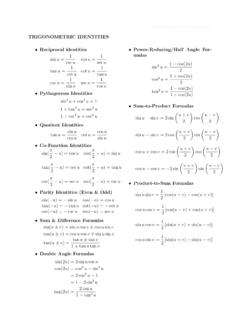
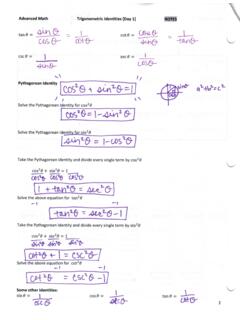
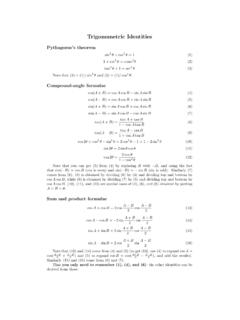
2 In this section, we explore the techniques needed to solve more complex trig Equations . Building off of what we already know makes this a much easier task. Consider the function2() 2fxxx . If you were asked to solve0)( xf, it would be an algebraic task: 022 xx Factor 0)12( xx Giving solutions x = 0 or x = -1/2 Similarly, for ( ) sin( )gtt , if we asked you to solve 0)( tg, you can solve this using unit circle values. 0)sin( t for 2,,0 tand so on. Using these same concepts, we consider the composition of these two functions: )sin()(sin2))(sin())(sin(2))((22tttttgf This creates an equation that is a polynomial trig function. With these types of functions, we use algebraic techniques like factoring, the quadratic formula, and Trigonometric Identities to break the equation down to Equations that are easier to work with. As a reminder, here are the Trigonometric Identities that we have learned so far: 410 Chapter 7 Identities Pythagorean Identities 1)(sin)(cos22 tt )(csc)(cot122tt )(sec)(tan122tt Negative Angle Identities )sin()sin(tt )cos()cos(tt )tan()tan(tt )csc()csc(tt )sec()sec(tt )cot()cot(tt Reciprocal Identities )cos(1)sec(tt )sin(1)csc(tt )cos()sin()tan(ttt )tan(1)cot(tt Example 1 Solve 0)sin()(sin22 tt for all solutions 20 t This equation is quadratic in sine, due to the sine squared term.
3 As with all quadratics, we can approach this by factoring or the quadratic formula. This equation factors nicely, so we proceed by factoring out the common factor of sin(t). 01)sin(2)sin( tt Using the zero product theorem, we know that this product will be equal to zero if either factor is equal to zero, allowing us to break this equation into two cases: 0)sin( t or 01)sin(2 t We can solve each of these Equations independently 0)sin( t From our knowledge of special angles t = 0 or t = 01)sin(2 t 21)sin( t Again from our knowledge of special angles 67 t or 611 t Altogether, this gives us four solutions to the equation on 20 t: 611,67,,0 t Section Solving Trigonometric Equations and Identities 411 Example 2 Solve 02)sec(5)(sec32 tt for all solutions 20 t Since the left side of this equation is quadratic in secant, we can try to factor it, and hope it factors nicely. If it is easier to for you to consider factoring without the trig function present, consider using a substitution)sec(tu , leaving 02532 uu, and then try to factor: )2)(13(2532 uuuu Undoing the substitution, 0)2))(sec(1)sec(3( tt Since we have a product equal to zero, we break it into the two cases and solve each separately.
4 01)sec(3 t Isolate the secant 31)sec( t Rewrite as a cosine 31)cos(1 t Invert both sides 3)cos( t Since the cosine has a range of [-1, 1], the cosine will never take on an output of -3. There are no solutions to this part of the equation. Continuing with the second part, 02)sec( t Isolate the secant 2)sec( t Rewrite as a cosine 2)cos(1 t Invert both sides 21)cos( t This gives two solutions 3 t or 35 t These are the only two solutions on the interval.
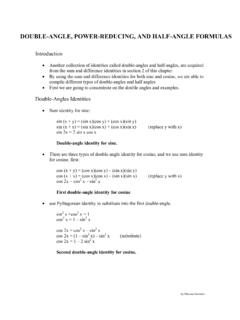
5 By utilizing technology to graph 2() 3sec () 5sec() 2fttt , a look at a graph confirms there are only two zeros for this function, which assures us that we didn t miss anything. 412 Chapter 7 Try it Now 1. Solve 01)sin(3)(sin22 tt for all solutions 20 t When solving some Trigonometric Equations , it becomes necessary to rewrite the equation first using Trigonometric Identities . One of the most common is the Pythagorean identity, 1)(cos)(sin22 which allows you to rewrite )(sin2 in terms of )(cos2 or vice versa, 2222sin ( ) 1 cos ( )cos ( ) 1 sin ( ) This identity becomes very useful whenever an equation involves a combination of sine and cosine functions, and at least one of them is quadratic Example 3 Solve 1)cos()(sin22 tt for all solutions 20 t Since this equation has a mix of sine and cosine functions, it becomes more complex to solve. It is usually easier to work with an equation involving only one trig function.
6 This is where we can use the Pythagorean identity. 1)cos()(sin22 tt Using )(cos1)(sin22 1)cos()(cos122 tt Distributing the 2 1)cos()(cos222 tt Since this is now quadratic in cosine, we rearranging the equation to set it equal to zero and factor. 01)cos()(cos22 tt Multiply by -1 to simplify the factoring 01)cos()(cos22 tt Factor 01)cos(1)cos(2 tt This product will be zero if either factor is zero, so we can break this into two separate Equations and solve each independently. 01)cos(2 t or 01)cos( t 21)cos( t or 1)cos( t 3 t or 35 t or t Section Solving Trigonometric Equations and Identities 413 Try it Now 2. Solve )cos(3)(sin22tt for all solutions 20 t In addition to the Pythagorean identity, it is often necessary to rewrite the tangent, secant, cosecant, and cotangent as part of solving an equation. Example 4 Solve )sin(3)tan(xx for all solutions 20 x With a combination of tangent and sine, we might try rewriting tangent )sin(3)tan(xx )sin(3)cos()sin(xxx Multiplying both sides by cosine )cos()sin(3)sin(xxx At this point, you may be tempted to divide both sides of the equation by sin(x).
7 Resist the urge. When we divide both sides of an equation by a quantity, we are assuming the quantity is never zero. In this case, when sin(x) = 0 the equation is satisfied, so we d lose those solutions if we divided by the sine. To avoid this problem, we can rearrange the equation to be equal to zero1. 0)cos()sin(3)sin( xxx Factoring out sin(x) from both parts 0)cos(31)sin( xx From here, we can see we get solutions when 0)sin( x or 0)cos(31 x. Using our knowledge of the special angles of the unit circle 0)sin( x when x = 0 or x = . For the second equation, we will need the inverse cosine. 0)cos(31 x 31)cos( x Using our calculator or technology x Using symmetry to find a second solution x We have four solutions on 20 x x = 0, , , 1 You technically can divide by sin(x) as long as you separately consider the case where sin(x) = 0. Since it is easy to forget this step, the factoring approach used in the example is recommended.
8 414 Chapter 7 Try it Now 3. Solve )cos(2)sec( for the first four positive solutions. Example 5 Solve 243 cos2 cottansec ( ) for all solutions 02 243 cos2 cottansec ( ) Using the reciprocal Identities )tan()tan(12)cos(3)(cos42 Simplifying 24 cos3 cos2 Subtracting 2 from each side 24 cos3 cos2 0 This does not appear to factor nicely so we use the quadratic formula, remembering that we are solving for cos( ). 8413)4(2)2)(4(433)cos(2 Using the negative square root first, )cos( This has no solutions, since the cosine can t be less than -1. Using the positive square root, )cos( By symmetry, a second solution can be found Important Topics of This Section Review of Trig Identities Solving Trig Equations By Factoring Using the Quadratic Formula Utilizing Trig Identities to simplify Section Solving Trigonometric Equations and Identities 415 Try it Now Answers 1. 7311,,62 6t on the interval 20 t 2.
9 5,33t on the interval 20 t 3. 357,,,44 4 4 416 Chapter 7 Section Exercises Find all solutions on the interval 02 1. 2sin1 2. 2sin 3 3. 2cos1 4. 2cos 2 Find all solutions 5. 2sin1 4x 6. 2sin 23x 7. 2cos 2 3t 8. 2cos 31t 9. 3cos 25x 10. 8cos62x 11. 7sin 32t 12. 4sin 41t Find all solutions on the interval [0, 2 ) 13. 10 sincos6 cosxxx 14. 3sin15cossinttt 15. csc 29 0x 16. sec 23 17. secsin2 sin 0xxx 18. tansinsin0xx x 19. 21sin4x 20. 21cos2 21. 2sec7x 22. 2csc3t 23. 22 sin3sin1 0ww 24. 28sin6sin1 0xx 25. 22coscos1tt 26. 28cos3 2cos 27. 24 cos ( ) 4 15 cosxx 28. 29sin2 4sin ( )ww 29.]
10 212 sincos6 0tt 30. 26cos7sin8 0xx 31. 2cos6 sin 32. 2sincostt 33. 3tan3 tanxx 34. 3coscostt 35. 5tantanxx 36. 5tan9 tan0xx 37. 4sincos2sin2cos1 0xxxx 38. 2 sincossin2 cos1 0xx xx 39. tan3sin 0xx 40. 3coscotxx 41. 22tan3sectt 42. 212tantanww Section Addition and Subtraction Identities 417 Section Addition and Subtraction Identities In this section, we begin expanding our repertoire of Trigonometric Identities . Identities The sum and difference Identities )sin()sin()cos()cos()cos( )sin()sin()cos()cos()cos( )sin()cos()cos()sin()sin( )sin()cos()cos()sin()sin( We will prove the difference of angles identity for cosine. The rest of the Identities can be derived from this one. Proof of the difference of angles identity for cosine Consider two points on a unit circle: P at an angle of with coordinates )sin(),cos( Q at an angle of with coordinates )sin(),cos( Notice the angle between these two points is.