Transcription of CHAPTER 8: EXPONENTS AND POLYNOMIALS
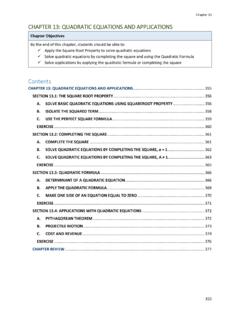
1 CHAPTER 8 211 CHAPTER 8: EXPONENTS AND POLYNOMIALS CHAPTER Objectives By the end of this CHAPTER , students should be able to: Simplify exponential expressions with positive and/or negative EXPONENTS Multiply or divide expressions in scientific notation Evaluate POLYNOMIALS for specific values Apply arithmetic operations to POLYNOMIALS Apply special-product formulas to multiply POLYNOMIALS Divide a polynomial by a monomial or by applying long division CHAPTER 8: EXPONENTS AND POLYNOMIALS .. 211 SECTION : EXPONENTS RULES AND PROPERTIES .. 212 A. PRODUCT RULE OF EXPONENTS .. 212 B. QUOTIENT RULE OF EXPONENTS .. 212 C. POWER RULE OF EXPONENTS .. 213 D. ZERO AS AN 214 E. negative EXPONENTS .. 214 F. PROPERTIES OF EXPONENTS .. 215 EXERCISE .. 216 SECTION SCIENTIFIC NOTATION .. 217 A. INTRODUCTION TO SCIENTIFIC NOTATION .. 217 B. CONVERT NUMBERS TO SCIENTIFIC NOTATION.
2 218 C. CONVERT NUMBERS FROM SCIENTIFIC NOTATION TO STANDARD NOTATION .. 218 D. MULTIPLY AND DIVIDE NUMBERS IN SCIENTIFIC NOTATION .. 219 E. SCIENTIFIC NOTATION APPLICATIONS .. 220 EXERCISE .. 222 SECTION : POLYNOMIALS .. 223 A. INTRODUCTION TO POLYNOMIALS .. 223 B. EVALUATING POLYNOMIAL EXPRESSIONS .. 225 C. ADD AND SUBTRACT POLYNOMIALS .. 226 D. MULTIPLY POLYNOMIAL EXPRESSIONS .. 228 E. SPECIAL PRODUCTS .. 230 F. POLYNOMIAL DIVISION .. 231 EXERCISE .. 237 CHAPTER REVIEW .. 239 CHAPTER 8 212 SECTION : EXPONENTS RULES AND PROPERTIES A. PRODUCT RULE OF EXPONENTS MEDIA LESSON Product rule of EXPONENTS (Duration 2:57) View the video lesson, take notes and complete the problems below 3 2=( )( ) = 5 Product rule: = + _____! Example 1: (2x3)(4x2)( 3x) = _____ Example 2: (5a3b7)(2a9b2c4) = _____ Warning!
3 The rule can only apply when you have the same base. YOU TRY Simplify: a) 53510 b) 1 3 2 c) (2 3 5 )(5 2 3) B. QUOTIENT RULE OF EXPONENTS MEDIA LESSON Quotient rule of EXPONENTS (Duration 3:12) View the video lesson, take notes and complete the problems below 5 3= = 2 Quotient Rule: = _____ Example 1: 7 2 3 = _____ Example 2: 8 7 46 5 = _____ YOU TRY Simplify a) 71375 b) 5 3 5 22 3 c) 3 5 3 CHAPTER 8 213 C.
4 POWER RULE OF EXPONENTS MEDIA LESSON Power rule of EXPONENTS (Duration 5:00) View the video lesson, take notes and complete the problems below (ab)3=_____ = _____ Power of a product: ( ) = 3=_____ =_____ Power of a Quotient: = , if b is not 0. ( 2)3 = _____ = _____ Power of a Power: ( ) = Example 1: (5 4 )3 Example 2: 5 39 4 2 Warning! It is important to be careful to only use the power of a product rule with multiplication inside parenthesis. This property is not allowed for addition or subtraction, , ( + ) + ( ) YOU TRY Simplify: a) 3 2 5 b) 2352 7 c) ( 3 2)4 d) (4 2 5)3 e) 3 8 5 2 f) 4 8 2 CHAPTER 8 214 D.
5 ZERO AS AN exponent MEDIA LESSON Zero as exponent (Duration 3:51) View the video lesson, take notes and complete the problems below 3 3=_____ Zero Power Rule: = Example 1: (5 3 5)0 Example 2: (3 2 0)(5 0 4) YOU TRY Simplify the expressions completely a) (3x2)0 b) 2 0 63 5 E. negative EXPONENTS MEDIA LESSON negative EXPONENTS (Duration 4:44) View the video lesson, take notes and complete the problems below 3 5 = _____ =_____ negative exponent Rule: = When a and b are not 0. 1 = = = Example 1: 7 53 1 4 Example 2: 25 4 Warning! It is important to note a negative exponent does not imply the expression is negative , only the reciprocal of the base.
6 Hence, negative EXPONENTS imply reciprocals. YOU TRY a) 35 1 b) 3 2 2 1 4 CHAPTER 8 215 F. PROPERTIES OF EXPONENTS Putting all the rules together, we can simplify more complex expression containing EXPONENTS . Here we apply all the rules of EXPONENTS to simplify expressions. exponent Rules Product = + Quotient = Power of Power ( ) = Power of a Product ( ) = Power of a Quotient = Zero Power = negative Power = Reciprocal of negative Power = negative Power of a Quotient = = MEDIA LESSON Properties of EXPONENTS (Duration 5:00) View the video lesson, take notes and complete the problems below Example 1: (4x5y2z)2(2 4 2 3)4 Example 2: 2x2y3 4 x4y 6 2(x 6y4)2 YOU TRY Simplify and write your final answers in positive EXPONENTS .
7 A) 4 5 3 3 3 26 5 3 b) 3 3 2 32 4 0 CHAPTER 8 216 EXERCISE Simplify. Be sure to follow the simplifying rules and write answers with positive EXPONENTS . 1) 4 44 44 2) 4 22 3) 3 4 4) 2 4 2 4 2 5) (33)4 6) (44)2 7) (2 3 2)2 8) (2 4)4 9) 4543 10) 2 4 2 11) ( )3 12) 3733 13) 323 14) 3 23 15) 4 3 43 3 16) 2 44 17) 3 4 2 18) ( 2 2 2 4)3 19) ( 3 4 2 2 3)2 20) 2 ( 4 4)4 21) 2 7 53 3 4 2 3 22) (2 )3 3 2 23) 2 17(2 2 4)4 3 24) 2 4 2 4 4 4 3 25) 2 5 2 2 32 4 3 26) 2 2 2 6 2 2 2( 2 3)2 27) 2 ( 0 2)4 28) 2 7 2 4 2 3 3 4 29) 2 2 2 7( 4)2 30) 2 4 22 4 31) 2 2 2 7( 4)2 32) 3 4 22 33) 2 3 2 22 2 4 2 34) 2 3 3 4 2 3( 3)2 35) 2 4 2 (2 3)4 36) 2 3 23 3 3 3 0 37) 12 0 4 2 38) 2 2 3 1 4 39) 2 2 4 3 44 4 4 4 40) 2 4 2 2 3 2 4 2 4 CHAPTER 8 217 SECTION SCIENTIFIC NOTATION A.
8 INTRODUCTION TO SCIENTIFIC NOTATION One application of exponent properties is scientific notation. Scientific notation is used to represent really large or really small numbers, like the numbers that are too large or small to display on the calculator. For example, the distance light travels per year in miles is a very large number (5,879,000,000,000) and the mass of a single hydrogen atom in grams is a very small number ( ). Basic operations, such as multiplication and division, with these numbers, would be quite cumbersome. However, the exponent properties allow us for simpler calculations. MEDIA LESSON Introduction of scientific notation (Watch from 0:00 9:00) View the video lesson, take notes and complete the problems below 100 =_____ 101 =_____ 102 =_____ 103 = _____ 10100 = _____ Avogadro number: 602,200,000,000,000,000,000,000 = _____ MEDIA LESSON Definition of scientific notation (Duration 4:59) View the video lesson, take notes and complete the problems below Standard Form (Standard Notation): _____ Scientific Notation: _____ b: _____ b positive: _____ b negative : _____ Example: Convert to Scientific Notation a) 48,100,000,000 = _____ b) = _____ CHAPTER 8 218 Definition Scientific notation is a notation for representing extremely large or small numbers in form of 10 where 1 < a < 10 and b is number of decimal places from the right or left we moved to obtain a.
9 A few notes regarding scientific notation: b is the way we convert between scientific and standard notation. b represents the number of times we multiply by 10. (Recall, multiplying by 10 moves the decimal point of a number one place value.) We decide which direction to move the decimal (left or right) by remembering that in standard notation, positive EXPONENTS are numbers greater than ten and negative EXPONENTS are numbers less than one (but larger than zero). Case 1. If we move the decimal to the left with a number in standard notation, then b will be positive. Case 2. If we move the decimal to the right with a number in standard notation, then b will be negative . B. CONVERT NUMBERS TO SCIENTIFIC NOTATION MEDIA LESSON Convert standard notation to scientific notation (Duration 1:40) View the video lesson, take notes and complete the problems below Example: Convert to scientific notation 8150000 = = YOU TRY Convert the following number to scientific notation a) 14,200 b) c) How long is a Light-Year?
10 The light-year is a measure of distance, not time. It is the total distance that a beam of light, moving in a straight line, travels in one year is almost 6 trillion (6,000,000,000,000) miles. Express a light year in scientific notation. (Source: NASA Glenn Educational Programs Office ) C. CONVERT NUMBERS FROM SCIENTIFIC NOTATION TO STANDARD NOTATION To convert a number from scientific notation of the form 10 to standard notation, we can follow these rules of thumb. If b is positive, this means the original number was greater than 10, we move the decimal to the right b times. If b is negative , this means the original number was less than 1 (but greater than zero), we move the decimal to the left b times. CHAPTER 8 219 MEDIA LESSON Convert scientific notation to standard notation (Duration 2:22) View the video lesson, take notes and complete the problems below Example: Rewrite in standard notation (decimal notation) a) 106 b) 10 4 YOU TRY Covert the following scientific notation to standard notation a) 105 b) 10 3 D.