Transcription of CHAPTER 9: USING VERBS CORRECTLY Choices: Investigating …
1 Language and Sentence Skills Practice179 Copyright by Holt, Rinehart and Winston. All rights : Investigating VerbsHere s your chance to step out of the grammar book and into the real world. You may not real-ize it, but examples of usage appear in your life every day. The following activities challengeyou to find a connection between VERBS and the world around you. Do the activity below thatsuits your personality best, and then share your discoveries with your class. Have fun!GAMEE very Word CountsWhat is the longest verb phrase (no compoundverbs!) that you can think of? Use as manymodals as you can. Challenge your classmates toa duel. To the victor goes the snack!CONTESTCome to OrderHold a contest. Begin by making a list of all thetenses. Then, write a sentence for each the class into groups of three or one copy of your sentences for each out the sentences, and tell everybody to cutthe sentences out so that they ll be on strips ofpaper.
2 On your signal, each group should placethe sentences in order from past to future. Thefirst group to do so CORRECTLY GlassChoose twenty of the peskiest VERBS in the chap-ter. Type them into a word processor. Then,enlarge the size of the letters that change for eachform. For instance, for the past participle of theword swim, you would see the letters s, w, andmin small letters and the letter u in a large may wish also to boldface the magnified letters. Pass out copies of your list to your ARTSit Down, You re Rockin the Boat!Use a public domain illustration library to createsmall posters illustrating the proper use of you want to go really wild, you could design adeck of playing cards, with each card illustratinga situation in which one form of these VERBS isused CORRECTLY . Naturally, you ll need to includethe sentence that each picture by OneWhether you know it or not, verb tenses are partof your life.
3 Make a list of all the tenses, includ-ing emphatic tense. For each tense, write onesentence about you and your life. Underlineeach verb or verb SituationsWhy do you think it is so important to maintainconsistency of verb tenses when writing aboutpast events? Try this activity. Write a descriptionof an event that happened to you or to someoneyou know, but don t pay close attention to theverb tenses. In fact, mix them up a bit. Next,rewrite your description, this time focusing onconsistent verb tenses throughout. Now, readyour first version aloud to a classmate. Have himor her write down the sequence of events as heor she believes they happened. Finally, read yoursecond version to your classmate and have himor her do the same thing. Is there a difference inyour classmate s perception of which event hap-pened before or after another?
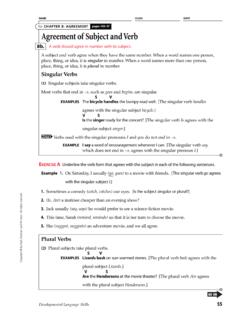
4 ANALYZINGThe Voice of ReasonYour textbook offers a reliable explanation ofhow sentences containing active-voice VERBS aretransformed into sentences containing passive-voice VERBS , but there may be more to it thanthat. Is it always the case that only the object ofan active-voice verb can become the subject of apassive-voice verb , or can something else, suchas the object of a preposition, become the sub-ject? For example, can t you say The house wasbroken into ? Think about these questions, andcome up with at least fifteen sentences that illus-trate different kinds of passive | Language in Context: ChoicesforCHAPTER 9: USING VERBS CORRECTLY pages 186=205180 HOLTHANDBOOKS econd CourseCopyright by Holt, Rinehart and Winston. All rights Principal Parts of VerbsThe four principal parts of a verb are the base form ,the present participle,the past,and thepast FORMPRESENT PARTICIPLEPASTPAST PARTICIPLE arrive[is]arrivingarrived[have]arrivedta lk[is]talkingtalked[have]talkedswim[is]s wimmingswam[have]swumEXERCISEIn each of the following sentences, identify the form of the underlined verb by writing above itBfor base form , PresPfor present participle, Pfor past,or PastPfor past dogs are rolling in the s sing another has heard about the failed left for Africa late Sunday ducks have been paddling around on the surface of the understood the speech, but I didn t agree with had been to England once the morning, the eagle s eggs you help Gina clean the kitchen, please?
5 Helicopters have landed next to the soccer save money, I am trying to bring my lunch to school more it true that she made them leave early? sun has set already, hasn t it? , the snake slithered quietly Ferris wheel is slowly coming to a by the crowds, we stood in a doorway and , have you ever seen a morning glory open? goalie leaped into the air and grabbed the hope the guards let us get close enough to see the they had swept, they carried out the thought you were singing in tonight s performance, 9: USING VERBS CORRECTLY pages 186=87 PresPLanguage and Sentence Skills Practice181 Copyright by Holt, Rinehart and Winston. All rights VerbsA regular verbforms its past and past participle by adding dor edto the base recently adopteda Chihuahua the blank in each of the following sentences, write the correct past or past participle formof the verb given in (collect)How many baseball cards have you _____?
6 1.(talk)When he first _____ to me, I thought he was from (suppose)They were _____ to help put up the (land)The spaceship _____ on the cold surface of the (name)Kelly has a dog that she _____ (enjoy)Carla has _____ the classes she is (consider)I _____ him my best (close)Have you _____ the front door?8.(open)The archaeologists carefully _____ the door to the (please)The jester _____ the court with his (stay)Have you _____ with her before, Susan?11.(predict)On the news last night, the forecaster _____ (watch)The mother cat has _____ over her kittens (roar)The lion _____ , and the tiger (cheer)Your funny story _____ her (wait)The patients have all _____ here for a while (gain)What, after all, have they _____ by being spiteful?17.(promise)If she has _____ , I know she will keep her (walk)The last people to finish the 10K race waved to me as they _____across the finish (return)I _____ to my seat and buckled my seat (expect)The dogs had _____ to go for a 9: USING VERBS CORRECTLY page 187collected182 HOLTHANDBOOKS econd CourseCopyright by Holt, Rinehart and Winston.
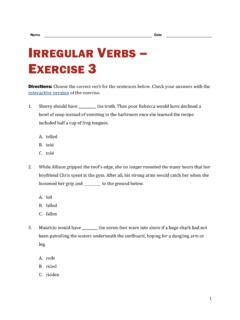
7 All rights VERBS AAn irregular verbforms its past and past participle in some other way than by adding dor edto the base irregular verb forms its past and past participle in one of these ways: changing consonants,changing vowels, changing consonants and vowels, or making no change at ship sankin readThe Pearlby John Steinbeck?EXERCISEIn each of the following sentences, underline the correct verb form in you (saw, seen)any of the movies showing now? strong wind has (blew, blown)the papers about the the morning, the delivery van (come, came)with our new washing mosquito (bited, bit)my leg the puppy had (ate, eaten)made it feel have (become, became) you ever (broken, broke)any bones? (brought, bringed)some pecans from our yard, was that project (began, begun)? think the inner tube in my front tire (bursted, burst)when I went over the have you (buyed, bought),Tony?
8 You (cut, cutted)any daisies to put on the dinner table? boy (chose, choosed)the straighter kind of table have you two (built, build)? think that lunch (costed, cost)more than Laura thought it or Frank (caught, catched)a baseball that was batted into the , has something (fallen, fell)over in there? had (drawn, drew)a picture of a just (drove, drived)to Cassville, you (drank, drunk)all the milk? (did, done)more than anyone else to make sure they 9: USING VERBS CORRECTLY pages 188=92 Language and Sentence Skills Practice183 Copyright by Holt, Rinehart and Winston. All rights VERBS BAn irregular verbforms its past and past participle in some other way than by adding dor edto the base irregular verb forms its past and past participle in one of these ways: changing consonants,changing vowels, changing consonants and vowels, or making no change at a snack I atesome fedthe horses?
9 EXERCISEIn each of the following sentences, underline the correct verb form in you two (lent, lended)Tom your notes? the sisters (forgave, forgiven)each other? two sides had (fought, foughten)about the terms of the many home runs have you (hitted, hit)this season? many times has that jet (flew, flown)across the Atlantic? think that Jorge (feeled, felt)bad about the water in the ice trays has not (frozen, froze) had (went, gone)to church before I had (gave, given)Aunt Jean a new we had dismounted, we (lead, led)the horses to the kinds of native plants (grown, grew)there? you (hurted, hurt)yourself, Amelia? both (heared, heard)the same cat (hid, hidden)under Michelle s bed and would not come anthropologist (found, finded)several cave dwellings in that mailbox (held, holded)seven catalogs and three think that the two of them (had, haved)a better time than they thought they have always (keeped, kept)secrets had long (knowed, known)Rabbi (laid, lay)the quilts on the two soldiers (got, gotten)ready for the 9: USING VERBS CORRECTLY pages 188=92184 HOLTHANDBOOKS econd CourseCopyright by Holt, Rinehart and Winston.
10 All rights VERBS CAn irregular verbforms its past and past participle in some other way than by adding dor edto the base irregular verb forms its past and past participle in one of these ways: changing consonants,changing vowels, changing consonants and vowels, or making no change at wasthe Great Wall of China built?Each student has writtenan essay about an endangered the blank in each of the following sentences, write the correct past or past participle formof the verb given in (let)Yesterday, the O Daniels _____ their cats go (shake)We had _____ the rugs (light)The hostess _____ the (lose)The boys have _____ no time getting (ride)The jockey _____ the thoroughbred across the finish (meet)The plan has _____ with strong (pay)I _____ a little more to get tools of better (put)Yesterday, Aunt Elma _____ a blooming rose in a vase on the (make)Has he ever _____ grits before?