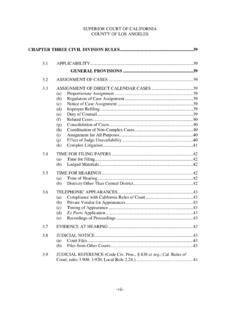
Transcription of CHAPTER THREE CIVIL DIVISION APPENDIX 3.A …
1 SUPERIOR COURT OF CALIFORNIACOUNTY OF LOS ANGELES[Ref. Local Rule eff. 7/1/2011] 1 of 4 CHAPTER THREECIVIL DIVISIONAPPENDIX FOR civility IN litigation (a) CONTINUANCES AND EXTENSIONS OF TIME. (1) First requests for reasonable extensions of time to respond to litigation deadlines, whetherrelating to pleadings, discovery or motions, should ordinarily be granted as a matter of courtesyunless time is of the essence. A first extension should be allowed even if the counsel requesting ithas previously refused to grant an extension.
2 (2) After a first extension, any additional requests for time should be dealt with by balancingthe need for expedition against the deference one should ordinarily give to an opponent s scheduleof professional and personal engagements, the reasonableness of the length of extension requested,the opponent s willingness to grant reciprocal extensions, the time actually needed for the task, andwhether it is likely a court would grant the extension if asked to do so.(3) A lawyer should advise clients against the strategy of granting no time extensions for thesake of appearing tough.
3 (4) A lawyer should not seek extensions or continuances for the purpose of harassment orprolonging litigation .(5) A lawyer should not attach to extensions unfair and extraneous conditions. A lawyer isentitled to impose conditions such as preserving rights that an extension might jeopardize or seekingreciprocal scheduling concessions. A lawyer should not, by granting extensions, seek to precludean opponent s substantive rights, such as his or her right to move against a complaint.(b) SERVICE OF PAPERS.(1) The timing and manner of service of papers should not be used to the disadvantage of theparty receiving the papers.
4 (2) Papers should not be served sufficiently close to a court appearance so as to inhibit theability of opposing counsel to prepare for that appearance or, where permitted by law, to respondto the papers.(3) Papers should not be served in order to take advantage of an opponent s known absencefrom the office or at a time or in a manner designed to inconvenience an adversary, such as late onFriday afternoon or the day preceding a secular or religious holiday.(4) Service should be made personally or by facsimile transmission when it is likely thatservice by mail, even when allowed, will prejudice the opposing COURT OF CALIFORNIACOUNTY OF LOS ANGELES[Ref.]
5 Local Rule eff. 7/1/2011] 2 of 4(c) WRITTEN SUBMISSIONS TO A COURT, INCLUDING BRIEFS, MEMORANDA, AFFIDAVITS ANDDECLARATIONS.(1) Written briefs or memoranda or points and authorities should not rely on facts that arenot properly part of the record. A litigant may, however, present historical, economic, or sociologicaldata if such data appear in or are derived from generally available sources.(2) Neither written submissions nor oral presentations should disparage the intelligence,ethics, morals, integrity or personal behavior of one s adversaries, unless such things are directlyand necessarily in issue.
6 (d) COMMUNICATIONS WITH ADVERSARIES.(1) Counsel should at all times be CIVIL and courteous in communicating with adversaries,whether in writing or orally.(2) Letters should not be written to ascribe to one s adversary a position he or she has nottaken or to create a record of events that have not occurred.(3) Letters intended only to make a record should be used sparingly and only when thoughtto be necessary under all the circumstances.(4) Unless specifically permitted or invited by the Court, letters between counsel should notbe sent to judges.
7 (e) DEPOSITIONS.(1) Depositions should be taken only where actually needed to ascertain facts or informationor to perpetuate testimony. They should never be used as a means of harassment or to generateexpense.(2) In scheduling depositions, reasonable consideration should be given to accommodatingschedules or opposing counsel and of the deponent, where it is possible to do so without prejudicingthe client s rights.(3) When a deposition is noticed by another party in the reasonably near future, counselshould ordinarily not notice another deposition for an earlier date without the agreement of opposingcounsel.
8 (4) Counsel should not attempt to delay a deposition for dilatory purposes but only ifnecessary to meet real scheduling problems.(5) Counsel should not inquire into a deponent s personal affairs or question a deponent sintegrity where such inquiry is irrelevant to the subject matter of the deposition.(6) Counsel should refrain from repetitive or argumentative questions or those asked solelyfor purposes of harassment.(7) Counsel defending a deposition should limit objections to those that are well founded andnecessary for the protection of a client s interest.
9 Counsel should bear in mind that most objectionsare preserved and need be interposed only when the form of a question is defective or privilegedinformation is sought.(8) While a question is pending, counsel should not, through objections or otherwise, coachthe deponent or suggest answers.(9) Counsel should not direct a deponent to refuse to answer questions unless they seekprivileged information or are manifestly irrelevant or calculated to harass.(10) Counsel for all parties should refrain from self-serving speeches during depositions.
10 (11) Counsel should not engage in any conduct during a deposition that would not be allowedin the presence of a judicial COURT OF CALIFORNIACOUNTY OF LOS ANGELES[Ref. Local Rule eff. 7/1/2011] 3 of 4(f) DOCUMENT DEMANDS.(1) Demands for production of documents should be limited to documents actually andreasonably believed to be needed for the prosecution or defense of an action and not made to harassor embarrass a party or witness or to impose an inordinate burden or expense in responding.(2) Demands for document production should not be so broad as to encompass documentsclearly not relevant to the subject matter of the case.