Transcription of chapter two - Salem State University
1 Thompson Strickland Gamble: crafting and executing strategy : Concepts and Cases, 16th EditionI. Concepts and Techniques for crafting and executing Strategy2. The Managerial Process of crafting and executing strategy The McGraw Hill Companies, 2008 Unless we change our direction we are likely to end up where we are headed. Ancient Chinese proverbIf we can know where we are and something about how we got there, we might see where we are trending and if the outcomes which lie naturally in our course are unacceptable, to make timely change. Abraham LincolnIf you don t know where you are going, any road will take you there.
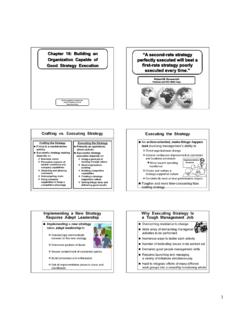
2 The KoranManagement s job is not to see the company as it is .. but as it can become. John W. TeetsFormer CEO2chapter twoThe Managerial Process of crafting and executing StrategyThompson Strickland Gamble: crafting and executing strategy : Concepts and Cases, 16th EditionI. Concepts and Techniques for crafting and executing Strategy2. The Managerial Process of crafting and executing strategy The McGraw Hill Companies, 2008 crafting and executing strategy are the heart and soul of managing a business enterprise. But exactly what is involved in developing a strategy and executing it proficiently?
3 What are the various components of the strategy -making, strategy - executing process? And to what extent are company personnel aside from top executives involved in the process? In this chapter we present an overview of the managerial ins and outs of crafting and executing company strategies. Special attention will be given to management s direction-setting responsibilities charting a strategic course, setting performance targets, and choosing a strategy capable of pro-ducing the desired outcomes. We will also examine which kinds of strategic decisions are made at which levels of management and the roles and responsibilities of the com-pany s board of directors in the strategy -making, strategy - executing DOES THE strategy -MAKING, strategy - executing PROCESS ENTAIL?
4 The managerial process of crafting and executing a company s strategy consists of five interrelated and integrated a strategic visionof where the company needs to head and what its future product/market/customer technology focus should objectivesand using them as yardsticks for measuring the company s performance and a strategy to achieve the objectivesand move the company along the strategic course that management has and executing the chosen strategy effi ciently and performance and initiating corrective adjustmentsin the company s long-term direction, objectives, strategy , or execution in light of actual experience, changing conditions, new ideas, and new displays this five-phase process.
5 Let s examine each phase in enough detail to set the stage for the forthcoming chapters and give you a bird s-eye view of what this book is Strickland Gamble: crafting and executing strategy : Concepts and Cases, 16th EditionI. Concepts and Techniques for crafting and executing Strategy2. The Managerial Process of crafting and executing strategy The McGraw Hill Companies, 2008 Very early in the strategy -making process, a company s senior managers must wrestle with the issue of what path the company should take and what changes in the com-pany s product/market/customer/technology focus would improve its market position and future prospects.
6 Deciding to commit the company to one path versus another pushes managers to draw some carefully reasoned conclusions about how to modify the company s business makeup and what market position it should stake out. A num-ber of direction-shaping factors need to be considered in deciding where to head and why such a direction makes good business sense see Table management s views and conclusions about the company s direction and future product/market/customer/technology focus constitute a strategic visionforthe company. A strategic vision delineates management s aspirations for the business, providing a panoramic view of where we are going and a convincing rationale for why this makes good business sense for the company.
7 A strategic vision thus points an organization in a particular direction, charts a strategic path, and molds organizational identity. A clearly articulated strategic vision communicates management s aspirations to stakeholders and helps steer the energies of company personnel in a common direction. For instance, Henry Ford s vision of a car in every garage had power because it captured the imagination of others, aided internal efforts to mobilize the Ford Motor Company s resources, and served as a reference point for gauging the merits of the company s strategic 1 Phase 2 Phase 3 Phase 4 Phase 5 Developinga strategicvisionSettingobjectivesCrafting astrategy toachieve theobjectivesand visionImplementingand executingthe strategyMonitoringdevelopments,evaluatin gperformance,and makingcorrectiveadjustmentsRevise as needed in light of actual performance.
8 Changing conditions, new opportunities, and new ideasFigure strategy -Making, strategy - executing ProcessCore ConceptAstrategic vision describes the route a company intends to take in developing and strength-ening its business. It lays out the company s strategic course in preparing for the A STRATEGIC VISION: PHASE 1 OF THE strategy -MAKING, strategy - executing PROCESS20 Part 1 Concepts and Techniques for crafting and executing StrategyThompson Strickland Gamble: crafting and executing strategy : Concepts and Cases, 16th EditionI. Concepts and Techniques for crafting and executing Strategy2.
9 The Managerial Process of crafting and executing strategy The McGraw Hill Companies, 2008 Well-conceived visions are distinctiveandspecifi cto a particular organization; they avoid generic feel-good statements like We will become a global leader and the first choice of customers in every market we choose to serve which could apply to any of hundreds of they are not the product of a committee charged with coming up with an innocuous but well-meaning one-sentence vision that wins consensus approval from various stakeholders. Nicely worded vision statements with no specifics about the company s product/market/customer/technology focus fall well short of what it takes for a vision to measure up.
10 A strategic vision proclaiming management s quest to be the market leader or to be the first choice of customers or to be the most innovative or to be recognized as the best company in the industry offers scant guidance about a company s direction and what changes and challenges lie on the road a strategic vision to function as a valuable managerial tool, it must (1) provide understanding of what management wants its business to look like and (2) provide managers with a reference point in making strategic decisions and preparing the com-pany for the future.