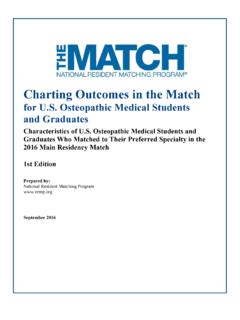
Transcription of Charting Outcomes in the Match
1 Charting Outcomes in the Matchfor allopathic SeniorsCharacteristics of allopathic Seniors Who Matched to Their Preferred Specialty in the 2016 Main Residency Match1st EditionPrepared by:National Resident Matching 2016 Questions about the contents of this publication may be directed to Mei Liang, Director of Research, National Resident Matching Program, (202) 400-2233 or about the NRMP should be directed to Mona M. Signer, President and CEO, National Resident Matching Program, (202) 400-2233 or 2016 National Resident Matching Program, 2121 K Street, NW, Suite 1000, Washington, DC 20037 USA. All rights reserved. Permission to use, copy and/or distribute any documentation and/or related images from this publication shall be expressly obtained from the NRMPN ational Resident Matching Program, Charting Outcomes in the Match for allopathic Seniors, 2016.
2 National Resident Matching Program, Washington, DC 2016. 2016 Table of Contents Introduction .. ii Tables and Charts for All Specialties Chart 1. Active Applicants in the 2016 Main Residency Match .. 2 Table 1. Number of Applicants and Positions in the 2016 Main Residency Match .. 3 Chart 2. Ratio of allopathic Seniors Ranking Specialty First / Available Positions .. 4 Chart 3. Match Rates of allopathic Seniors .. 5 Table 2. Summary Statistics on allopathic Seniors .. 6 Chart 4. Median Number of Contiguous Ranks of allopathic Seniors .. 7 Chart 5. Mean Number of Different Specialties Ranked of allopathic Seniors .. 8 Chart 6. USMLE Step 1 Scores of allopathic Seniors .. 9 Chart 7.
3 USMLE Step 2 CK Scores of allopathic Seniors .. 10 Chart 8. Mean Number of Research Experiences of allopathic Seniors .. 11 Chart 9. Mean Number of Abstracts, Presentations, and Publications of allopathic Seniors .. 12 Chart 10. Mean Number of Work Experiences of allopathic Seniors .. 13 Chart 11. Mean Number of Volunteer Experiences of allopathic Seniors .. 14 Chart 12. Percentage of allopathic Seniors Who are Members of AOA .. 15 Chart 13. Percentage of allopathic Seniors Graduating from One of the 40 Medical Schools with the Highest NIH Funding .. 16 Chart 14. Percentage of allopathic Seniors Who Have a Graduate Degree .. 17 Tables and Charts for Individual Specialties Anesthesiology.
4 18 Child Neurology .. 27 Dermatology .. 36 Diagnostic Radiology .. 45 Emergency Medicine .. 54 Family Medicine .. 63 General Surgery .. 72 Internal Medicine .. 81 Internal Medicine/Pediatrics .. 90 Neurological Surgery .. 99 Neurology .. 108 Obstetrics and Gynecology .. 117 Orthopaedic Surgery .. 126 Otolaryngology .. 135 Pathology .. 144 Pediatrics .. 153 Physical Medicine and Rehabilitation .. 162 Plastic Surgery .. 171 Psychiatry .. 180 Radiation Oncology .. 189 Vascular Surgery .. 198 iCopyright 2016 NRMP. Reproduction prohibited without the written permission of the Outcomes in the Matchfor allopathic Seniors, 2016 2016 IntroductioniiCopyright 2016 NRMP.
5 Reproduction prohibited without the written permission of the first edition of Charting Outcomes in the Match was published in August 2006 to document how applicant qualifications affectsuccess in the Main Residency Match . The report was published biennially between 2007 and 2011 and was a collaboration of theNational Resident Matching Program (NRMP ) and the Association of American Medical Colleges (AAMC ). Match outcome data from the NRMP were combined with applicant characteristics from the AAMC s Electronic Residency Application Service (ERAS ) and United States Medical Licensing Examination (USMLE ) scores from the AAMC data warehouse. However, starting with the 2014 MainResidency Match , the NRMP added a Professional Profile section to its Match registration process to collect the USMLE scores and otherapplicant characteristics.
6 NRMP has used those data to independently produce this report since the 2014 version of Charting Outcomes inthe Match . In prior years, this report examined the Match success of only two applicant groups: senior students from allopathic medical schools and independent applicants. Independent applicants included all applicant types other than seniors: previous graduates of medical schools, students/graduates of osteopathic medical schools, students/graduates of Fifth Pathway programs,students/graduates of Canadian medical schools, and citizen and citizen students/graduates of international medicalschools. Because independent applicants are a heterogeneous group, a decision was made this year to report data separately for allopathic medical school seniors, students/graduates of osteopathic medical schools, citizen students/graduates of international medical schools, and citizen students/graduates of international medical schools.
7 This report examines the characteristics allopathic seniors. DataMatch success, specialty preference, and ranking information were collected through the Main Residency Match . The 40 medical schools receiving the highest totals of National Institutes of Health (NIH) grants were obtained from the NIH website. Other applicantcharacteristics, including USMLE Step 1 and Step 2 CK scores, academic degrees, publications, Alpha Omega Alpha Honor MedicalSociety (AOA) membership, and research, work and volunteer experiences, were self-reported through the Professional Profile section ofthe NRMP s Applicant Registration Form for the Match . To complete the form, applicants were asked to answer the questions as they didin their ERAS Common Application Form (CAF).
8 Completion of the form was optional, and applicants who completed the form couldconsent or decline to participate in NRMP research. Data collection for the self-reported Professional Profile section was grantedexemption by the American Institutes for Research (AIR) Institutional Review Board (IRB). A total of 18,187 allopathic seniors submitted certified rank order lists in the 2016 Main Residency Match . After excluding the of allopathic seniors who did not give consent to participate in NRMP research, 16,484 applicants were included in the finaldataset. Missing data were found in Step 1 scores ( missing), Step 2 CK scores ( ), number of research experiences ( ), number of abstracts, presentations, and publications ( ), number of work experiences ( ), number of volunteer experiences( ), degree ( ), other graduate degree ( ), and AOA membership ( ).
9 To ensure that USMLE Step scores were not misreported, the NRMP asked medical schools to verify the scores of their seniorstudents. In 2016, 91 percent of the Step 1 scores and 92 percent of the Step 2 CK scores used in this report were verified, corrected, orsupplied by medical schools. Because the self-reported scores are highly accurate (the intracorrelation coefficient (ICC) between the self-reported scores and school-verified scores was for Step 1 scores and for Step 2 CK scores), both verified and unverified scores were used to prepare this report. MethodsSpecialties that offered 50 or more positions in the 2016 Main Residency Match are included in this report. Over the years, newspecialties have been added to the report, including Otolaryngology and Neurology in 2007, Neurological Surgery in 2009, and Child Neurology and Vascular Surgery in 2014.
10 Transitional Year programs were excluded beginning with the 2011 report because they are notviewed as a specialty measures are incorporated in this report. Probability analysis using a simple logistic regression model was introduced in 2009 toevaluate the relationship between Match success and contiguous ranks and USMLE Step 1 scores. Probability analyses in this report used data on seniors who participated in the Match in 2014, 2015, and 2016. Charting Outcomes in the Matchfor allopathic Seniors, 2016 iiiCopyright 2016 NRMP. Reproduction prohibited without the written permission of the is important to note that for purposes of this report, Match success is defined as a Match to the specialty of the applicant s first-ranked program, or "preferred specialty," because that is assumed to be the specialty of choice.