Transcription of CHEAT SHEET HAM RADIO FOR DUMMIES CHEAT SHEET
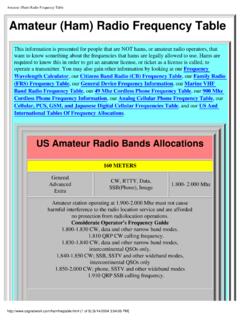
1 CHEAT SHEET HAM RADIO FOR DUMMIES CHEAT SHEET From Ham RADIO For DUMMIES , 3rd Edition By H. Ward Silver If you re new to ham RADIO , these articles contain information that new ham RADIO operators should keep handy while gathering experience. You ll find these references to be just what you need while learning to navigate the RADIO bands and make contacts. Bookmarking the websites in your web browser will help you while you re online, too. TECHNICIAN CLASS frequency PRIVILEGES IN HAM RADIO When you re getting started, remembering where you re allowed to operate is important. As a Technician licensee, you have free access to all amateur frequencies above 50 MHz, but what about on the shortwave high- frequency (HF) bands? This chart helps you follow the rules. A band-by-band plan showing where to find different types of activity is available from the American RADIO Relay League (ARRL). Band Frequencies (In MHz) Modes You Can Use 80 meters CW 40 meters CW 15 meters CW 10 meters CW, RTTY/data, 200 watts PEP maximum power CW, phone, 200 watts PEP maximum power Above 50 MHz All amateur privileges CW = Morse code; PEP = peak envelope power; RTTY = radioteletype.
2 GENERAL CLASS frequency PRIVILEGES IN HAM RADIO Soon, if you haven t done so already, you ll be thinking about upgrading. You have many more frequencies to use on the high- frequency (HF) bands, as shown in the following table . A complete chart of the frequency and mode privileges for all license classes is available from the American RADIO Relay League (ARRL). Band Frequencies (in MHz) Mode 160, 60, 30 meters All amateur privileges 80 meters CW, RTTY, data CW, phone, image 40 meters CW, RTTY, data CW, phone, image 20 meters CW, RTTY, data CW, phone, image 15 meters CW, RTTY, data CW, phone, image 17, 12, 10 meters All amateur privileges Above 50 MHz All amateur privileges CW = Morse code; RTTY = radioteletype. COMMON HAM RADIO Q SIGNALS Hams use three-letter Q signals on every mode and even in face-to-face conversation. Here are the Q signals most commonly used in day-to-day operation.
3 Each signal can be a question or an answer, as shown in the Meaning column. A complete list of ham RADIO Q signals, including those used on nets and repeaters, is available from the AC6V website. Q Signal Meaning QRL Is the frequency busy? The frequency is busy. Please do not interfere. QRM Abbreviation for interference from other signals. QRN Abbreviation for interference from natural or human-made static. QRO Shall I increase power? Increase power. QRP Shall I decrease power? Decrease power. QRQ Shall I send faster? Send faster (__words per minute [wpm]). QRS Shall I send more slowly? Send more slowly (__wpm). QRT Shall I stop sending or transmitting? Stop sending or transmitting. QRU Have you anything more for me? I have nothing more for you. QRV Are you ready? I am ready. QRX Stand by. QRZ Who is calling me? QSB Abbreviation for signal fading. QSL Did you receive and understand? Received and understood. QSO Abbreviation for a contact.
4 QST General call preceding a message addressed to all amateurs. QSX I am listening on ___ kHz. QSY Change to transmission on another frequency (or to ___ kHz). QTH What is your location? My location is ____. COMMON HAM RADIO REPEATER CHANNEL SPACINGS AND OFFSETS Until you become accustomed to using repeaters on all the different ham RADIO bands, this chart can help you remember the right offsets and channel spacings to use. Many radios have the standard options preprogrammed, but you need to be aware of what they should be. Band Output Frequencies of Each Group (In MHz) Offset from Output to Input frequency 6 meters 500 kHz 2 meters (a mix of 20 kHz and 15 kHz channel spacing) 600 kHz 600 kHz + 600 kHz 222 MHz or 1-1/4 meters MHz 440 MHz or 70 cm (local options determine whether inputs are above or below outputs) 442 445 (California repeaters start at 440 MHz) 447 450 + 5 MHz 5 MHz 1296 MHz or 23 cm 1282 1288 1290 1294 12 MHz YOUR HAM RADIO GO KIT Would you be ready if a call came from your local public service group to provide some ham RADIO expertise for a day or so?
5 Items in the following list are the basics of what should be in your RADIO go kit. Now is a good time to check your supplies and be prepared! Don t forget to put together a personal go kit, too. Dual-band (VHF/UHF) handheld RADIO and mini manual Full-size flexible whip antenna Copy of your Federal Communications Commission (FCC) license and any public service group or government agency IDs Mag-mount antenna with necessary adapters for connecting to various connectors Extra battery packs and charger AA-cell battery pack if available and fresh batteries AC power supply and cigarette-plug cord with spare fuses Headset with microphone (preferred) or speaker-mic Copy of your local emcomm frequencies, phone numbers, and procedures Pocket knife and/or multipurpose tool Flashlight or headlamp and spare batteries Pencil and notebook, clipboard, and permanent marker Duct tape, electrical tape, and a few small cable ties Cash for food, gas, and telephone calls (about $20 in small bills and change)
6 10 HANDY HAM RADIO WEBSITES The most common question asked by newcomers to ham RADIO is How do These ten websites are full of information that you can use as you try new things or hone your existing skills. Be sure to bookmark these pages in your home and mobile browsers. Website Organization and Use ARRL Many useful regulatory, educational, operating, and technical items and links AC6V and DX Zone General-interest websites with many links on all phases of ham RADIO Call sign lookup service and general-interest ham RADIO portal News, articles, equipment swap-and-shop, product reviews, and mailing lists Radiowave Propagation Center Real-time information on propagation and solar data Space Weather Prediction Center Real-time information on space weather and RADIO communications TAPR Information on digital data modes and software-defined RADIO (SDR) AMSAT Main site for information on amateur satellites WA7 BNM Contest Calendar Contest calendar and log due dates YOTA (Youngsters On the Air) World-wide group for student and young adult hams, based in Europe Collection of real-time maps showing worldwide activity on any amateur band DX Summit Worldwide DX spotting network