Transcription of Chemistry Moles Packet
1 Chemistry Moles Packet PAGE 1 Chemistry Moles Packet Chemistry Moles Packet PAGE 2 INTRODUCTION TO Moles We are about to start on a unit of chemical calculations called stoichiometry . Stoichiometry is how we calculate the relationships between the amounts of reactants and the amounts of products.
2 For example, if we know the amount of reactants we have, we can use stoichiometry to calculate how many products the chemical reaction will produce. This Packet provides an organized, step-by-step approach for these problems. If you follow this system and complete work each day as it is assigned, this will not be a difficult unit. That is good, because stoichiometry is one of the most central and important concepts in Chemistry . It is essential that you understand this unit in order to move forward in Chemistry .
3 In short: do not fall behind or you will be lost. These problems involve numbers but no difficult mathematics. All you will ever have to do is add, multiply or divide. You will be expected to have a functioning calculator with you for every Chemistry class. As we solve these problems we will apply the factor-label (dimensional analysis) method you mastered early in the class, and we will frequently use scientific notation. Remember chapter 3 you followed the procedure: what you are = what you are X a fraction or series of fractions where the = looking for given numerator is equivalent to the denominator The only new concept we will introduce in this unit is the idea of a mole.
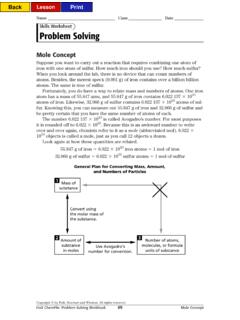
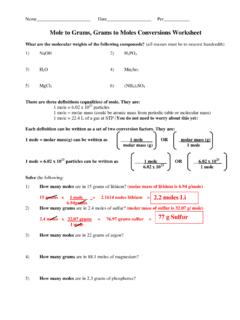
4 A mole is a quantity of matter that we use for conversion purposes. We can convert from grams to Moles , liters to Moles (for gases), and atoms or molecules to Moles . If you can convert any of these things to Moles (and therefore Moles to any of these things) we can convert grams to liters or molecules, liters to grams of molecules, and molecules to liters or grams. answer Molar mass (# grams) Atomic Weight (for elements) or Gram Formula/Molecular Weight (for compounds) X 1023 ATOMS (for elements) or X 1023 MOLECULES (for compounds) Moles LITERS OF A GAS AT STP (standard temperature and pressure) Chemistry Moles Packet PAGE 3 Chemistry WORKSHEET # 1 MOLAR mass (GRAM MOLECULAR/FORMULA WEIGHTS)
5 We know that grams are actually a measure of the mass of matter and not the weight. mass is the quantity of matter present; weight is a measure of the pull of gravity on matter and is measured in pounds or newtons. However, it is common usage in Chemistry to talk about the gram formula weight rather than the technically correct term gram formula mass or molar mass . We have learned that the smallest particle of an element is an atom and the periodic table tells us the atomic masses or atomic weights for each element.
6 We have also learned that the smallest unit of a compound are either molecules (for covalent compounds) or a collection of positive and negative ions (for ionic compounds). 1. What is the difference between mass and weight? 2. What unit is used to measure mass ? Weight? 3. What is the small unit of a covalent compound? An ionic compound? Molar mass tells us the mass ( weight ) of 1 mol of an atom or compound. In each case we simply calculate the sum of the weights of the atoms in the formula to determine the weight of a mole.
7 These weights can be found on the periodic table. EXAMPLE: Calculate the molar mass (gram molecular weight) of a mole of iodine, I2. Round to 2 decimal places. 2 I = 2 X ( ) = g I2/mol EXAMPLE: Calculate the molar mass (gram formula weight) of a mole of aluminum sulfate, Al2(SO4)3. Round to 2 decimal places. 2 Al = 2 X ( ) = 53. 96 3 S = 3 X ( ) = + 12 O = 12 X ( ) = _____ Al2(SO4)3 = g Al2(SO4)3 /mol CALCULATE THE MOLAR mass FOR THE FOLLOWING COMPOUNDS OR DIATOMIC ELEMENTS.
8 SET UP EACH PROBLEM AS SHOWN IN THE EXAMPLE ABOVE. INCLUDE UNITS (G/MOL) FORMULA CALCULATION mass OF A MOLE 1. water _____ _____ 2. calcium chloride _____ _____ 3. copper(II) sulfate _____ _____ 4. silver nitrate _____ _____ 5. sulfuric acid _____ _____ Chemistry Moles Packet PAGE 4 FORMULA CALCULATION mass OF A MOLE 6. calcium phosphate _____ _____ 7.
9 Sodium carbonate _____ _____ 8. ammonia _____ _____ 9. potassium chlorate _____ _____ 10. lead(II) nitrate _____ _____ 11. sodium oxalate _____ _____ 12. zinc chloride _____ _____ 13. magnesium oxide _____ _____ 14. antimony(III) chloride _____ _____ 15. nitrogen _____ _____ 16. oxygen _____ _____ 17. fluorine _____ _____ 18. chlorine _____ _____ Chemistry Moles Packet PAGE 5 Chemistry WORKSHEET # 2: THE MOLE AS A UNIT OF mass Define the term molar mass (worksheet #1): _____ Now that you know how to find the mass of one mole of a substance (molar mass ) you can easily find the mass of several Moles or the mass of a fraction of a mole using the factor-label technique.
10 EXAMPLE: What is the mass of Moles of water(H20)? 2 H = 2 x( ) = # grams H20 = Moles H20 x g H20 = g H2O O = 1 x( ) = 1 mole H20 H20 = g NOW YOU TRY ONE: What is the mass of Moles of calcium carbonate(CaCO3 )? Ca = #g CaCO3 = C = 3O = CaCO3 = USE A SEPARATE SHEET OF PAPER TO SOLVE THE FOLLOWING PROBLEMS. SHOW YOUR WORK. ROUND MOLAR MASSES TO TWO PLACES AFTER THE DECIMAL. ADD UNITS.