Transcription of Chemtech Blitz
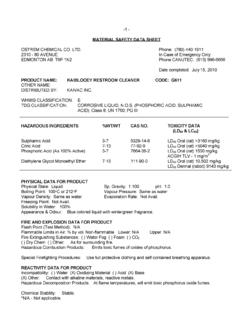
1 ITW AAMTech AustraliaChemwatch Hazard Alert Code: 3 Chemtech BlitzChemwatch: 8529-82 Version No: Data Sheet according to WHS and ADG requirementsIssue Date: 01/01/2013 Print Date: 28/03 1 IDENTIFICATION OF THE SUBSTANCE / MIXTURE AND OF THE COMPANY / UNDERTAKINGP roduct IdentifierProduct nameChemtech shipping namePHOSPHORIC ACID, SOLUTIONO ther means ofidentificationNot AvailableRelevant identified uses of the substance or mixture and uses advised againstRelevant identifiedusesAluminium of the supplier of the safety data sheetRegistered companynameITW AAMTech AustraliaAddress1-9 Nina Link, Dandenong South VIC 3175 AustraliaTelephone1800 177 989 Fax1800 308 telephone numberAssociation /OrganisationNot AvailableEmergency telephonenumbers1800 039 008 Other emergencytelephone numbers0800 2436 2255 SECTION 2 HAZARDS IDENTIFICATIONC lassification of the substance or mixtureHAZARDOUS CHEMICAL. DANGEROUS GOODS.
2 According to the WHS Regulations and the ADG ScheduleS6 Classification [1]Metal Corrosion Category 1, Acute Toxicity (Oral) Category 4, Skin Corrosion/Irritation Category 1A, Serious Eye DamageCategory 1 Legend:1. Classified by Chemwatch; 2. Classification drawn from HSIS ; 3. Classification drawn from EC Directive 1272/2008 - AnnexVILabel elementsGHS label WORDDANGERH azard statement(s)H290 May be corrosive to if severe skin burns and eye statement(s) PreventionP101If medical advice is needed, have product container or label at out of reach of label before not breathe dust/fume/gas/mist/ statement(s) ResponseP301+P330+P331IF SWALLOWED: Rinse mouth. Do NOT induce +P361+P353IF ON SKIN (or hair): Remove/Take off immediately all contaminated clothing. Rinse skin with +P351+P338IF IN EYES: Rinse cautiously with water for several minutes. Remove contact lenses, if present and easy to do. call a POISON CENTER or statement(s) StorageP405 Store locked statement(s) DisposalP501 Dispose of contents/container in accordance with local 3 COMPOSITION / INFORMATION ON INGREDIENTSS ubstancesSee section below for composition of MixturesMixturesCAS No%[weight]Name7664-38-230-60 Not Available1-10surfactantsNot Available0-1other non-hazardous ingredients7732-18-5>30 SECTION 4 FIRST AID MEASURESD escription of first aid measuresEye ContactIf this product comes in contact with the eyes: Immediately hold eyelids apart and flush the eye continuously with running water.
3 Ensure complete irrigation of the eye by keeping eyelids apart and away from eye and moving the eyelids by occasionallylifting the upper and lower lids. Continue flushing until advised to stop by the Poisons Information Centre or a doctor, or for at least 15 minutes. Transport to hospital or doctor without delay. Removal of contact lenses after an eye injury should only be undertaken by skilled personnel. Skin ContactIf skin or hair contact occurs:Immediately flush body and clothes with large amounts of water, using safety shower if available. Quickly remove all contaminated clothing, including footwear. Wash skin and hair with running water. Continue flushing with water until advised to stop by the Poisons InformationCentre. Transport to hospital, or doctor. InhalationIf fumes or combustion products are inhaled remove from contaminated area. Lay patient down. Keep warm and rested. Prostheses such as false teeth, which may block airway, should be removed, where possible, prior to initiating first aidphosphoric acidwaterChemwatch: 8529-82 Version No: 2 of 10 Chemtech BlitzIssue Date: 01/01/2013 Print Date: 28/03 Apply artificial respiration if not breathing, preferably with a demand valve resuscitator, bag-valve mask device, or pocketmask as trained.
4 Perform CPR if necessary. Transport to hospital, or doctor, without delay. IngestionFor advice, contact a Poisons Information Centre or a doctor at once. Urgent hospital treatment is likely to be needed. If swallowed do NOT induce vomiting. If vomiting occurs, lean patient forward or place on left side (head-down position, if possible) to maintain open airway andprevent aspiration. Observe the patient carefully. Never give liquid to a person showing signs of being sleepy or with reduced awareness; becoming unconscious. Give water to rinse out mouth, then provide liquid slowly and as much as casualty can comfortably drink. Transport to hospital or doctor without delay. Indication of any immediate medical attention and special treatment neededTreat acute or short term repeated exposures to strong acids:Airway problems may arise from laryngeal edema and inhalation exposure. Treat with 100% oxygen initially.
5 Respiratory distress may require cricothyroidotomy if endotracheal intubation is contraindicated by excessive swelling Intravenous lines should be established immediately in all cases where there is evidence of circulatory compromise. Strong acids produce a coagulation necrosis characterised by formation of a coagulum (eschar) as a result of the dessicating action of the acid onproteins in specific tissues. INGESTION:Immediate dilution (milk or water) within 30 minutes post ingestion is recommended. DO NOT attempt to neutralise the acid since exothermic reaction may extend the corrosive injury. Be careful to avoid further vomit since re-exposure of the mucosa to the acid is harmful. Limit fluids to one or two glasses in an adult. Charcoal has no place in acid management. Some authors suggest the use of lavage within 1 hour of ingestion. SKIN:Skin lesions require copious saline irrigation. Treat chemical burns as thermal burns with non-adherent gauze and wrapping.
6 Deep second-degree burns may benefit from topical silver sulfadiazine. EYE:Eye injuries require retraction of the eyelids to ensure thorough irrigation of the conjuctival cul-de-sacs. Irrigation should last at least 20-30 minutes. DO NOT use neutralising agents or any other additives. Several litres of saline are required. Cycloplegic drops, (1% cyclopentolate for short-term use or 5% homatropine for longer term use) antibiotic drops, vasoconstrictive agents or artificialtears may be indicated dependent on the severity of the injury. Steroid eye drops should only be administered with the approval of a consulting ophthalmologist). [Ellenhorn and Barceloux: Medical Toxicology]SECTION 5 FIREFIGHTING MEASURESE xtinguishing mediaWater spray or fog. Foam. Dry chemical powder. BCF (where regulations permit). Special hazards arising from the substrate or mixtureFire IncompatibilityNone for firefightersFire FightingAlert Fire Brigade and tell them location and nature of hazard.
7 Wear full body protective clothing with breathing apparatus. Prevent, by any means available, spillage from entering drains or water course. Use fire fighting procedures suitable for surrounding area. Fire/Explosion HazardNon combustible. Not considered to be a significant fire risk. Acids may react with metals to produce hydrogen, a highly flammable and explosive gas. Heating may cause expansion or decomposition leading to violent rupture of containers. Decomposition may produce toxic fumes of:,carbon dioxide (CO2),phosphorus oxides (POx),other pyrolysis products typical of burning organic : 8529-82 Version No: 3 of 10 Chemtech BlitzIssue Date: 01/01/2013 Print Date: 28/03 6 ACCIDENTAL RELEASE MEASURESP ersonal precautions, protective equipment and emergency proceduresSee section 8 Environmental precautionsSee section 12 Methods and material for containment and cleaning upMinor SpillsClean up all spills immediately.
8 Avoid breathing vapours and contact with skin and eyes. Control personal contact with the substance, by using protective equipment. Contain and absorb spill with sand, earth, inert material or vermiculite. Major SpillsClear area of personnel and move upwind. Alert Fire Brigade and tell them location and nature of hazard. Wear full body protective clothing with breathing apparatus. Prevent, by any means available, spillage from entering drains or water course. Personal Protective Equipment advice is contained in Section 8 of the 7 HANDLING AND STORAGEP recautions for safe handlingSafe handlingDO NOT allow clothing wet with material to stay in contact with skinAvoid all personal contact, including inhalation. Wear protective clothing when risk of exposure occurs. Use in a well-ventilated area. WARNING: To avoid violent reaction, ALWAYS add material to water and NEVER water to material. Other informationStore in original containers.
9 Keep containers securely sealed. Store in a cool, dry, well-ventilated area. Store away from incompatible materials and foodstuff containers. Conditions for safe storage, including any incompatibilitiesSuitable containerDO NOT use aluminium or galvanised containersCheck regularly for spills and leaks Lined metal can, lined metal pail/ can. Plastic pail. Polyliner drum. Packing as recommended by manufacturer. StorageincompatibilityReacts with mild steel, galvanised steel / zinc producing hydrogen gas which may form an explosive mixture with air. Segregate from alkalies, oxidising agents and chemicals readily decomposed by acids, cyanides, sulfides, carbonates. SECTION 8 EXPOSURE CONTROLS / PERSONAL PROTECTIONC ontrol parametersOCCUPATIONAL EXPOSURE LIMITS (OEL)INGREDIENT DATAS ourceIngredientMaterial nameTWASTELPeakNotesAustralia ExposureStandardsphosphoric acidPhosphoric acid1 mg/m33 mg/m3 Not AvailableNot AvailableEMERGENCY LIMITSI ngredientMaterial nameTEEL-1 TEEL-2 TEEL-3phosphoric acidPhosphoric acidNot AvailableNot AvailableNot AvailableIngredientOriginal IDLHR evised IDLH phosphoric acid10,000 mg/m31,000 mg/m3 Chemwatch: 8529-82 Version No: 4 of 10 Chemtech BlitzIssue Date: 01/01/2013 Print Date: 28/03 AvailableNot Availableother non-hazardousingredientsNot AvailableNot AvailablewaterNot AvailableNot AvailableExposure controlsAppropriateengineering controlsEngineering controls are used to remove a hazard or place a barrier between the worker and the hazard.
10 Well-designedengineering controls can be highly effective in protecting workers and will typically be independent of worker interactions toprovide this high level of basic types of engineering controls are:Process controls which involve changing the way a job activity or process is done to reduce the and/or isolation of emission source which keeps a selected hazard "physically" away from the worker andventilation that strategically "adds" and "removes" air in the work protectionEye and faceprotectionChemical face shield may be required for supplementary but never for primary protection of lenses may pose a special hazard; soft contact lenses may absorb and concentrate irritants. A written policydocument, describing the wearing of lenses or restrictions on use, should be created for each workplace or protectionSee Hand protection belowHands/feet protectionThe selection of suitable gloves does not only depend on the material, but also on further marks of quality which vary frommanufacturer to manufacturer.