Transcription of Chicago/Turabian Style
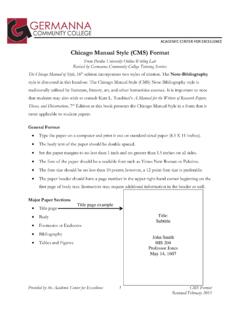
1 1 Chicago/Turabian Style formatting your paper All font must be the same throughout paper (12-point Times New Roman font recommended) Use left justification, not full justification Apply one inch margins around the entire paper Use a 1/2 inch indention for each paragraph Double space all lines, except block quotations and notes Use one space after concluding punctuation marks Place page numbers centered or flush right of an inch from the top of the page Use only white 8 1/2 by 11 inch paper Citing Sources To document means to tell the reader the source of any material a writer uses in writing his or her essay. Material needing documentation includes facts, statistical data, and ideas as well as the words used to express such information. Writers need to document, or cite, sources whether or not they are using the exact words of the original.
2 If using any of the exact words (even just a phrase), writers need to put quotation marks around those words in addition to citing the source. Failure to use quotation marks appropriately constitutes plagiarism. Key Terms Footnotes-These are notes that appear at the bottom of each page. Endnotes-These are notes that appear on the last page of the paper . Referential Notes-These are footnotes or endnotes that simply cite your source. Contextual Notes-These are footnotes or endnotes that contain explanatory information, not a citation. Parenthetical Reference/Author-date method-Use for in-text citation. Reference List-A list that appears at the end of the paper that cites the sources using the author-date method. Use the reference list in conjunction with parenthetical references. This list includes only those sources that are directly cited in the paper .
3 Bibliography-A list that appears at the end of the paper that cites all of the sources you consulted while researching for the paper . This list includes sources you do not directly cite in your paper . UMKC Writing Studio 2 How to use Chicago/Turabian in your paper With all of these key terms, you are probably wondering what type of citation devices you should use in the paper . If you are writing for a class, your best bet is to ask the professor, because he or she may prefer footnotes or endnotes to parenthetical references. If you have contextual analysis that you would like to leave outside the body of the paper , choose the note form of citation as opposed to parenthetical citation. Here are some quick guidelines to follow no matter what type of method you choose: If using endnotes or footnotes as referential notes, then a bibliography or reference page is not required.
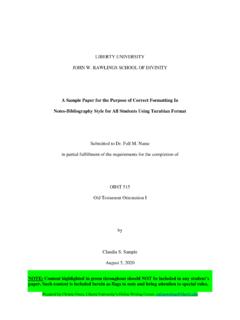
4 A bibliography is recommended, however, to provide context for your paper as a whole. Using a bibliography can reduce information needed in referential notes. If using endnotes or footnotes as contextual notes, then you need to cite the sources using a bibliography. If using parenthetical references/author date references, then a reference page is needed. Creating a Title Page If your professor does not give specific guidelines for creating a title page, Chicago/Turabian suggests that you center the title one-third of the way down the page written in ALL CAPS. Several lines below the title include: Your name Example of a title page The title of the course, including the department and course number The date TITLE OF THE paper Susie Q.
5 Student History 110: History of Western Civilization December 10, 2011 3 Using Footnotes and Endnotes With footnotes and endnotes, use the same number in both the body of the paper and in the note itself. Notes are numbered sequentially throughout the paper and are superscripted. The number in the footnote is followed by a period and only the first line is indented. Endnotes stylistically look the same as footnotes, and are also numbered sequentially; however, they appear at the end of the paper on a page entitled Notes, rather than at the bottom of each page. Numbering Footnotes and Endnotes Referential notes are numbered sequentially throughout a paper . Even if a specific reference is used multiple times, reference notes must appear in numerical order. If using footnotes, the note must always begin on the same page as the footnote marker, even if the note extends onto a later page.
6 Direct Quotation: Ex: Ann Charters explains that the history of storytelling extends far back to a time long before the invention of the printing press. 1 Paraphrased idea: Ex: In The Basic Elements of Fiction, the authors explain that conflict is at the core of a short story. Conflict allows the audience to follow the story in a particular direction, while adding structure and meaning to the Example of a footnote Example of endnotes page Referential Notes Referential notes are notes that simply cite the source. They do not need to contain any additional information. Contextual Notes You may include explanatory information in your footnotes and endnotes instead of, or in addition to, reference information.
7 If you provide contextual information as well citing a source in a note, give the source first, followed by a period, and then add your contextual explanation. Notes 1. Robert Sheer, Electorate Is Wising Up to the Iraq Blunder The Nation, 1 June 2003, 24. 2. Charles Bazerman, The Informed Writer (Boston: Houghton Mifflin Company, 1981), 25. 3. Christina Gorman, Why So Many of Us Are Getting Diabetes, Time, 30 Nov 2003, 24. After 9/11, the country looked toward President Bush for security and guidance. Americans believed that he had a clear understanding of how to fight terrorists, and that the war with Iraq was a necessary battle in this war on terrorism. Now, however, the trust that the American people have invested in the president for the last two and a half years is 1.
8 Robert Sheer, Electorate Is Wising Up to the Iraq Blunder The Nation, 1 June 2003, 24. 4 Ex: 1. Gillespie, The Allyn and Bacon Guide to Peer Tutoring, 35. Gillespie s list of questions is somewhat abbreviated, but it serves as a starting point for future discussion. Should you need both contextual endnotes and a bibliography, place the endnotes page before the bibliography. Using In-Text Citations Parenthetical References If you do not wish to use footnotes or endnotes, you may reference your sources in-text by using parenthetical citations. This method is also called the author/date method because, in the citation, the author s name is followed by the date of publication. Include the page number after the date. Ex: Informed writers can take information that they have read, process it in their minds, and then write about it in a way that is interpretive and analytical (Bazerman 1981, 22).
9 If you decide to use this method, include a reference list at the end of the paper . This list is different from a bibliography or an endnotes page because it follows the same author/date format that appears in the parenthetical references. An entry in a reference list would look like this: Ex: Bazerman, Charles. 1981. The informed writer. Boston: Houghton Mifflin Company. Notice that the date follows the name of the author. This makes it easier for a person reading the paper to find the source in the reference list. Short Form Notes If you include a bibliography as well as referential notes in your paper , the notes do not need to include full publication information; the bibliography will handle such details. The referential note need only include the author s last name, the full title of the referenced work and the page number (if appropriate).
10 The title of the work is often shortened if it is longer than four words; if so, omit A/An or The at the beginning of a title, focusing instead on key words; in such cases, however, the order of the words cannot be altered nor can words be skipped (see example 8 below). Short form notes are also used if the same source is referenced in a later note when the full citation information has already been given, in order to reduce documentation clutter. If you reference the same work multiple times in succession (with no other source between), you can instead use the word ibid. This term substitutes for the author s name and the work s title, and can also substitute for the page reference if needed. If the reference is to a different page, simply add the page number after ibid. as normal.