Transcription of Child Immunization Schedule - AAFP Home
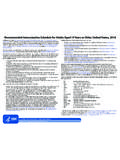
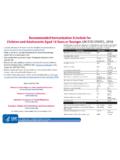
1 Figure 1. recommended Immunization Schedule for persons aged 0 through 18 years United States, 2014. (FOR THOSE WHO FALL BEHIND OR START LATE, SEE THE CATCH-UP Schedule [FIGURE 2]). These recommendations must be read with the footnotes that follow. For those who fall behind or start late, provide catch-up vaccination at the earliest opportunity as indicated by the green bars in Figure 1. To determine minimum intervals between doses, see the catch-up Schedule (Figure 2). School entry and adolescent vaccine age groups are in routinely recommendedRange of recommended ages for certain high-risk groupsRange of recommended ages for all childrenRange of recommended ages for catch-up immunizationNOTE: The above recommendations must be read along with the footnotes of this Schedule . This Schedule includes recommendations in effect as of January 1, 2014.
2 Any dose not administered at the recommended age should be administered at a subsequent visit, when indicated and feasible. The use of a combination vaccine generally is preferred over separate injections of its equivalent component vaccines. Vaccination providers should consult the relevant Advisory Committee on Immunization Practices (ACIP) statement for detailed recommendations, available online at Clinically significant adverse events that follow vaccination should be reported to the Vaccine Adverse Event Reporting System (VAERS) online ( ) or by telephone (800-822-7967).Suspected cases of vaccine-preventable diseases should be reported to the state or local health department. Additional information, including precautions and contraindications for vaccination, is available from CDC online ( ) or by telephone (800-CDC-INFO [800-232-4636]).
3 This Schedule is approved by the Advisory Committee on Immunization Practices ( ), the American Academy of Pediatrics ( ), the American Academy of Family Physicians ( ), and the American College of Obstetricians and Gynecologists ( ).Range of recommended ages during which catch-up is encouraged and for certain high-risk groupsVaccineBirth1 mo2 mos4 mos6 mos9 mos12 mos15 mos18 mos19 23 mos2-3 yrs4-6 yrs7-10 yrs11-12 yrs13 15 yrs16 18 yrsHepatitis B1 (HepB)Rotavirus2 (RV) RV1 (2-dose series); RV5 (3-dose series)Diphtheria, tetanus, & acel-lular pertussis3 (DTaP: <7 yrs)Tetanus, diphtheria, & acel-lular pertussis4 (Tdap: >7 yrs)Haemophilus influenzae type b5 (Hib)Pneumococcal conjugate6 (PCV13)Pneumococcal polysaccha-ride6 (PPSV23)Inactivated poliovirus7 (IPV) (<18 yrs)Influenza8 (IIV; LAIV) 2 doses for some: See footnote 8 Measles, mumps, rubella9 (MMR)Varicella10 (VAR)Hepatitis A11 (HepA) Human papillomavirus12 (HPV2: females only; HPV4: males and females)Meningococcal13 (Hib-Men-CY > 6 weeks; MenACWY-D >9 mos.)
4 MenACWY-CRM 2 mos) Booster1st doseSee footnote 13(3-dose series) 2-dose series, See footnote 112nd dose1st dose2nd dose1st doseAnnual vaccination (IIV or LAIV)Annual vaccination (IIV only)(Tdap)See footnote 22nd dose1st dose4th dose3rd dose2nd dose1st dose4th dose3rd dose2nd dose1st dose3rd or 4th dose, See footnote 5 See footnote 52nd dose1st dose5th dose4th dose3rd dose2nd dose1st dose3rd dose2nd dose1st doseFIGURE 2. Catch-up Immunization Schedule for persons aged 4 months through 18 years who start late or who are more than 1 month behind United States, figure below provides catch-up schedules and minimum intervals between doses for children whose vaccinations have been delayed. A vaccine series does not need to be restarted, regardless of the time that has elapsed between doses. Use the section appropriate for the Child s age.
5 Always use this table in conjunction with Figure 1 and the footnotes that aged 4 months through 6 yearsVaccineMinimum Age for Dose 1 Minimum Interval Between DosesDose 1 to dose 2 Dose 2 to dose 3 Dose 3 to dose 4 Dose 4 to dose 5 Hepatitis B1 Birth4 weeks8 weeks and at least 16 weeks after first dose; minimum age for the final dose is 24 weeksRotavirus26 weeks4 weeks4 weeks2 Diphtheria, tetanus, & acellular pertussis 36 weeks4 weeks4 weeks6 months6 months3 Haemophilus influenzae type b56 weeks4 weeks if first dose administered at younger than age 12 months8 weeks (as final dose) if first dose administered at age 12 through 14 monthsNo further doses neededif first dose administered at age 15 months or older4 weeks5 if current age is younger than 12 months and first dose administered at < 7 months old8 weeks and age 12 months through 59 months (as final dose)5 if current age is younger than 12 months and first dose administered between 7 through 11 months (regardless of Hib vaccine [PRP-T or PRP-OMP] used for first dose).
6 ORif current age is 12 through 59 months and first dose administered at younger than age 12 months; ORfirst 2 doses were PRP-OMP and administered at younger than 12 months. No further doses needed if previous dose administered at age 15 months or older8 weeks (as final dose) This dose only necessary for children aged 12 through 59 months who received 3 (PRP-T) doses before age 12 months and started the primary series before age 7 months Pneumococcal66 weeks4 weeks if first dose administered at younger than age 12 months8 weeks (as final dose for healthy children) if first dose administered at age 12 months or older No further doses needed for healthy children if first dose administered at age 24 months or older4 weeks if current age is younger than 12 months8 weeks (as final dose for healthy children) if current age is 12 months or olderNo further doses needed for healthy children if previous dose administered at age 24 months or older8 weeks (as final dose)
7 This dose only necessary for children aged 12 through 59 months who received 3 doses before age 12 months or for children at high risk who received 3 doses at any ageInactivated poliovirus76 weeks4 weeks74 weeks76 months7 minimum age 4 years for final doseMeningococcal136 weeks8 weeks13 See footnote 13 See footnote 13 Measles, mumps, rubella912 months4 weeksVaricella1012 months3 monthsHepatitis A1112 months6 monthsPersons aged 7 through 18 yearsTetanus, diphtheria; tetanus, diphtheria, & acellular pertussis47 years44 weeks 4 weeks if first dose of DTaP/DT administered at younger than age 12 months6 months if first dose of DTaP/DT administered at age 12 months or older and then no further doses needed for catch-up6 months if first dose of DTaP/DT administered at younger than age 12 monthsHuman papillomavirus129 yearsRoutine dosing intervals are recommended12 Hepatitis A1112 months6 monthsHepatitis B1 Birth4 weeks8 weeks (and at least 16 weeks after first dose)Inactivated poliovirus76 weeks4 weeks4 weeks76 months7 Meningococcal136 weeks8 weeks13 Measles, mumps, rubella912 months4 weeksVaricella1012 months3 months if person is younger than age 13 years 4 weeks if person is aged 13 years or olderNOTE.
8 The above recommendations must be read along with the footnotes of this Schedule . 1. Hepatitis B (HepB) vaccine. (Minimum age: birth)Routine vaccination: At birth: Administer monovalent HepB vaccine to all newborns before hospital discharge. For infants born to hepatitis B surface antigen (HBsAg)-positive mothers, administer HepB vaccine and mL of hepatitis B immune globulin (HBIG) within 12 hours of birth. These infants should be tested for HBsAg and antibody to HBsAg (anti-HBs) 1 to 2 months after completion of the HepB series, at age 9 through 18 months (preferably at the next well- Child visit). If mother s HBsAg status is unknown, within 12 hours of birth administer HepB vaccine regardless of birth weight. For infants weighing less than 2,000 grams, administer HBIG in addition to HepB vaccine within 12 hours of birth.
9 Determine mother s HBsAg status as soon as possible and, if mother is HBsAg-positive, also administer HBIG for infants weighing 2,000 grams or more as soon as possible, but no later than age 7 following the birth dose: The second dose should be administered at age 1 or 2 months. Monovalent HepB vaccine should be used for doses administered before age 6 weeks. Infants who did not receive a birth dose should receive 3 doses of a HepB-containing vaccine on a Schedule of 0, 1 to 2 months, and 6 months starting as soon as feasible. See Figure 2. Administer the second dose 1 to 2 months after the first dose (minimum interval of 4 weeks), administer the third dose at least 8 weeks after the second dose AND at least 16 weeks after the first dose. The final (third or fourth) dose in the HepB vaccine series should be administered no earlier than age 24 weeks.
10 Administration of a total of 4 doses of HepB vaccine is permitted when a combination vaccine containing HepB is administered after the birth dose. Catch-up vaccination: Unvaccinated persons should complete a 3-dose series. A 2-dose series (doses separated by at least 4 months) of adult formulation Recombivax HB is licensed for use in children aged 11 through 15 years. For other catch-up guidance, see Figure Rotavirus (RV) vaccines. (Minimum age: 6 weeks for both RV1 [Rotarix] and RV5 [RotaTeq])Routine vaccination:Administer a series of RV vaccine to all infants as follows: 1. If Rotarix is used, administer a 2-dose series at 2 and 4 months of age. 2. If RotaTeq is used, administer a 3-dose series at ages 2, 4, and 6 months. 3. If any dose in the series was RotaTeq or vaccine product is unknown for any dose in the series, a total of 3 doses of RV vaccine should be administered.