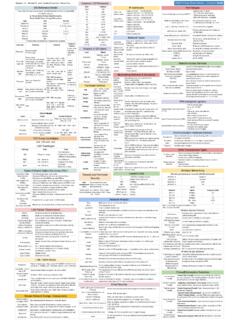
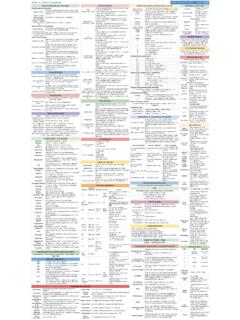
Transcription of CISSP Cheat Sheet Series Software Development Lifecycle
1 Anti-Virus TypesSignature basedNot able to detect new malware Zero-day attacksHeuristic based Static analysis without relying on signaturesCISSP Cheat Sheet SeriesSoftware Development Lifecycle (SDLC)Understand and integrate security throughout the Software Development Lifecycle (SDLC) Development MethodologiesBuild and fix No key architecture design Problems fixed as they occur No formal feedback cycle Reactive not proactiveWaterfall Linear sequential Lifecycle Each phase is completed before moving on No formal way to make changes during cycle Project ends before collecting feedback and re-startingV-shaped Based on the waterfall model Each phase is complete before moving on Verification and validation after each phase No risk analysis phasePrototyping Rapid prototyping - quick sample
2 To test the current project Evolutionary prototyping - incremental improvements to a design Operational prototypes - incremental improvements intended for productionIncremental Multiple cycles (~ multiple waterfalls) Restart at any time as a different phase Easy to introduce new requirements Delivers incremental updates to softwareSpiral Iterative Risk analysis during Development Future information and requirements considered for risk analysis Allows for testing early in developmentRapid Application Development (RAD)
3 Rapid prototyping Designed for quick Development Analysis and design are quickly demonstrated Testing and requirements are often revisitedAgile Umbrella term - multiple methods Highlights efficiency and iterative Development User stories describe what a user does and why Prototypes are filtered down to individual featuresProgramming Language TypesMachine LanguagesDirect instructions to processor - binary representationAssembly LanguageUse of symbols, mnemonics to represent binary codes - ADD, PUSH and POPHigh-Level LanguageProcessor independent programming languages - use IF, THEN and ELSE statements aspart of the code logicVery high-level languageGeneration 4 languages further reduce amount of code required - programmers can focus on algorithms.
4 Python, C++, C# and JavaNatural languageGeneration 5 languages enable system to learn and change on its own - AIDatabase Architecture and ModelsRelational ModelUses attributes (columns) and tuples (rows) to organize dataHierarchical ModelParent child structure. An object can have one child, multiple children or no ModelSimilar to hierarchical model but objects can have multiple ModelHas the capability to handle a variety of data types and is more dynamic than a relational ModelCombination of object oriented and relational Interface LanguagesOpen database connectivity (ODBC)Local or remote communication via APIJava database connectivity (JDBC)
5 java API that connects to a database , issuing queries and commands, etcXMLDB API allows XML applications to interact with more traditional databasesObject Linking and Embedding database (OLE DB)is a replacement for ODBCData Warehousing and Data MiningData WarehousingCombine data from multiple MiningArrange the data into a format easier to make business decisions based on the ThreatsAggregation The act of combining information from various Process of information piecingAccess Control Content Dependent Access Control: access is based on the sensitivity of the data Context Dependent Access Control: access via location, time of day, and previous access Control Mechanisms database Views.
6 Set of data a user or group can see database Locks: prevent simultaneous access Polyinstantiation: prevent data interference violations in databasesA C I DAtomicityDatabase roll back if all operations are not completed, transactions must be completed or not completed at allConsistency Preserve integrity by maintaining consistent transactionsIsolationTransaction keeps separate from other transactions until completeDurability Committed transaction cannot be roll backedTraditional SDLCS tepsAnalysis, High-level design, Detail Design, Construction, testing, ImplementationPhases Initiation.
7 Feasibility, cost analysis, risk analysis, Management approval, basic security controls Functional analysis and planning: Requirement definition, review proposed security controls System design specifications: detailed design specs, Examine security controls Software Development : Coding. Unit testing Prototyping, Verification, Validation Acceptance testing and implementation: security testing, data validationChange Management ProcessRequest ControlDevelop organizational framework where users can request modifications, conduct cost/ benefit analysis by management, and task prioritization by developersChange ControlDevelop organizational framework where developers can create and test a solution before implementation in a production ControlChange approval before releaseConfiguration Management ProcessSoftware Version Control (SVC)
8 A methodology for storing and tracking changes to softwareConfiguration IdentificationThe labelling of Software and hardware configurations with unique identifiersConfiguration ControlVerify modifications to Software versions comply with the change control and configuration management AuditEnsure that the production environment is consistent with the accounting recordsCapability Maturity ModelReactive1. Initiating informal processes,2. Repeatable project management processesProactive3. Defined engineering processes, project planning, quality assurance, configuration management practices4.
9 Managed product and process improvement5. Optimizing continuous process improvementProject Management ToolsGantt chartType of bar chart that illustrates the relationship between projects and schedules over Evaluation Review Technique (PERT)Project-scheduling tool used to measure the capacity of a Software product in Development which uses to calculate ( Development & Operations) Software Development Quality Assurance IT OperationsSoftware Development MethodsDatabase SystemsDatabaseDefine storing and manipulating dataDBMS ( database management system)
10 Software program control access to data stored in a TypesHierarchical Network Mesh Object-orientated RelationalDDLData definition language defines structure and schema DMLD egree of Db number of attributes (columns) in tableTuplerowDDED ynamic data exchangeDCLData control language. Subset of integrityensure semantic rules are enforced between data typesReferential integrity all foreign keys reference existing primary keysCandidate Keyan attribute that is a unique identifier within a given table, one of the candidates key becomes primary key and others are alternate keysPrimary Key unique data identificationForeign Keyreference to another table which include primary key.