Transcription of Claims Made vs. Occurrence Form Professional …
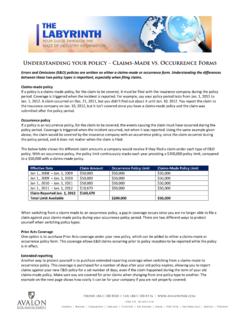
1 Claims made vs. Occurrence form Professional liability policies There are two primary policy forms for Professional liability Coverage the Claims made form and Occurrence form . Many types of Professional liability coverage, including Directors and Officers liability and Employment Practices liability , are only written on a Claims made form . Here are the differences between the two forms: Occurrence form When a policyholder has an Occurrence form , an incident that occurs during the policy period will be covered by that policy, regardless of how many years later the claim is reported. Incidents that occur before the Occurrence form policy is issued are not covered. Claims made form When a policyholder has a Claims made form , a claim that is made against the insured is covered by the policy in force at the time the claim is made .
2 A retroactive date is usually established as the day the very first Claims made policy is issued. All subsequent renewal policies use the same initial retroactive date. Claims occurring before the original retroactive date are not covered. When a policyholder decides not to renew a Claims made form , an Extended Reporting Period (ERP) endorsement may need to be purchased. This endorsement does not need to be purchased if: The policyholder switches insurance companies and remains on a Claims made form with the new company keeping the same original retro date. The policyholder switches insurance companies and goes on an Occurrence form which is endorsed with a Prior Acts endorsement as of the original retro date. With the APA, Inc.
3 Policy underwritten by Allied World Insurance Company, an unlimited Extended Reporting Period endorsement is provided free of charge when a policyholder no longer needs to renew or cancels coverage due to permanent retirement (must be age 55 or older and an APA, Inc. policyholder for at least 5 years), permanent disability or death. Therefore, a policyholder will only need to purchase ERP coverage in the event the policyholder chooses to switch to another insurer who does not offer a Prior Acts coverage endorsement, or is under age 55 and/or an APA, Inc. policyholder for less than five years when deciding to retire. In these instances, the one time cost for the ERP endorsement is 175% of the expiring premium. BENEFITS OF AN Occurrence form No need to buy Extended Reporting endorsement DISADVANTAGES OF AN Occurrence form Because a claim can sometimes be filed 10 years or more after a Professional liability incident, the policyholder may have the following uncertainties: Tracking which Occurrence policy in the past will respond to the claim just filed.
4 The former Insurance Company may no longer be solvent. If the Insurance Company filed bankruptcy, the policyholder would have to rely on state Guaranty Funds which usually provide lower limits and services. Whether the past policy now has adequate limits due to inflation. BENEFITS OF A Claims made form Less expensive than Occurrence form , especially in the first four years of coverage of the Allied World Insurance form . After five years, the Claims made Premium levels off. The lower cost for the first four years is especially attractive to professionals just starting their career. Flexible - Recently increased limits and broadening endorsements will apply to past incidents that are reported under the current policy and occurred after the retro date.
5 For example, $500,000 per Occurrence limit may have been considered adequate when a Claims made form was first issued years ago. Today, $1,000,000 or even $2,000,000 may be considered adequate due to inflation. If a Claims made policy is endorsed today to $2,000,000 limits, these higher limits will apply to a covered incident that may have happened two, five, ten years ago or more. Less uncertainty as to the current company's financial stability. Coverage can be switched to another carrier with no lapse of coverage if your agent determines the current carrier is in financial difficulty. DISADVANTAGE OF A Claims made form Need to plan for Extended Reporting Period endorsement when deciding not to renew a Claims made form . Your APA, Inc.
6 Underwriter will guide you when or if an Extended Reporting Period endorsement is needed. You will also receive formal written notice when your Claims made policy lapses or non renews to remind you of your need to investigate your need for this endorsement.