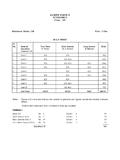
Transcription of Class XI (Theory) Duration: 3 hours Total Marks: 70 …
1 Computer Science (Code 083)CBSE-Curriculum 20051 ..It is unworthy of excellent men to loose hours like slaves in the labour of calculationwhich could safely be regulated to anyone else if machines were said Leibnitz inthe beginning of seventeenth Century. Farsighted vision, in-depth study accompanied by target-oriented effort of suchtorchbearers have ushered in an age of it Science or Engineering, medical world or launching Space Shuttles, Study ofUniverse or global communications, Research and Development or Edutainment thecore ingredient is Objectives:1. To understand the problem statement2. To develop logic for problem solving3.
2 To understand the concept of Object Oriented Methodology4. To implement Object Oriented Programming using C++5. To understand the concept of working with Relational Database 6. To understand the basic concept of algebra of logic7. To understand and explore the world of communication and networksCompetencies:The student will be proficient in the following:1. Identification of a system2. Categorisation of parts of an objective system3. Problem Solving4. Designing an efficient logic using object oriented approach for solutiondevelopment5. Database handling6. Logic Circuit designingClass XI ( theory ) duration : 3 hoursTotal marks : 70 Unit NameMarks1. COMPUTER METHODOLOGY103.
3 INTRODUCTION TO PROGRAMMING IN C++444. COMPUTER SYSTEM ORGANISATION1070 UNIT 1: COMPUTER FUNDAMENTALSE volution of computers; Basics of computer and its operation: FunctionalComponents and their inter-connections, concept of Booting, Use of OperatingSystem for directory listing, hierarchical directory structure, renaming, deletingfiles/folders, formatting floppy, copying files, concepts of path and pathname,switching between tasks, installation/removal of applications;Computer Science (Code 083)CBSE-Curriculum 20052 Software Concepts: Types of Software - System Software, Utility Software and Application Software;System Software: Operating System, Compilers, Interpreters and Assembler; Operating System: Need for operating system, Functions of Operating System(Processor Management, Memory Management, File Management and DeviceManagement), Types of operating system Interactive (GUI based), TimeSharing, Real Time and Distributed;Note: The above-mentioned Operating System specific tasks can be illustratedand implemented using any operating 2: PROGRAMMING METHODOLOGYG eneral Concepts; Modular approach; Clarity and Simplicity of Expressions, Useof proper Names for identifiers, Comments, Indentation; Documentation andProgram Maintenance.
4 Running and Debugging programs, Syntax Errors, Run-Time Errors, Logical Errors;Problem Solving Methodology and Techniques: Understanding of the problem,Identifying minimum number of inputs required for output, Step by step solutionfor the problem, breaking down solution into simple steps, Identification ofarithmetic and logical operations required for solution, Using Control Structure:Conditional control and looping (finite and infinite);UNIT 3: INTRODUCTION TO PROGRAMMING IN C++ Object Oriented Technology is regarded as the ultimate paradigm for the modeling of information, be thatinformation data or logic. The C++ has by now shown to fulfill this goal.
5 Programming by Example In C++ Language :C++ character set, C++ Tokens (Identifiers, Keywords, Constants, Operators),Structure of a C++ Program (include files, main function); Header files , ; cout, cin; Use of I/O operators (<< and >>), Use of endland setw(), Cascading of I/O operators, Error Messages; Use of editor, basiccommands of editor, compilation, linking and execution; standard input/outputoperations from C language: gets(), puts() of header file;Data Types, Variables and Constants:Concept of Data types; Built-in Data types: char, int, float and double;Constants: Integer Constants, Character Constants (Backslash characterconstants - /n, /t ), Floating Point Constants, String Constants; Access modifier:const; Variables of built-in data types, Declaration/Initialisation of variables,Assignment statement; Type modifier: signed, unsigned, long;;Operators and Expressions:Computer Science (Code 083)CBSE-Curriculum 20053 Operators: Arithematic operators (-,+,*,/,%), Unary operator (-), Increment andDecrement Operators (--,++), Relational operators (>,>=,<,<=,==,!)
6 =), Logicaloperators (!, &&, ||), Conditional operator: <condition>?<if true>:<else>;Precedence of Operators; Expressions; Automatic type conversion inexpressions, Type casting; C++ shorthands (+=, -=, *=, /=, %=); Flow of control:Conditional statements: if-else, Nested if, , , break statement (to be used in only); Loops: while ,do - while , for and Nested loops;Structured Data Type: ArrayDeclaratrion/initialisation of One dimensional array, Inputting array elements,Accessing array elements, Manipulation of Array elements (sum of elements,product of elements, average of elements, linear search, findingmaximum/minimum value).
7 Declaration/Initilaisaion of a String, string manipulations (countingvowels/consonants/digits/specia l characters, case conversion, reversing a string,reversing each word of a string); String and Character related Library functions:isalnum(), isalpha(), isdigit(), islower(), isupper(), tolower(), toupper(),strcpy(), strcat(), strlen(), strcmp(), strcmpi();Declaration/initialisation of a two-dimensional array, inputting array elementsAccessing array elements, Manipulation of Array elements (sum of row element,column elements, diagonal elements, finding maximum/minimum values);User Defined Functions:Defining a function; function prototype, Invoking/calling a function, passingarguments to function, specifying argument data types, default argument,constant argument, call by value, call by reference, returning values from afunction, calling functions with arrays, scope rules of functions and variables;local and global variables;Mathematical and Other Functions:Header , ;Functions: fabs(), log(), log10(), pow(), sqrt(), sin(), cos(), abs(), randomize(),random().
8 Event programming: Games as examplesGeneral Guidelines: Initial Requirement, developing an interface for user (it isadvised to use text based interface screen), developing logic for playing thegame and developing logic for scoring pointsComputer Science (Code 083)CBSE-Curriculum 200541. Memory Game: A number guessing game with application of 2dimensional arrays containing randomly generated numbers in pairshidden inside boxes. 2. Cross N Knots Game: A regular tic-tac-toe game3. Hollywood/Hangman: A word Guessing game4. Cows N Bulls: A word/number Guessing gameUNIT 4: COMPUTER SYSTEM ORGANISATIONN umber System: Binary, Octal, Decimal, Hexadecimal and conversion betweentwo different number systems.
9 Integer, Floating Point, 2 s complement of numberfrom base-2;Internal Storage encoding of Characters: ASCII, ISCII (Indian scripts StandardCode for Information Interchange), UNICODE; Microprocessor: Basic concepts, Clock speed (MHz, GHz), 16 bit, 32 bit, 64 bitprocessors; Types CISC, RISC; Concept of System Buses, Address bus, Databus, Concepts of Accumulator, Instruction Register, and Program Counter;Commonly used CPUs and CPU related terminologies: Intel Pentium Series, IntelCeleron, Cyrix, AMD Series, Xeon, Intel Mobile, Mac Series; CPU Cache;Concept of heat sink and CPU fan, Motherboard; Single, Dual and Multipleprocessors;Types of Memory: Cache (L1,L2), Buffer, RAM (DRAM, SDRAM, RDRAM,DDRAM), ROM (PROM, EPROM), Access Time;Input Output Ports/Connections: Power connector, Monitor Socket, Serial (COM)and Parallel (LPT) port, Universal Serial Bus port, PS-2 port, SCSI port, PCI/MCIsocket, Keyboard socket, Infrared port (IR), audio/speaker socket, Mic socket;data Bus; external storage devices connected using I/O ports.
10 Power Supply: Switched Mode Power Supply (SMPS): Elementary Concept ofPower Supply: Voltage, Current, Power (Volt, Ampere, Watt), SMPS supplies Mother Board, Hard Disk Drive, Floppy Disk Drive, CD/DVD Drive;Power Conditioning Devices: Voltage Stabilizer, Constant Voltage Transformer(CVT), Uninterrupted Power Supply (UPS)-Online and Science (Code 083)CBSE-Curriculum 20055 Class XI (Practical) duration : 3 HoursTotal marks : in C++10 One programming problem in C++ to be developed and tested in Computerduring the examination. marks are allotted on the basis of following:Logic: 5 MarksDocumentation/Indentation : 2 MarksOutput presentation: 3 MarksNotes: The types of problems to be given will be of application type from thefollowing topics2 Project Work10(As mentioned in general guidelines for project, given at the end of thecurriculum)3 Practical File05 Must have minimum 15 programs from the topics covered in Class XI course.