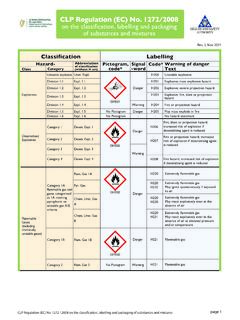
Transcription of Classification, Labelling & Packaging according to the CLP ...
1 The classification , Labelling and Packaging (CLP) Regulation covers hazardous chemicals sold to professional users and consumers. This information sheet outlines the key requirements for the Labelling and Packaging of hazardous chemicals under the CLP Labelling & Packaging according to the CLP RegulationMay, 2014 Cyan 100%Magenta 76%Yellow 0 Black 27%All hazardous chemicals (substances and mixtures) placed on the market must be classified, labelled and packaged according to the CLP Regulation (EC) No. 1272/2008 by 1st June 2015. The responsibility for Labelling and Packaging of hazardous substances and mixtures lies with: manufacturers of substances, importers of substances or mixtures, formulators of mixtures, and distributers or Downstream Users, who do not reformulate or change the substances or mixtures but relabel/repackage from CLPW aste and cosmetics, medicines, medical devices, veterinary products, foodstuffs or animal feed which are in their finished state, intended for the final user are not covered by the CLP RegulationClassification of Hazardous Substance/Mixtures:The physical properties along with health and environmental effects of chemicals must be identified and evaluated to determine if they need to be classified.
2 Some hazardous chemical substances have legally harmonised (agreed) classifications which are listed in Annex VI of the CLP Regulation. If a chemical substance does not have a classification listed in Annex VI, then the manufacturer or importer is legally obliged to examine all relevant available information against the CLP classification criteria and self classify the hazardous substance when it meets the criteria. Similarly, formulators or importers of mixtures must examine all relevant available information against the CLP classification criteria and self classify hazardous mixtures. Once the chemicals hazards are identified, communication of these hazards must be provided on the hazard label and the chemical must be contained in Packaging that meets the requirements of CLP.
3 Information SheetPage 1 Hazard Labelling & Packaging according to the CLP RegulationInformation SheetLabelling of Hazardous Substances/Mixtures:A hazard label must contain the following elements applicable to the substance or mixture placed on the market as shown in figure 1. name, address and telephone number of the EU supplier(s), product identifiers chemical name and CAS/EC no. of the substance/trade name of a mixture along with the chemical name(s) of all substances responsible for classification of the mixture (excluding skin and eye irritants), hazard pictogram(s1):signal word: either Warning or Danger depending on the classification hazard statement(s) description of the hazardous effect Harmful if inhaled, the appropriate precautionary statements to allow the user of the chemical to take measures to protect health/environment Keep out of reach of children, nominal quantity (when the chemical is supplied to the general public), and supplemental information.
4 Obligatory supplemental information includes hazard statements taken from the previous chemical legislation EUH001 Explosive when dry and EUH204 Contains isocyanates. May produce an allergic reaction .Non-obligatory supplemental Labelling information, for example, instructions for use is not part of the legal Labelling requirements under CLP. However, if provided it must not distract from nor contradict the obligatory label elements, hazard and precautionary statements. Statements such as non-toxic , non-polluting may not be used on hazard information on the label must be consistent with the classification in Section and the label elements in Section of the Safety Data Sheet (SDS) provided for the same and dimensions of the Hazard Label:The label must: be firmly attached to the surface of the product, be visible, legible and readable in English, and have the following dimensions.
5 Capacity of the Dimensions of label package (mm) 3 litres If possible at least 52 x 74> 3 litres but 50 litres At least 74 x 105> 50 litres but 500 litres At least 105 x 148> 500 litres At least 148 x 210 have all the hazard pictograms, signal word, hazard and precautionary statements together, have, where more than one language is used, all the hazard and precautionary statements of the same language grouped together, ensure that the hazard pictogram stands out clearly (black print on white background surrounded by red frame being at least one fifteenth and at least 1 cm2 of the label), and have no blank pictograms (where blank pictograms are unavoidably printed on the label they should be blacked out).1 free of charge for download from the website 2 Hazard Labelling & Packaging according to the CLP RegulationInformation SheetSUBSTANCE XYZ-123 CAS No.
6 Xxxx-xx-x Danger Flammable liquid and vapourMay be fatal if swallowed and enters airwaysCauses skin irritationMay cause drowsiness or dizzinessToxic to aquatic life with long lasting effects Keep out of reach of children. Keep away from heat/sparks/open flames/hot surfaces. No smoking. Store in a well-ventilated place. Wear protective gloves/protective clothing/eye protection/face protection. IF SWALLOWED: Immediately call a POISON CENTER or doctor/physician. Do NOT induce vomiting. IF INHALED: Remove victim to fresh air and keep at rest in a position comfortable for breathing. 2L Supplier: XYZChem Lane, Dublin 123 Tel.
7 No. 01 123 4567 Hazard Pictograms shaped as a diamond with black symbol on a white background with a red border. Must cover at least one fifteenth of surface area of label, but not be less than identifier must be identical to that used in the SDS. For substances this will be the chemical name and CAS number or EC number. Signal wordHazard Statements Precautionary Statements maximum of 6 on the label. All relevant precautionary statements should be in the supplemental information recycling details name, address and tel. quantity required where product is sold to the general 1: Example of Hazard Label for SupplyUpdating the Hazard LabelThe label should be updated without undue delay, when there is a change in classification of the substance or mixture which results in a more severe hazard or where new supplemental information is required on the label taking account of the nature of the change.
8 Other required label changes change in supplier address shall be done within 18 months of the required change. Suppliers should cooperate to ensure that labels are updated without undue delay. Page 3 Hazard Labelling & Packaging according to the CLP RegulationInformation SheetLabelling of workplace chemicalsThe requirement for a CLP hazard label is dependent on whether the chemical is being placed on the market or not, noting that import is deemed to be placing on the market . All incoming or outgoing chemicals to or from a workplace require a CLP hazard label if they are being placed on the market . Therefore, all incoming chemicals to a workplace should be labelled by the supplier, and all outgoing chemicals from a workplace equally should be labelled before being placed on the market.
9 However, for chemicals produced and used within a workplace the situation is different, because they are stored and transported within the workplace and not being placed on the market in containers and pipe work on site, the CLP hazard Labelling rules do not apply. However, there is still a requirement to ensure a risk-based approach is undertaken to determine any potential hazards from such chemicals produced, stored, transported and used within the workplace. This may result in a requirement to produce an in-house hazard label. Such workplace chemicals come under the remit of the Chemical Agent and Work Place Signs Regulations. These Regulations will be amended before 1st June 2015 to align them with CLP. Unpackaged chemicals There is a new provision under CLP for wet cement which is sold to the general public without Packaging .
10 It must be accompanied by a copy of the label elements required under CLP (see part 5 Annex II of the CLP Regulation for further details).Derogations from Labelling Derogations from hazard Labelling requirements are permitted in special cases including transportable gas cylinders, gas containers intended for propane, butane or liquefied petroleum gas, certain aerosols, certain mixtures containing elastomers and explosives. (See section Annex I of the CLP Regulation for further details). Exemptions from labellingCertain Labelling elements may be omitted where the contents do not exceed 125ml, depending on the hazard classification of the substance or mixture (see Section Annex I of the CLP Regulation for further details) Where Packaging is either in such a shape or form or so small as to not allow the necessary hazard Labelling information to fit on the label, derogation exists.